Ecommerce Merchandiser: The Most Underrated Job in Online Retail
On this page
A brand I know spent about $40,000 on paid social in a month and got a modest return.
In the same month, someone reordered the products on their three biggest collection pages, moved the best sellers above the fold, and fixed the site search so that a common misspelling returned results instead of nothing.
The second thing made more money than the first. It cost nothing and took two days.
That's merchandising, and the reason it's underrated is that it doesn't look like marketing. There's no campaign. Nothing gets launched. Somebody just makes the store better at selling what's already in it.

What the job is
You decide what customers see and in what order.
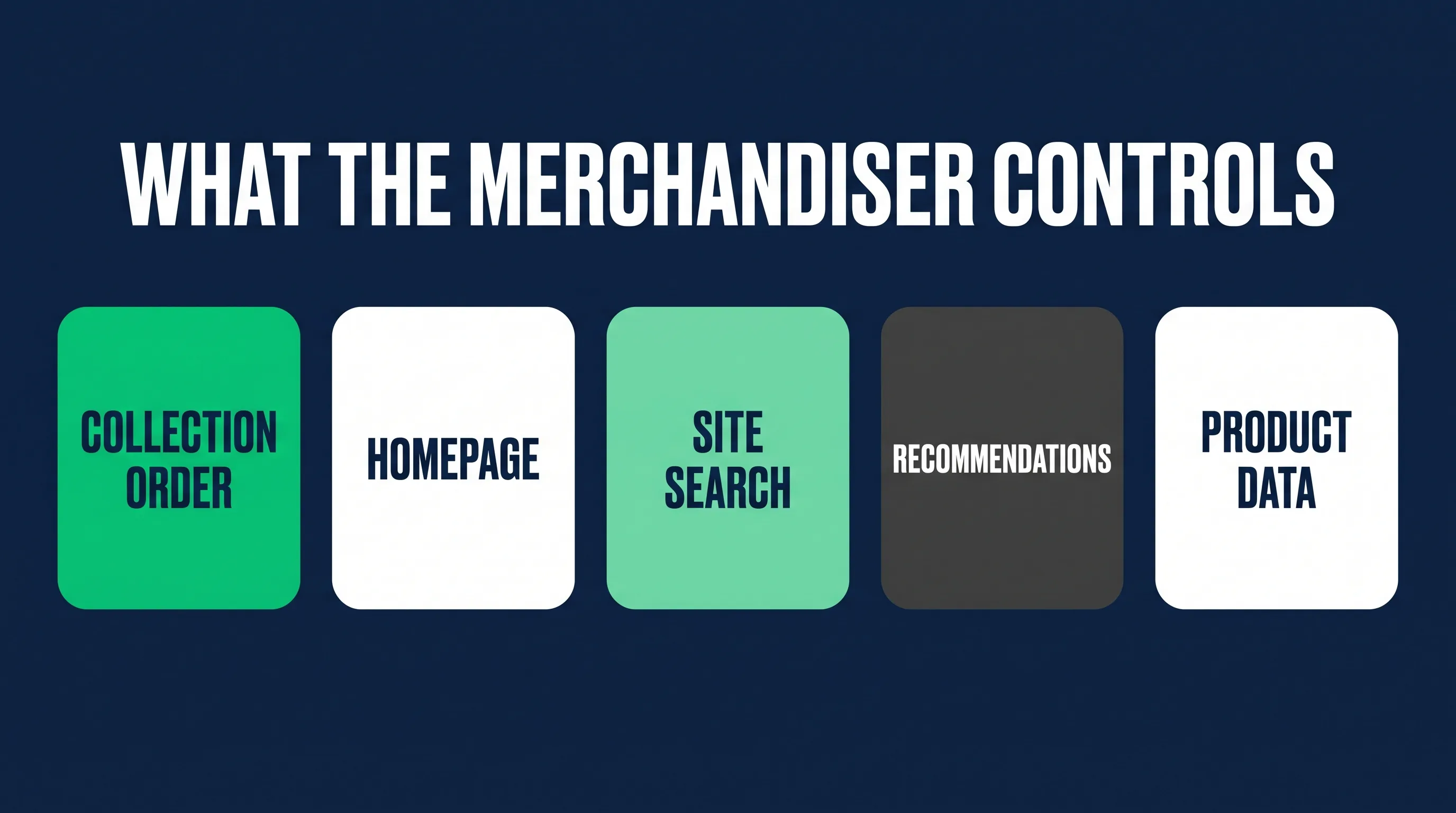
Collection and category ordering. Which products appear first on a page, and why. Best sellers, new arrivals, high margin, whatever the strategy calls for. This is the single highest-leverage lever most stores never touch deliberately.
Homepage and landing pages. What gets featured this week and how the story is told.
Site search. What comes back when someone types something. Synonyms, misspellings, zero-result queries. Customers who use search convert at multiple times the rate of browsers, which makes bad search extraordinarily expensive.
Recommendations and cross-sell. What shows in "you might also like" and in the cart.
Product data quality. Attributes, tags, and categorization, because filters and search only work if the underlying data is clean.
Promotions and pricing display. How offers appear, what's bundled with what.
Analysis. Which products are viewed but not bought, which pages have high exits, where the catalog is being ignored.
What it pays
$55k to $85k for most US ecommerce merchandisers or digital merchandisers, with senior merchandisers and merchandising managers at $85k to $115k, and director-level merchandising roles higher.
The number climbs fastest for people who can connect merchandising decisions to margin rather than to revenue. Selling more of a low-margin product isn't automatically a win, and merchandisers who understand that get promoted.
For how this sits against the rest, the ecommerce jobs guide has the full ladder.
Why it's underrated
Three reasons, and they compound.
It's invisible. Nobody outside the team sees a collection page get reordered. There's no launch to celebrate.
It sounds like retail. The word merchandiser makes people think of arranging shelves, so applicants from marketing skip it and go for the campaign jobs.
The results are easy to misattribute. Revenue went up in a week when three things changed, and the paid team usually claims it first.
Which means the competition is thinner than for roles with the same pay, and the work itself is genuinely interesting if you like the intersection of data and taste.
The skills that matter
Analytical ability. You need to read product performance data and know which products deserve prominence. Views, conversion rate by product, add-to-cart rate, margin, and stock position all feed the decision.
Commercial judgment. Knowing that the product with the highest conversion rate might be the wrong hero if it has three units left, or if it cannibalizes something more profitable.
Platform fluency. How your store handles collections, sorting, tagging, and search configuration. Shopify, and whatever search tool sits on top of it.
Data hygiene instinct. Merchandising fails when product data is inconsistent. People who fix the taxonomy quietly outperform people who only rearrange things.
Some technical ability. Being able to edit a template, set up a custom sort, or write a rule in the search tool means you implement ideas the same day instead of queueing them. That's the technical half taught in the Ecommerce Specialist path, and it changes what you're capable of in this role more than any other skill.
Taste, honestly. Some sense for what looks appealing and what a customer is trying to do. It's learnable by paying attention, but it's real.
How to get into it
From ecommerce assistant or coordinator. The natural route. You already handle product data; merchandising is the decision layer on top of it. Covered in the coordinator guide.
From physical retail. Genuinely strong. If you've merchandised a store floor, you already understand adjacency, hero products, and how people move through a space. The digital version is the same instinct with data attached.
From buying or category management. Very common and usually a raise.
What to show: take any store, including your own, and produce a merchandising analysis. Which products are being hidden by the current sort order, what the search returns for the ten most likely queries, and what you'd change. That document is the job.

The honest downsides
Attribution is murky. Proving your reorder caused the revenue lift is hard, and you'll fight for credit against teams with cleaner numbers.
You're constrained by the platform. Some stores make custom sorting and search rules easy; others make everything a developer ticket.
Peak season is intense, like everything else in ecommerce.
And there's a tension with brand and design teams that never fully resolves. They want the beautiful lifestyle image above the fold. You want the products that sell. Both of you are partly right and it's a recurring argument.
FAQ
What does an ecommerce merchandiser do? Decides what products customers see and in what order: collection sorting, homepage features, site search behavior, recommendations, product data quality, and the analysis behind those decisions.
How much does an ecommerce merchandiser make? Typically $55k to $85k in the US, with senior and manager-level merchandising roles at $85k to $115k.
Is digital merchandiser the same job? Yes, in almost all cases. Digital merchandiser, ecommerce merchandiser, and site merchandiser are used interchangeably.
Do I need retail experience? No, though it transfers well. Analytical ability and platform fluency matter more.
Do I need to code? Not to get hired. Being able to implement your own sorting rules and template tweaks makes you significantly faster and is a common differentiator.
What comes after merchandising? Senior merchandiser, merchandising manager, or a move into ecommerce management or buying. Some merchandisers move toward analytics instead.
If you want a quick sense of whether this job suits you, go to any online store you like and look at their main collection page.
Ask yourself why those products are in that order, whether it's deliberate, and what you'd change. If you found that question interesting rather than tedious, you'd probably be good at this.