Web Content Manager: 26 Job Titles for What Is Basically the Same Job

On this page
Somebody spends a month applying for "web content manager" roles, finds eleven openings in their whole state, and concludes the job barely exists.
Meanwhile the same work is posted that week as website administrator, digital producer, CMS specialist, web editor, content operations manager, and web coordinator. Different HR department, different label, same person doing the same thing on Monday morning.
This is the single most expensive mistake people make in this corner of the job market. So here's the full map.

The job underneath all the titles
Somebody has to run the company's website. Not build it once, run it. Every day.
Pages get published and updated. Product and service information changes. The legal team needs a disclaimer added by Friday. A campaign launches and needs a landing page. Images need resizing and alt text. Links rot. Navigation gets messy as the site grows. Someone has to say no to the executive who wants their department's page to be the homepage.
That's the role. It lives in a CMS, usually WordPress, Drupal, Sitecore, Contentful, AEM, or whatever the company chose eight years ago and can't leave. It sits between marketing, design, legal, and whoever owns the code.
What it is not, despite the confusion the word "administrator" causes, is server administration. You're not patching Linux boxes. This is content operations, and mixing the two up is why so many people bounce off these job postings.
The 26 titles, grouped by what they actually mean
The manager titles. Web content manager, website manager, web manager, digital content manager, online content manager, CMS manager, content operations manager. These usually mean you own the site: what goes on it, in what order, and to what standard. Often one or two people report to you, or the freelancers do.
The specialist titles. Web content specialist, website specialist, web specialist, CMS specialist. Execution roles. You're in the CMS all day doing the work rather than deciding the plan. This is the most common entry point.
The administrator titles. Web administrator, website administrator. Same work as the specialist titles at most companies, with a slightly more technical flavor and occasionally some genuine systems responsibility mixed in. The label carries baggage from an older era, which I dug into in web administrator vs webmaster.
The editorial titles. Web editor, web content editor, web publisher, digital producer. These lean toward writing and editing as well as publishing. Common in media, universities, and nonprofits. Web editor is the odd one out here: at some companies it's a senior editorial role and the competition is much stiffer.
The coordinator titles. Website coordinator, web coordinator. Junior, and often the easiest first job to get in the whole family. Frequently found at universities, hospitals, and government agencies.
The operations titles. Web operations manager, digital operations manager, digital experience manager. More senior, more process and governance, usually at larger organizations with multiple sites and a lot of stakeholders. These pay the best in the family.
The technical titles. CMS developer, CMS administrator. Here you're building templates and components, not just filling them. Real code required, and pay reflects it.
The analyst title. Web analyst. Adjacent rather than identical: you're measuring the site rather than running it, but the two blur at smaller companies.
What each one tends to pay
| Title group | Typical US range |
|---|---|
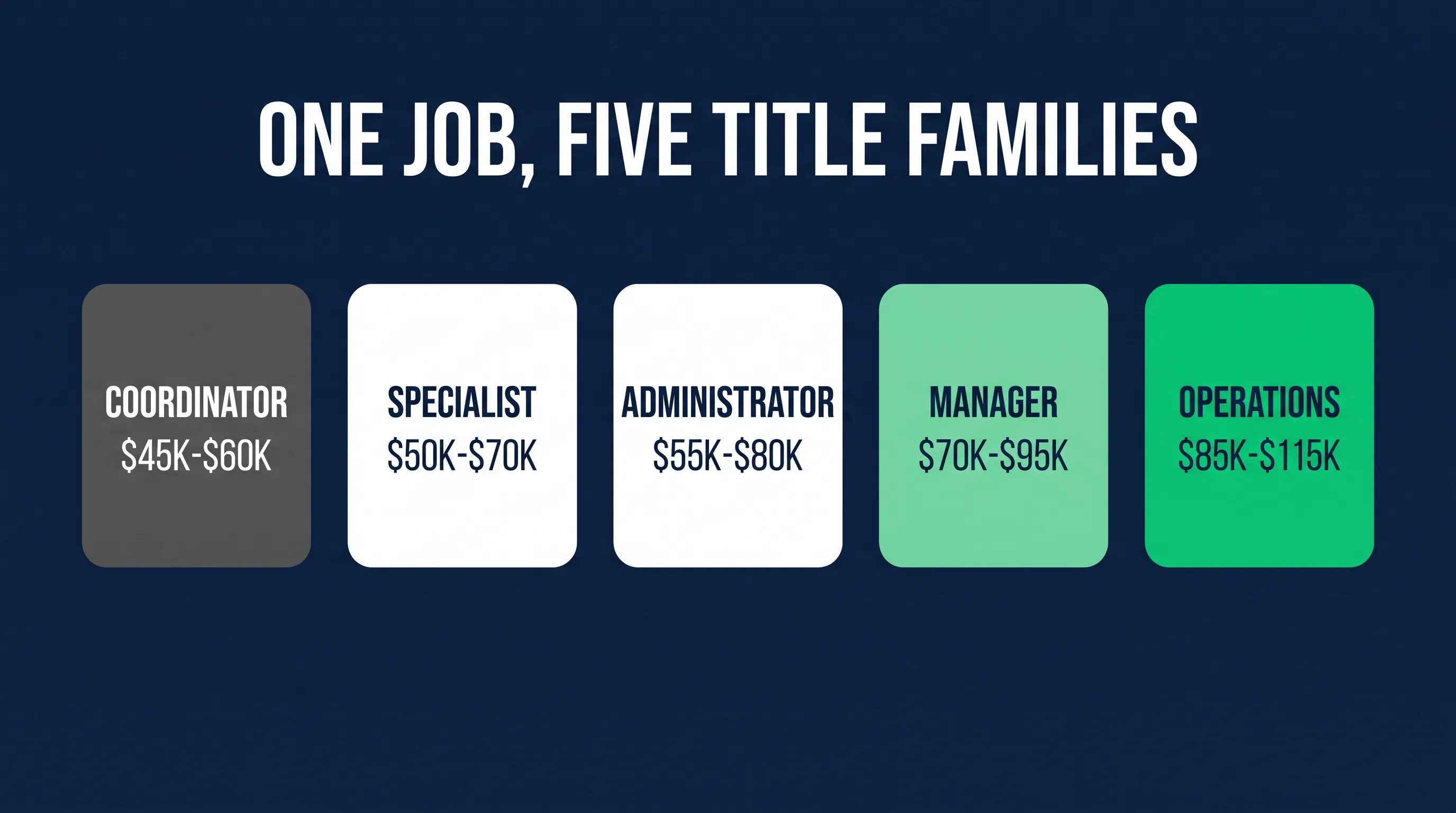
| Coordinator titles | $45k to $60k |
| Specialist and publisher titles | $50k to $70k |
| Administrator titles | $55k to $80k |
| Editor and producer titles | $55k to $80k |
| CMS specialist and administrator | $60k to $85k |
| Web analyst | $65k to $95k |
| Manager titles | $70k to $95k |
| Digital and content operations manager | $75k to $100k |
| Digital experience and web operations manager | $85k to $115k |
| CMS developer | $75k to $120k |
Those are ranges, and the deciding factors are how big the site is, how regulated the industry is, and whether you can touch code. The detailed breakdown is in the web content manager salary guide, with the administrator-specific version in the web administrator salary guide.
What actually differs between them
Three things, and none of them is the title itself.
Seniority. Coordinator, specialist, manager, senior manager. Every family above has all four rungs somewhere.
How much code you touch. At one end you never leave the CMS editor. At the other you're writing templates, components, and enough JavaScript to make things work. Pay tracks this closely, which is why learning HTML, CSS, and the templating language of your CMS is the fastest raise available in this field.
Whether you own strategy or execute it. The manager and operations titles decide, the specialist and coordinator titles do. Small companies collapse this into one person.
Everything else, the industry vocabulary and the department the role reports into, is noise. Judge a posting by its responsibilities section, never by its title.
How to use this when you're job hunting
Search all of them. Set up alerts on at least eight or ten of the titles above, not one. This one change usually multiplies the number of openings a person sees by five or more.
Search by CMS as well. "WordPress" plus "manager", "Drupal" plus "specialist", "Sitecore", "Contentful", "AEM". The CMS name is often more reliable than the job title, because the company always names their platform.
And look where these jobs actually concentrate: universities, hospitals and healthcare systems, government agencies, nonprofits, law and finance firms, and mid-sized B2B companies. Places with big, messy, regulated websites and no ability to hire a full engineering team for them. Where to find web content manager jobs goes deeper on that, including the remote side.

Why this job is worth aiming at
Low competition, mostly. The people who could do this job easily are usually chasing developer roles instead, and the marketers applying for it can't handle the technical half. That leaves a gap in the middle that's genuinely easier to walk into than almost anything else in tech.
It's also durable. Every organization with a website needs someone keeping it correct and current, and that's true in a recession too. It's not glamorous work, and I've never met anyone who dreamed about it as a kid, but it pays well above the job most people are leaving to get it and it teaches you skills that keep opening doors: CMS depth, SEO, analytics, and eventually code.
Our Web Content Manager path is built for exactly this route, and how to become a web content manager is the step-by-step version if you want to start this week.
FAQ
What is a web content manager? The person responsible for a company's website content: publishing and updating pages, keeping information accurate, managing the CMS, coordinating with marketing and legal, and maintaining structure, SEO, and quality as the site grows.
Is a web content manager the same as a webmaster? Practically, yes, though webmaster is largely a retired term that now mostly returns Search Console results. Modern postings use manager, specialist, administrator, or producer instead.
Which of these titles pays the most? Digital experience manager, web operations manager, and CMS developer sit at the top. Coordinator titles sit at the bottom. The gap between them is roughly the gap between clicking in a CMS and being able to build in one.
Do I need to code for these jobs? Not to get hired into the specialist and coordinator roles. To move past about $75k, yes, at least HTML, CSS, and your CMS's templating. It's the clearest lever on pay in the whole family.
Which CMS should I learn first? WordPress, because it runs a huge share of the web and appears in the most postings. Then look at what your target industry uses, which is often Drupal in government and education. There's a full comparison in the best CMS platforms to learn.
Is this a good career if I'm not technical yet? Yes, and it's one of the few tech-adjacent careers where you can start before you're technical and become technical on the job. Is web administration a good career is the honest long answer.
What's the difference between the CMS titles specifically? CMS specialist, CMS manager, and CMS developer are three tiers with about a $60k spread between them. The split is explained in CMS specialist vs manager vs developer.
Which title is the top of this ladder? Digital experience manager, generally, at $85k to $115k and up. What changes at that level is covered in the digital experience manager guide.
What if I also have email or ecommerce skills? Then your list is much longer than the 26 here. At small companies these are one job, and the combined set runs past 70 titles. They're all mapped in the marketing job titles guide.
If you take one thing from this page, make it the alerts. Go set up job alerts for ten of these titles tonight rather than the one you've been searching.
Most people in this field didn't find their job because they were the strongest candidate. They found it because they were the one who saw the posting, and the posting was called something they weren't looking for.