CMS Specialist vs CMS Manager vs CMS Developer: Which One Are You?
On this page
Three people work on the same Drupal site.
One publishes and updates pages. One decides what the site should look like next quarter and who's allowed to touch what. One writes the templates and components the other two use.
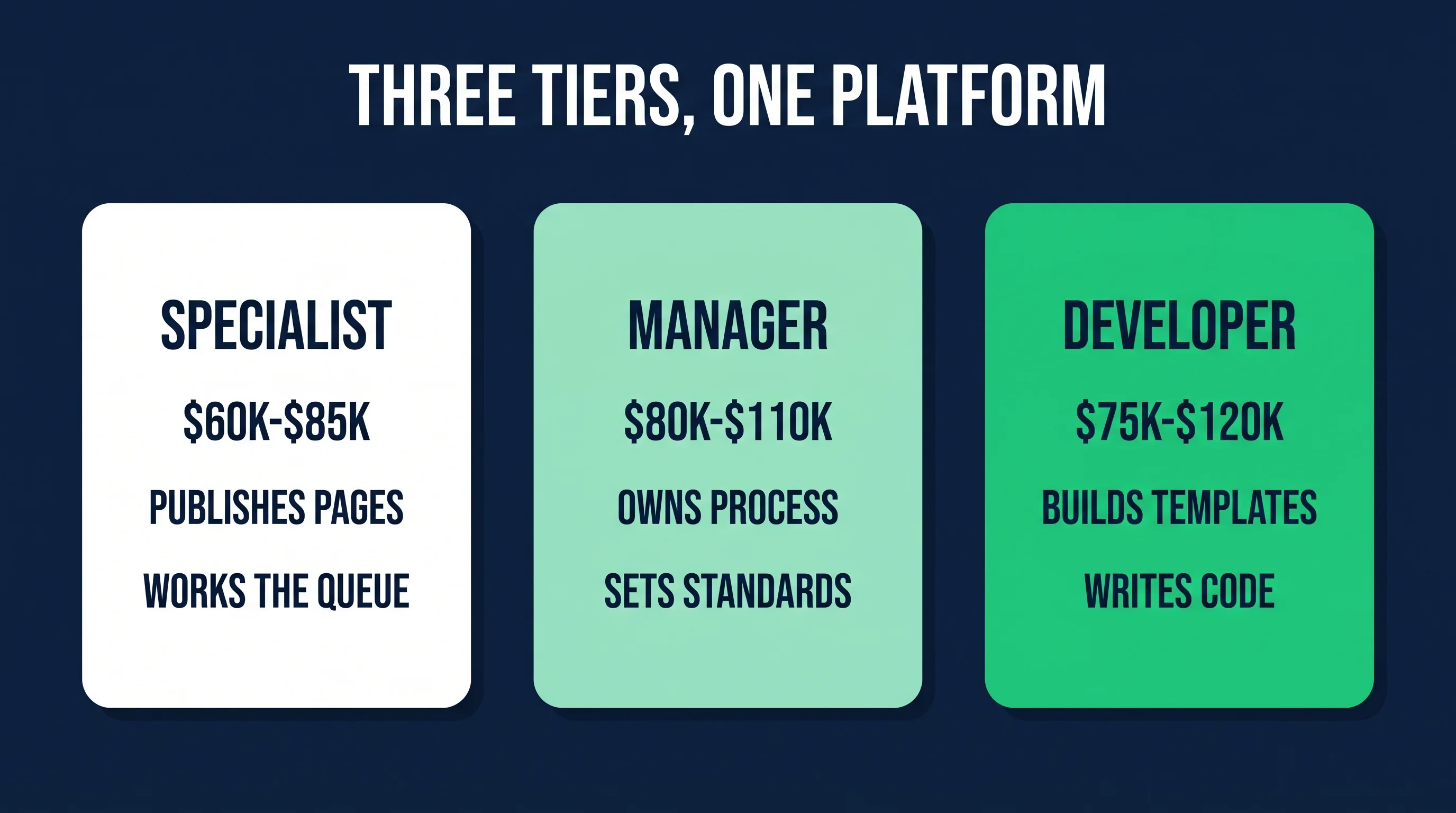
They earn about $65k, $85k, and $110k, and the ladder between them is not time served. It's how far into the system each of them can actually reach.

The CMS specialist
You are the person in the system. Pages get built, content gets published, images get resized and captioned, links get fixed, the promo banner comes down on the day it's supposed to.
You work from other people's requests, and the skill is doing it accurately and fast without breaking anything. On a good day you're improving structure and cleaning up old pages. On a bad day you're publishing forty press releases someone forgot about.
Pay: roughly $60k to $85k, with the upper half going to people who know an enterprise platform rather than only WordPress.
Ceiling: real, and you'll feel it. Once you can execute cleanly, the only ways up are deciding more or building more.
The CMS manager
You own the platform and the process around it.
That means governance, which sounds dull and is actually the whole job: who has permissions, what the content standards are, how a page gets approved, what the taxonomy is, when the site gets restructured, and how you say no to the department that wants a 90-slide carousel on the homepage.
You also own the roadmap for the platform. Migration to a new CMS, template redesigns, integrating the site with the CRM or the search tool. And typically you manage one or two specialists or a set of freelancers.
Pay: roughly $80k to $110k, higher at large organizations running multiple sites.
What actually gets you here: demonstrating judgment, not just output. The specialist who notices that the same broken process causes the same problem every month, writes it down, fixes the process, and reports on it, is the one who becomes the manager.
The CMS developer
You build the thing the other two work inside.
Templates, custom components, theme development, integrations, migrations, and performance work. In Drupal that means modules and Twig. In WordPress, custom themes, blocks, and PHP. In headless setups, working against an API with a JavaScript framework on the front.
You are much closer to a software developer than to a marketer, and the work is judged the way developer work is: does it function, is it maintainable, is it fast.
Pay: roughly $75k to $120k, and past that in enterprise environments with Sitecore or Adobe Experience Manager on the résumé.
What gets you here: actual code. There's no soft version of this transition, which is exactly why fewer people make it and why it pays.
Side by side
| Specialist | Manager | Developer | |
|---|---|---|---|
| Works on | Content and pages | Process and platform strategy | Templates and code |
| Typical US pay | $60k to $85k | $80k to $110k | $75k to $120k |
| Core skill | Accuracy and speed in the CMS | Judgment and governance | Programming |
| Day is mostly | Requests and publishing | Meetings, standards, planning | Building and debugging |
| Gets promoted by | Owning a problem, not a queue | Scale and outcomes | Depth and complexity |
| Learn next | HTML, CSS, SEO | Analytics, governance, stakeholder work | Framework and platform internals |
Which one should you be aiming at
If you're not in any of these yet, start as a specialist. It's the accessible door, it doesn't require code to enter, and it teaches you the platform from the inside. The route in is in how to become a web content manager, and all the adjacent titles are mapped in the 26 job titles guide.
From there the fork is genuinely about temperament.
Go manager if you find yourself annoyed by bad processes and interested in why the site is structured the way it is. If your instinct when something breaks twice is to write down a rule so it stops happening, that's the manager instinct.
Go developer if you find yourself opening the code view to understand what's happening rather than to fix one thing. If the template file is more interesting than the content calendar, you already know.
Money-wise they end up close at the middle and the developer track goes higher at the top, especially in enterprise CMS work. But the developer path also demands genuinely learning to program, and half of the people who say they want the pay bump don't want the four months of practice underneath it.
The gap between specialist and everything else
Almost everyone in this field is a specialist, and almost all of them are stuck for the same reason. They can operate the CMS and nothing else.
The specialists who move up in a year rather than five all did one of two things. They learned enough HTML, CSS, and templating to stop needing a developer for small changes, or they started owning outcomes rather than tickets: "organic traffic to our top service pages is up 30% since I restructured them" instead of "I published 140 pages this quarter."
The technical route is the more reliable of the two, because it's entirely in your control and doesn't require anyone to notice you. It's the reason our Web Content Manager path puts code in the middle of a content operations curriculum, and it's the same argument I make in the salary guide.

A note on which CMS you learn
It matters more than the title does.
WordPress is the easiest to learn, has the most jobs, and pays the least, because supply of people who know it is enormous. It's still where I'd start.
Drupal is common in government, higher education, and healthcare, and pays better because it's harder and the organizations running it are big.
Sitecore and Adobe Experience Manager are enterprise platforms with a real learning curve and a genuine pay premium. Specialists on these platforms often out-earn managers on WordPress.
Contentful, Sanity, and other headless systems are where newer companies are going, and they lean more technical by nature, so they pull you toward the developer end whether you planned it or not. There's a fuller comparison in the best CMS platforms to learn.
FAQ
What is a CMS specialist? The person who does the hands-on work in a content management system: building and publishing pages, maintaining content, fixing issues, and keeping the site accurate and current.
What does a CMS manager do? Owns the platform and the process: governance, permissions, content standards, taxonomy, the roadmap for the site, and usually a small team or set of contractors.
Is a CMS developer a real developer job? Yes. You write code, review code, and ship to production. The framing is different because the product is a website rather than an application, but the skill set is genuine software development.
Which pays the most? CMS developer at the top end, especially on enterprise platforms. Manager and developer are close in the middle. Specialist is the lowest of the three and the easiest to enter.
Can I go from specialist to developer without a degree? Yes, and it's a common route. You already understand the platform and the content model, which is the part developers coming from outside have to learn. What you need is HTML, CSS, and the templating language of your CMS, then a real component you built.
Do I need to know both WordPress and Drupal? No. Depth in one beats familiarity with both. Learn your target industry's platform properly and the concepts transfer when you need them.
If you're a specialist reading this and feeling stuck at $70k, the honest answer is that both exits are open and both take a few months of deliberate work rather than years of waiting.
Pick one. Either write down the process that keeps breaking and fix it, or open the template file and start learning what's in it. The people one tier above you did exactly one of those two things.