Web Content Manager Salary: What Every Title in This Job Family Pays

On this page
Most people running a company's website in the US earn between $60k and $85k.
That's the honest middle. What makes this job family unusual is how wide the whole spread is: the same underlying work runs from about $45k at the coordinator end to $115k at the digital experience end, and the distance between those two people is much smaller than $70k of skill.
Which is good news, because it means the gap is closable and I can tell you exactly what closes it.

The ranges by title
| Title | Typical US range |
|---|---|
| Website coordinator, web coordinator | $45k to $60k |
| Web content specialist, web publisher | $50k to $70k |
| Web administrator, website administrator | $55k to $80k |
| Web editor, web content editor, digital producer | $55k to $80k |
| CMS specialist, CMS administrator | $60k to $85k |
| Web content manager, website manager, web manager | $70k to $95k |
| Digital content manager, content operations manager | $75k to $100k |
| Web analyst | $65k to $95k |
| Digital experience manager, web operations manager | $85k to $115k |
| CMS developer | $75k to $120k |
If you want the map of which titles mean which job, the 26 job titles guide lays it out. For the administrator label specifically, including entry-level numbers, there's the web administrator salary guide.
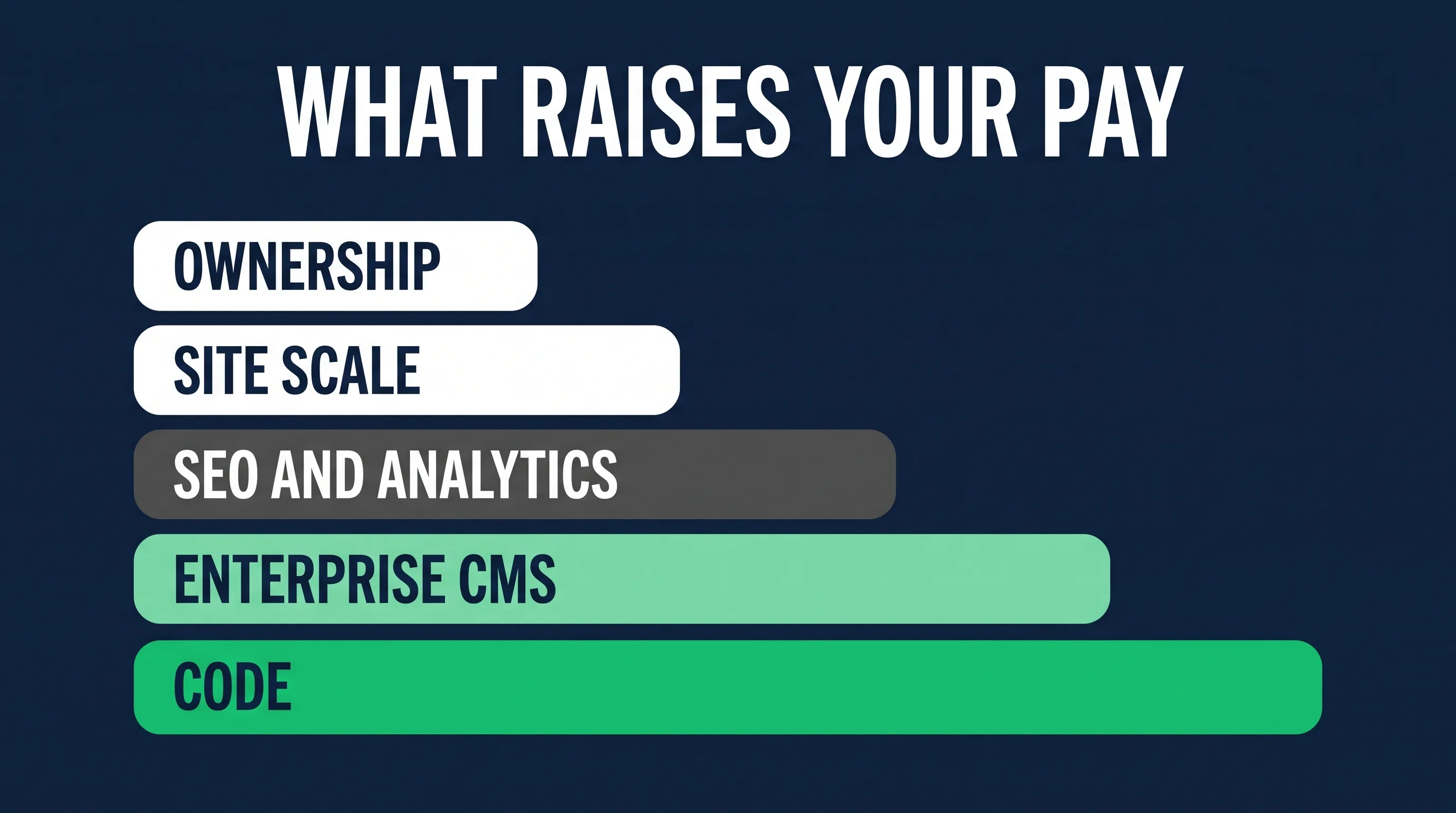
The five things that actually move your number
Code. This is the big one and it isn't close. Someone who can only work inside the CMS editor is capped somewhere around $75k. Someone who can write HTML and CSS, edit templates, build a component, and debug a broken page moves into the $85k to $110k band, because they stop needing a developer for every change. If you do one thing this year for your salary, do this.
CMS depth in an enterprise platform. WordPress skills are common and priced accordingly. Sitecore, Adobe Experience Manager, Drupal at scale, and Contentful pay noticeably more, because the organizations running them are large, the platforms are painful, and few people know them well. Learning an enterprise CMS is one of the few genuinely reliable pay jumps in this field.
SEO and analytics. The moment you can say "I restructured the site and organic traffic to the service pages went up 40%," you stop being a cost center. Content managers who understand search are the ones who get pulled into strategy conversations, and strategy conversations are where salary bands get rewritten.
Site scale and regulation. Running one 40-page marketing site is not the same job as running 12 sites across 40 countries with legal review on every page. Big, regulated, multi-site organizations pay more, and healthcare, finance, government, and higher education are where those sites live.
Ownership. Whether you decide or execute. Every step from coordinator to specialist to manager is really a step in how much you're trusted to decide without asking.
Location, and how much remote flattened it
The coastal metros still pay roughly 15 to 25 percent above the national middle. New York, San Francisco, Seattle, Boston, Washington DC. The Midwest and South run somewhat below it.
But this is one of the most remote-friendly jobs in tech, because the work is entirely in a browser. That has pulled the bands together. A remote posting from a company headquartered in an expensive city often keeps a national band, which is very good news if your rent is $1,200 rather than $4,000.
Government, higher education, and healthcare are the exceptions worth knowing about. They pay less than private industry at the same level, sometimes 10 to 20 percent less, and offer pension, stability, and genuine work-life balance in exchange. Plenty of people take that trade knowingly and never regret it.
What a realistic progression looks like
Year one. Coordinator or specialist, $50k to $65k. You learn the CMS, the publishing process, and how the organization actually works, which is half the job.
Years two and three. Specialist or administrator, $60k to $80k. You've learned HTML and CSS by now, ideally, and you're the person people come to when something breaks.
Years three to five. Manager, $75k to $95k. You own the site, you set standards, you push back on bad requests, and you probably direct a freelancer or a junior.
Year five and beyond. Digital experience or web operations manager, $85k to $115k, or a sideways step into a CMS developer role at $75k to $120k if the technical half is what you enjoyed.
That's a realistic doubling in about five years from a starting point that requires no degree. Not many fields offer that.

How to get paid more where you are
Start collecting evidence now, before you need it. Screenshot the site's analytics the week you start. Keep a log of everything you shipped and what changed after: page speed, organic traffic, time to publish, error rate, how many hours a week you saved someone.
Then, at review time, bring three numbers rather than a feeling. "Time from request to published page went from four days to same day, organic traffic to the top ten service pages is up 31%, and we stopped paying the agency $2,400 a month because I took the template work in-house." That last sentence in particular tends to end the conversation quickly.
If the answer is still no, this field has an unusually easy external market. The titles are everywhere, the skills transfer between industries almost perfectly, and switching companies is the most common way people in this job get a real raise. Where the jobs are, including remote covers how to run that search properly.
And if you're capped because you can't build, fix that. Our Web Content Manager path exists for this exact ceiling: it teaches the code and the CMS depth that turn a $65k content person into a $95k one.
FAQ
What is the average web content manager salary? Around $60k to $85k in the US for most people in the role, with manager titles at $70k to $95k and senior operations roles reaching $115k.
Is $60k a good salary for a web content manager? For a first or second year, yes. Past that it's on the low side unless you're in a low cost area or the public sector, and it's worth either negotiating or looking. The gap between $60k and $80k in this field is usually one skill, not five years.
Do web content managers make more than web administrators? Usually a little, because the manager title carries ownership. In practice the two overlap so heavily that some administrator roles pay more than some manager roles. Read the responsibilities, not the label.
How do I get to six figures in this career? Three routes. Enterprise CMS depth, especially Sitecore or AEM. The technical route into CMS development. Or the operations route into digital experience management at a large organization. All three are reachable within about five years.
Does a degree affect the pay? Barely, outside of higher education and government where pay scales sometimes formally require one. Private employers care about the CMS you know and the sites you've run.
Which industries pay the most? Finance, healthcare, and enterprise software, mostly because their sites are large and the cost of a mistake is high. Nonprofits and higher education pay the least and usually know it.
The reason I keep pushing the code point is that it's the one thing in this list you fully control. You can't make your employer's site bigger or your industry more regulated. You can spend three months learning enough HTML, CSS, and templating to stop filing tickets.
That's the difference between the two ends of this salary table, and it's the shortest path I know from $60k to $90k without changing careers.