Web Content Manager Jobs: Where They Hide and How to Find the Remote Ones
On this page
The complaint I hear about this career is that the jobs don't exist.
They exist. They're just posted by a state university's communications office, a regional hospital system, a law firm, and a mid-sized manufacturer of industrial pumps, under four different titles, none of which is the one you searched.
Nobody's job board is broken. The search is.

Where these jobs actually concentrate
Universities and colleges. The most reliable source of these roles in the country. Every institution has an enormous site, dozens of departments demanding changes, and a permanent shortage of people who can manage that. Titles skew toward web content specialist, digital content coordinator, and web editor. Pay is moderate, stability and benefits are excellent, and they hire people without degrees more often than you'd expect.
Hospitals and healthcare systems. Huge, heavily regulated sites where accuracy is a legal matter. They pay better than universities and move slower than everyone.
Government agencies. State and local especially. Accessibility compliance is a genuine requirement rather than a nice-to-have, which means learning accessibility properly is a direct advantage here. Drupal is everywhere in this world.
Nonprofits and associations. Smaller budgets, broader roles. Good first jobs because you'll touch everything.
Mid-sized B2B companies. Manufacturers, logistics companies, professional services, industrial suppliers. Their sites matter enormously to their sales pipeline and they cannot justify a full engineering team for them. This is the most underrated segment on this list and the one with the least competition, because nobody dreams of running the website for a pump manufacturer. Those roles pay well and go unfilled for months.
Law and finance firms. Content-heavy, compliance-heavy, and willing to pay for someone careful.
Agencies. You'll run several clients' sites at once. Brutal pace, fastest learning available.
Ecommerce and consumer brands. Here the role blurs into merchandising and the titles blur too, sometimes landing closer to the ecommerce jobs family.
The search that actually works
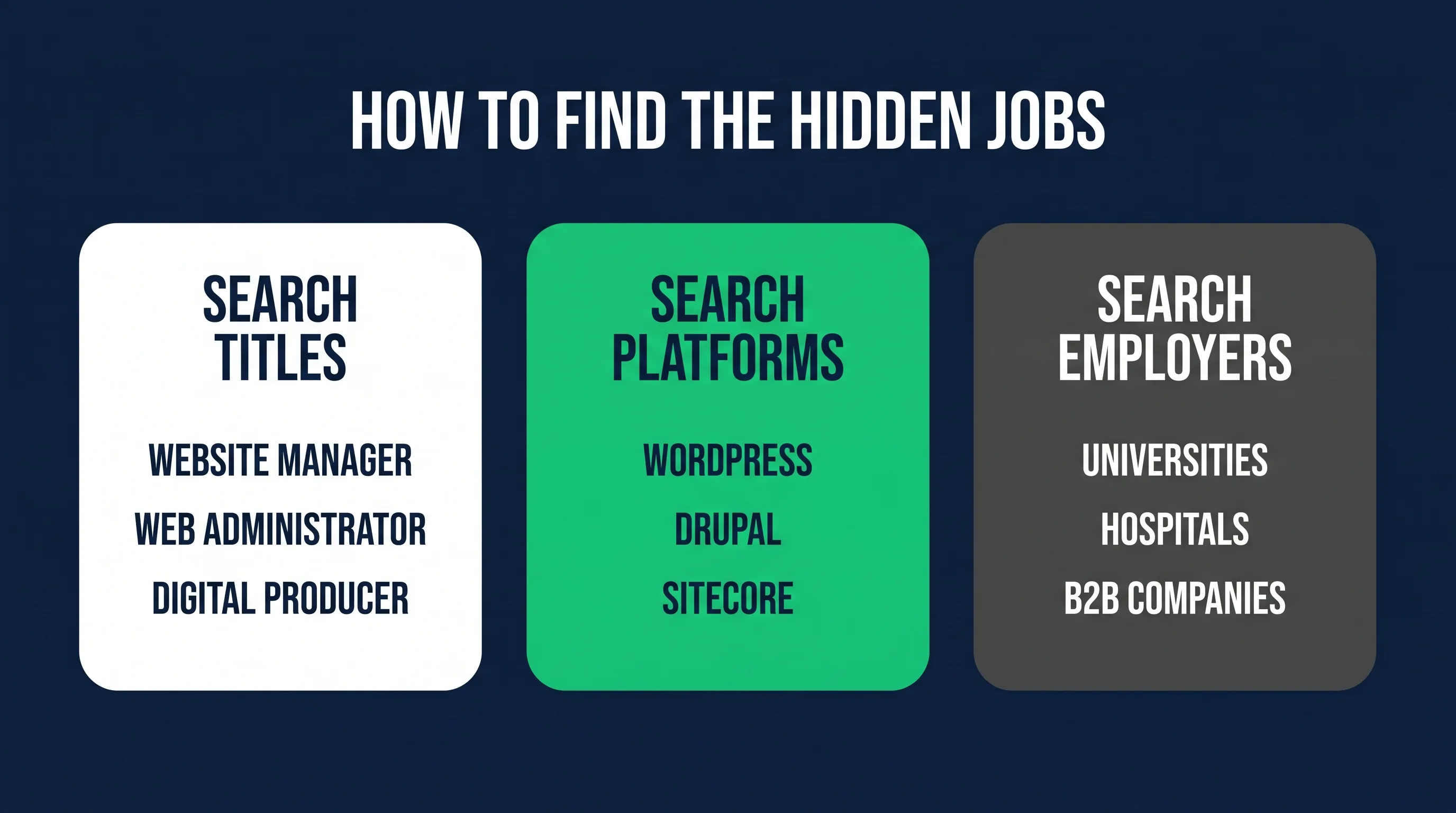
Alert on the titles, all of them. Web content manager, website manager, web manager, web content specialist, website administrator, web administrator, digital content manager, digital producer, CMS specialist, web editor, website coordinator, content operations manager. Ten to twelve alerts. Most people run one and conclude the market is dead. The full list and what each label means is in the 26 job titles guide.
Search by platform, not just title. Job postings almost always name the CMS. Searching "WordPress" or "Drupal" or "Sitecore" or "Contentful" or "Adobe Experience Manager" surfaces roles whose titles you'd never have guessed. This is the single best trick in this article.
Go direct to the employer sites. Universities, hospitals, and government agencies post on their own careers pages first and syndicate late or not at all. Pick fifteen large institutions within reach, bookmark their job pages, and check them weekly. This alone puts you ahead of everyone who only refreshes Indeed.
Search adjacent function words. "Web operations", "digital experience", "content operations", "digital communications". Communications is the department that owns this role at a lot of institutions, and their titles reflect it.
How remote is it, honestly
Very, with caveats.
The work is entirely in a browser. There's no hardware, no lab, no reason to be in a building. Plenty of these roles are fully remote and more are hybrid.
The caveats: universities and government agencies often require on-site or in-state residency, even when the work obviously doesn't need it. Healthcare varies. Private companies are the most flexible, and agencies are almost all remote-friendly now.
If remote is non-negotiable for you, weight your search toward mid-sized B2B companies, agencies, and software companies, and search "remote" alongside each of the title variants. Remote web administrator jobs covers that hunt in more detail, and everything there applies to the manager titles too.
What gets you shortlisted
A site you can point at. Anything real. A club's site you rebuilt, a small business you moved onto WordPress, your own project with actual content in it. The specific claim that works: "I run this site, here's what I changed, here's what happened to traffic."
Proof you can handle a mess. Nobody hires a web content manager for a clean site. They hire because the site is a disaster of 400 pages with broken links and three different button styles. Say something in your application about auditing and fixing a messy site and you'll sound like someone who's done this.
Accessibility knowledge. Rare among applicants, legally required at public institutions, and increasingly demanded everywhere else. A working understanding of WCAG basics moves you up the pile fast in the education and government segments.
A little code. HTML and CSS at minimum. It's what separates the two ends of the pay range and it's usually the deciding factor between two otherwise similar candidates. If that's the gap for you, our Web Content Manager path is built around closing it, and how to become a web content manager is the ordered plan.

How to apply so you don't disappear
Skip the generic cover letter. Open their site, find three real problems, and send those. Broken links, pages that fail an accessibility check, service pages with no meta descriptions, a mobile menu that doesn't work. Then say what you'd do about them in the first month.
It feels presumptuous. It works, especially at organizations that already know their site is a mess and have been trying to hire someone about it for four months.
Also apply when you're not fully qualified. These postings are usually written as a wish list by a committee, and the person hired frequently meets about 60% of it. If you know the CMS and can show a site you've run, apply.
FAQ
Are web content manager jobs in demand? Steadily, yes. Every organization with a website needs someone maintaining it, and the demand is spread thinly across every industry rather than concentrated in tech, which is why it feels invisible until you search properly.
Can web content manager jobs be done remotely? Often, since the work is browser-based. Private companies and agencies are the most remote-friendly. Universities and government agencies frequently require local presence regardless of the work.
What job titles should I search besides web content manager? Website manager, web administrator, digital content manager, web content specialist, CMS specialist, digital producer, web editor, website coordinator, and content operations manager, at minimum.
Do these jobs require a degree? Private sector, rarely. Universities and government sometimes list one as a formal requirement, though experience substitutions are common and worth asking about.
What's the fastest way to get the first one? Learn one CMS properly, run a real site so you have proof, and apply to mid-sized B2B companies and universities where competition is lowest. Six months of focused work is a realistic timeline.
How much do these jobs pay? Most land between $60k and $85k, with coordinator roles lower and operations roles reaching $115k. Full breakdown by title in the salary guide.
If you've been searching one title and coming up empty, don't take that as evidence about the market. Take it as evidence about the search.
Set twelve alerts tonight, add four CMS names to them, and bookmark the careers pages of the ten largest institutions near you. You'll see more openings in the next two weeks than you saw in the last two months.