Remote Web Administrator Jobs - Where They Are and How to Land One
On this page
Can you actually land a remote web administrator job, or are these all senior-only roles wearing a "remote" sticker to bait clicks?
Honest answer: yes, you can. And not in the "manifest it" way. In the "these jobs genuinely exist, hire remotely, and don't all demand ten years of experience" way.
Here's what nobody says out loud, though. Web administration might be the most quietly remote-friendly job in all of tech. People pile into remote software engineering roles and fight 800 applicants for one opening. Web admin roles sit right next to them, fully remote, with a fraction of the competition, because the title doesn't sound sexy enough for everyone to chase it.
That's your opening. The work is digital end to end, which means companies don't blink at letting you do it from your apartment in Ohio or your kitchen table in Lisbon.
Let me show you where these jobs actually hide.
Why web administration is built for remote work
Think about what the job actually is. You publish pages through a CMS, build landing pages for campaigns, update products and promos, fix broken links and typos, keep the brand consistent across the site, and fill in the SEO and analytics fields nobody else remembers.
Now ask yourself: how much of that requires you to be in a building?
None of it.
The work is digital end to end. The CMS is a login. The pages live in a browser. The style guide is a shared doc. There is no physical thing you need to stand next to.
It also produces verifiable output. The page is live and correct, or it isn't. The promo banner went up on schedule, or it didn't. Your manager doesn't need to watch you work to know whether you did. That matters more than people realize, because remote managers trust roles where results speak for themselves.
And most of it is async by nature. A landing page published at 2pm and a landing page published at 6pm look identical to the visitor. You're not stuck in a synchronous assembly line. You work your request queue, batch your updates, QA your own pages, and ship.
A job that's digital, measurable, and async is a job that was basically designed to be done from anywhere. Web admin checks all three.

Who actually hires remote web admins
This is where people get stuck. They search "remote web administrator" once, see twelve results, and assume the jobs don't exist. The jobs exist. They're just spread across industries that don't advertise loudly.
Marketing teams. Every company with a serious website has a marketing team drowning in publish requests: new landing pages, campaign updates, blog posts, event pages. A dedicated web admin is how they stop bottlenecking on developers. This is the biggest bucket, and lots of these roles went permanently remote after 2020 and stayed that way.
E-commerce brands. Product listings, category pages, promo banners, seasonal sales. Somebody has to keep the catalog accurate and the promos on schedule, and that somebody can be anywhere.
Digital agencies. They publish for dozens of clients at once and need someone who can jump between CMSs without breaking anyone's brand. Agencies were remote-first before remote was cool.
Media companies and publishers. They call this role "web producer," and it's the same job at high volume: getting stories, features, and packages onto the site fast and clean.
Universities and nonprofits. Sprawling sites, many departments, endless content updates, and never enough hands. They often post these as "content coordinator" roles, plenty are remote or hybrid, and they come with stable hours and friendlier interviews.
Notice the pattern: every one of these has a website that has to stay accurate and fresh, and not enough people to do it. That gap is your job.
The exact titles to search for
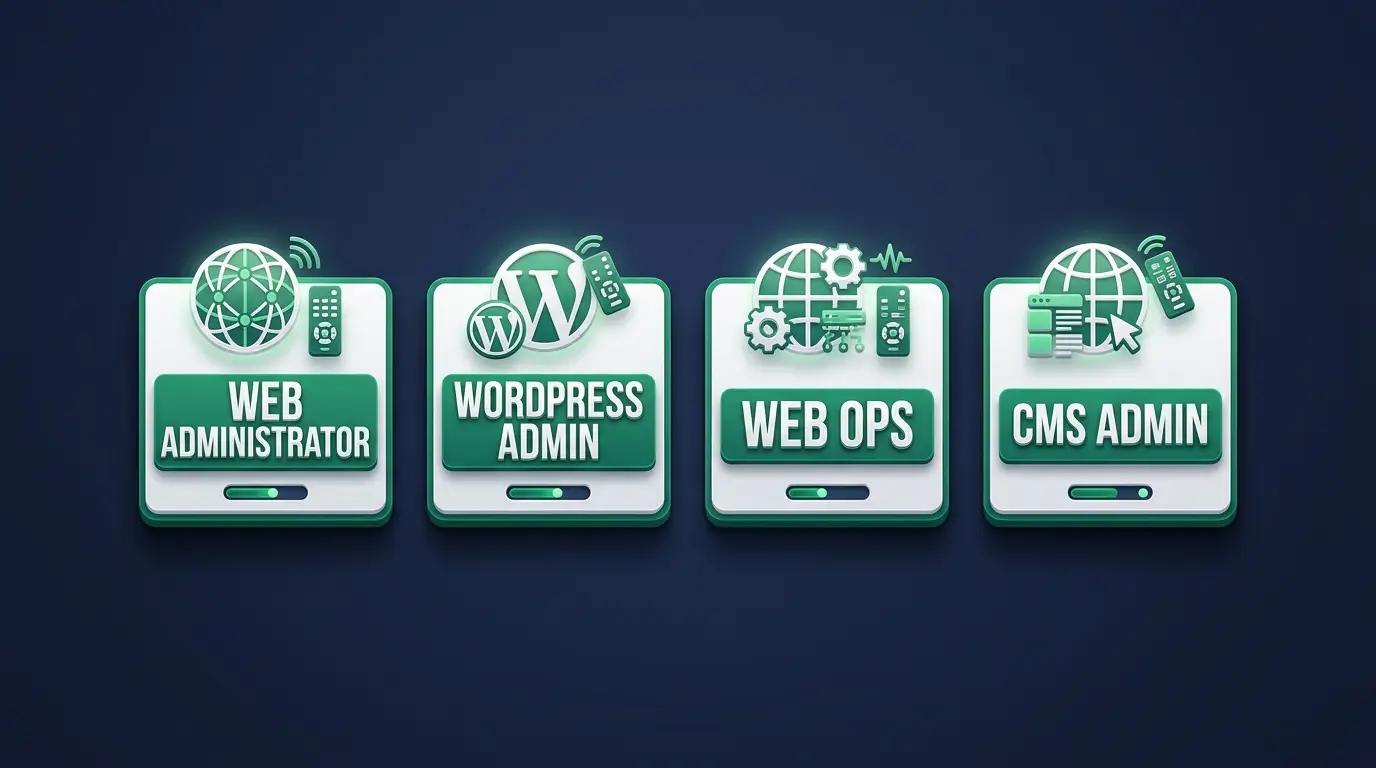
Half the battle is that this role wears six different name tags. If you only search one, you miss most of the openings. Search all of these:
- Web Administrator. The generalist version: the person who owns the company website day to day.
- Webmaster. The old-school name for the same job; still all over government, nonprofit, and university postings.
- Web Producer. The media and publisher flavor, built around getting content live fast and clean.
- Web Content Manager / Content Coordinator. The marketing-team version, heavier on editorial calendars and brand consistency.
- Website Manager. Usually the same role with a bit more ownership of analytics and site strategy.
- E-commerce Specialist / E-commerce Coordinator. The online-store flavor: catalog, promos, and product pages.
Run each one through your filters. Same skills, different listings, and searching all six multiplies your market instead of leaving you invisible to most of it. If the naming still feels fuzzy, I untangle the overlap in web administrator vs webmaster.
If you want the full picture of what the role involves before you apply, read how to become a web administrator so the job descriptions actually make sense to you.
Where to find the openings
LinkedIn with the remote filter on. Search each title above, set location to "Remote," then save the search. LinkedIn will email you new matches. Saved searches are the single highest-leverage move here, because new remote roles get flooded fast and being early is half the win.
Remote job boards. We Work Remotely, Remote OK, Remotive, and Working Nomads all carry web and content roles. They're smaller but the listings are pre-filtered to remote, so no junk to wade through.
Agency and brand career pages directly. Make a list of ten agencies and e-commerce brands whose sites you respect, then check their careers pages every couple weeks. The best roles often never hit a job board.
Freelance platforms. Upwork and Contra are full of "manage my WordPress site" and "keep our site updated" gigs. They're not glamorous, but two or three retainer clients is real remote income, and it's the fastest way to build proof when you have no formal title yet.
How to stand out for a remote role specifically
Getting hired remotely is a different game than getting hired in person. They can't read your body language or vibe with you at lunch. So you have to make a few things undeniable.
A demo site they can click. Not just "I know WordPress." Build a small live site with a campaign landing page, a product page, and a blog post, all clean, consistent, and correct on mobile. If you need ideas for what this looks like, steal from these web administrator portfolio examples.
A documented publish/QA checklist. Write down the exact steps you run before a page goes live: links clicked, images compressed, meta title and description filled, mobile view checked, analytics firing. Attach it to your application. Nothing signals "safe pair of hands" faster to a manager who's been burned by a sloppy publish. Calm dependability beats raw genius for this job.
Written communication that's actually clear. Most remote coordination happens in Slack, tickets, and email. If a stakeholder can read your update once and know exactly what shipped and what's blocked, without a follow-up question, you've already passed a test half your competition fails.
Self-direction. Nobody's going to tap your shoulder with the next task. Talk about a time you spotted a problem and fixed it before anyone asked. That's the whole remote ballgame.
Here's the line I'd tattoo on every remote job seeker: remote work doesn't pay you to be present, it pays you to be trusted. Build the trust and the location stops mattering.
What remote pay actually looks like
Remote web admin roles in the US generally land between $45,000 and $85,000+, depending on experience, the size and volume of the sites you manage, and how much strategy (SEO, analytics, e-commerce revenue) sits on your plate. Those bands hold across all the titles above, whether the posting says web producer, content manager, or e-commerce coordinator.
The quiet advantage of remote is that it widens your market. You're no longer competing for the three jobs in your town. You're applying to companies in higher-paying metros while living somewhere cheaper. That gap is real money.
I break the numbers down by experience level in the web administrator salary guide if you want to know what to ask for.
The honest tradeoffs
I'm not going to sell you a fantasy.
Remote web admin work can be lonely and isolating. No coworkers to grab lunch with, no hallway help when you're stuck.
The queue can feel reactive. A lot of days are working through other people's requests: this banner, that typo, this new landing page. If you need to originate everything you build, that grind will wear on you.
Deadlines come in volume. Product launches, seasonal promos, and campaign dates don't move because you're behind, and some weeks turn into a publishing sprint.
The work is quiet when it's done well. A site where every page is live and correct gets noticed by nobody. You'll have to document your own wins or reviews will undervalue you.
You have to run your own structure. No commute and no manager hovering means it's on you to start, focus, and stop. Some people thrive on that. Some quietly fall apart on it. Be honest about which one you are before you chase the lifestyle.
And remote roles can get more applicants precisely because they're open to everyone. The competition is wider even when it's shallower. That's exactly why the portfolio and the multi-title search matter so much.
FAQ
Are remote web administrator jobs actually entry-level friendly? Some are. Agencies, nonprofits, and marketing teams will hire juniors to handle publish requests and content updates under supervision. The trick is proving you're reliable, which is why even one or two freelance site-management clients makes you far more hireable than a blank resume.
Do I need a degree to get a remote web admin job? Usually no, outside of some higher-ed and government roles. Most employers care about whether you can publish clean, correct pages on schedule and communicate clearly. A portfolio and real results beat a diploma here.
What's the difference between a web administrator and a webmaster? Mostly the era the company is from. "Webmaster" is the older term and you'll see it in government, nonprofit, and university postings. The day-to-day work overlaps heavily, so search both.
Can I do remote web admin work as a side hustle first? Absolutely, and I'd encourage it. Managing content and updates for two or three small business sites on retainer is the cleanest way to build proof, earn while you learn, and decide if the work suits you before you go full time.
Which skills should I sharpen to get remote roles faster? WordPress or another major CMS, enough HTML and CSS to fix formatting, the SEO and analytics fields (meta titles, descriptions, tracking), and clear written communication. The last one is underrated and it's often what gets you the remote offer over an equally capable applicant.
If you're like Marcus and you just want to do solid technical work from your own place, web administration is one of the most realistic on-ramps there is. It's digital, it's in demand, and the door is wider than people think.
Start by understanding the role end to end on the web content manager career path, build a small portfolio, save those LinkedIn searches under all six titles, and apply before the listings get buried.
You don't need to move to a city to do this work. You just need to be the person they can trust to get every page live and right. I'll help you become that person.