Web Administrator vs Webmaster: What's the Difference in 2026?
On this page
Back in the mid-90s, almost every company that had a website had a webmaster. The word was everywhere. You'd see it stamped at the bottom of the page next to a "mailto:webmaster@..." link, and clicking it sent your complaint straight to the one person who ran the whole thing. That person wrote the HTML, uploaded it over FTP, swapped the banner images, and fixed the broken links. Master of the web. Singular. It fit, because back then one human really could hold the entire site in their head.
Then the web got bigger, HR departments got involved, and the romantic old word started to sound like dial-up. Companies stopped writing "webmaster" on job posts and started writing "web administrator." Then "website manager." Then "web producer." Then "web content manager." And in stores that sell things online, "e-commerce specialist."
So here's the thing people get wrong, and I got emails about this exact confusion after my last few posts. They assume each of those titles is a different job, and they burn weeks trying to figure out which one to train for.
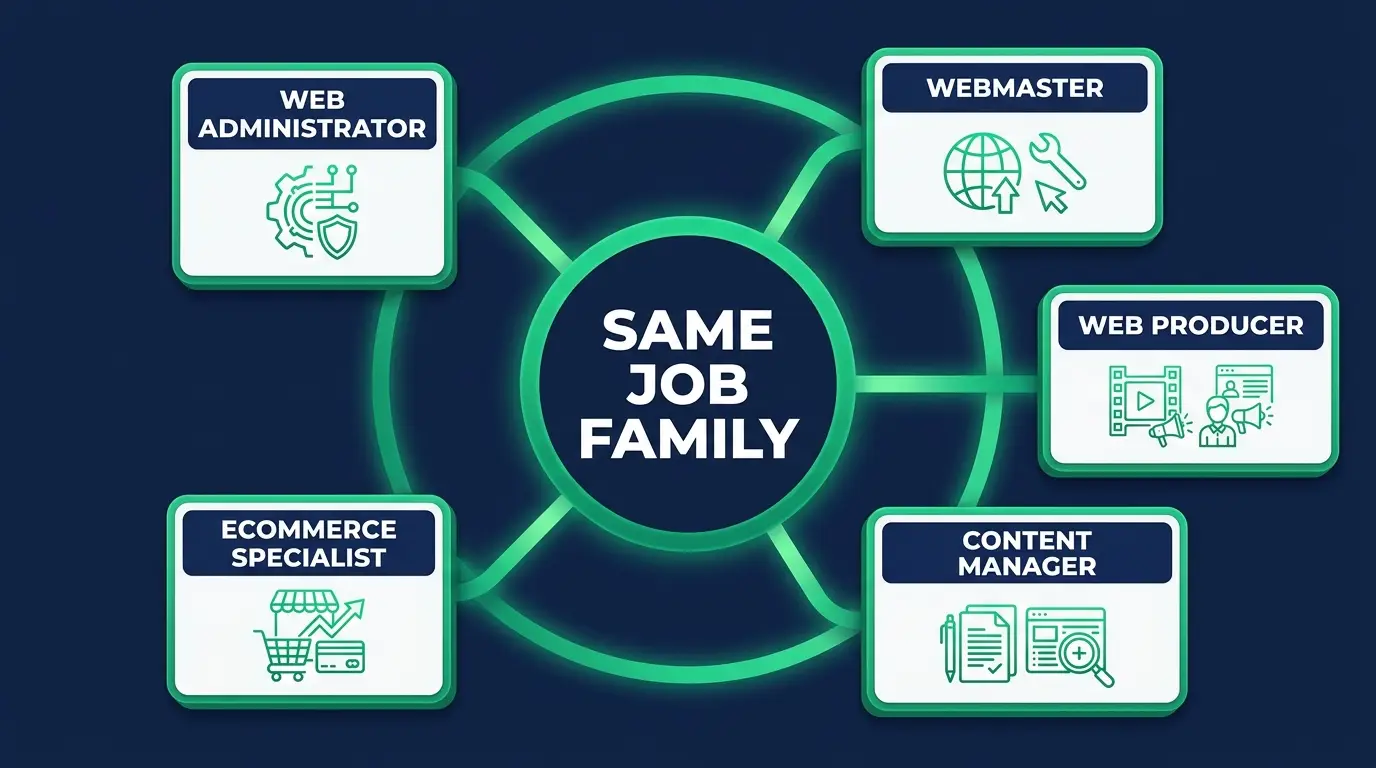
They're not different jobs. They're different name tags on the same job.
The one-line difference
Here's the honest answer, and it's less dramatic than the "vs" in the title suggests.
The difference between a web administrator and a webmaster is mostly the era and the org chart.
"Webmaster" is what the role was called in the 90s and 2000s. "Web administrator" and "website manager" are what most companies call it today. "Web producer" is the same role at media companies and agencies. "E-commerce specialist" is the same role pointed at an online store.
Underneath every one of those titles, the core work is identical: content goes in, gets QA'd, gets published, gets measured. Somebody has to own that loop. That somebody is you, whatever the badge says.

The actual job, under all the names
Strip the titles away and here's what the person actually does, week in and week out:
- Publishing and updating pages through a CMS. New landing pages, refreshed product pages, the promo banner that has to go live Friday at 9am.
- QA before and after launch. Checking links, forms, images, and layouts so the company doesn't find out from a customer that checkout is broken on mobile.
- Hunting broken links and stale content. The unglamorous sweep that keeps a site trustworthy.
- Keeping the brand consistent. Right logo, right colors, right voice, on every page, because marketing will notice when it isn't.
- Analytics and basic SEO. Watching what pages perform, filling in title tags and meta descriptions, flagging what's tanking.
The technical floor is real but light. You need to be genuinely fluent in a CMS (WordPress, Shopify, HubSpot, whatever the company runs), comfortable tweaking HTML and CSS when a page misbehaves, and aware of what cPanel and hosting are so you can talk to the people who manage them.
Notice what's not on the list. Server security, uptime monitoring, incident response at 3am. That's a different job with a different ladder (sysadmin, DevOps), and job posts that pile those duties onto this title are describing two roles and paying for one. Knowing where the line sits is half of interviewing well. I walk through the day-to-day and the skills in how to become a web administrator.

The titles, decoded
Same job family, but each name carries a hint about who's hiring and what they'll lean on hardest. Here's how I read them when I scan job boards.
Web administrator / website manager. The default modern names. You'll see these at mid-size companies, universities, healthcare systems, and nonprofits, anywhere the website lives under marketing or IT-adjacent operations. Broadest version of the role: pages, QA, analytics, a little of everything.
Web content manager. Same role with the dial turned toward writing and editorial workflow. Common in government, education, and B2B companies with big resource libraries.
Web producer. The media and agency flavor. Emphasis on volume and deadlines: getting a high count of articles, campaign pages, or client updates published fast and clean. If you like a newsroom pace, search this one.
E-commerce specialist. The same job pointed at a product catalog. Instead of blog posts you're publishing product listings, promo pages, and seasonal sales, and your analytics conversations are about conversion. Retail brands and Shopify shops post this constantly.
Webmaster. The original. It still shows up, almost always at small organizations (a church, a local nonprofit, a 12-person company) where one person handles everything web. The title is dated; the work inside it is the same work.
The payoff: search every name, not one
Here's where this stops being trivia and starts being money.
If you only search "web administrator" on job boards, you're seeing a slice of the market and mistaking it for the whole thing. The company that would hire you might have posted the identical role as "web producer" or "e-commerce specialist," and you'll never see it.
So set up alerts for all of them: web administrator, website manager, webmaster, web producer, web content manager, e-commerce specialist. Read the duties, not the title. If the post says CMS, publishing, QA, and analytics, it's your job, whatever they named it. This matters even more when you're hunting remote, where the applicant pool is national and every extra search term is extra at-bats. I put together a whole guide on that in remote web administrator jobs, and the honest look at pay and growth lives in is web administration a good career.
So which title should you chase?
Neither. That's the trap.
Stop choosing between titles and choose the skill set: CMS fluency, content operations, QA discipline, light HTML and CSS. Then apply to every name that skill set wears.
Here's the line I'd have you keep: you're not applying for a title, you're applying for a loop: content in, QA'd, published, measured. Learn to run that loop well and you're qualified for five job titles at once, which is a strange and wonderful kind of leverage for a role you can learn without a degree.
The honest tradeoff: because the technical floor is light, so is the barrier to entry, which means you stand out through reps and a portfolio, not credentials. Build a site, run it like a job, and show the loop working.
FAQ
Is webmaster an outdated job title? The word is used less every year, but it still appears, mostly at small organizations where one person handles the whole site. The skills behind it are the same ones behind "web administrator" and "website manager" posts, so don't skip a webmaster listing over the label.
Are web administrator and webmaster the same job? Essentially yes. They're different-era names for the same content-operations role: managing a site through a CMS, publishing and QA'ing pages, fixing broken links, keeping the brand consistent, and watching analytics. The name changed more than the work did.
What's the difference between a web producer and a web administrator? Emphasis, not substance. "Web producer" is the media and agency version of the role, with more weight on publishing volume and deadlines. Same CMS-and-QA core.
Is an e-commerce specialist the same as a website manager? It's the same job family aimed at an online store. You publish and maintain product listings and promo pages instead of articles, and your metrics tilt toward conversion. The skill set transfers in both directions.
What should I search for when job hunting? All of it: web administrator, website manager, webmaster, web producer, web content manager, e-commerce specialist. Judge posts by the duties (CMS, publishing, QA, analytics), not the title, or you'll miss most of the market.
If you've been stuck comparing titles instead of applying, I hope this untangles it. The market renamed one job five times; that's the market's confusion, not yours.
The skill set underneath every one of those names (CMS fluency, HTML and CSS, content ops, QA) is exactly what we build step by step in the web content manager career path. Learn the loop once, and apply to every name it wears. You don't have to know everything on day one. You just have to start.