Digital Experience Manager: The Top of the Web Content Ladder

On this page
Most people running a company's website think the next step up is running a bigger website.
It isn't. The next real step is a change in what you're responsible for: from the pages themselves to the whole experience someone has with the organization online, including the parts you don't directly control.
That job usually gets called digital experience manager, and it's the best-paid title in this family.

What the job covers
The whole digital footprint, not one site. Often several sites, plus a portal, plus the search experience, plus whatever the mobile app does, plus how those connect.
Journey design. How someone moves from a search result to a page to a form to a confirmation email, and where they fall out of that. This is the part that distinguishes the role: you own the path, not the pages.
Governance at scale. Standards, permissions, and who can publish what across a large organization with many departments who all believe their content is the most important.
Platform strategy. Which CMS, whether to replatform, what integrates with what, and building the case for spending money on any of it.
Measurement. Not just traffic. Task completion, drop-off, search success, accessibility conformance, and satisfaction.
Working across teams. Marketing, IT, design, legal, and the departments that own the content. You rarely have authority over any of them, which makes influence the core competency.
What it pays
$85k to $115k for most US digital experience managers, going higher at large enterprises and in regulated industries, with senior and director-level roles reaching $140k and beyond.
That's the top of the range for this whole job family, where coordinators start around $45k and manager titles sit at $70k to $95k.
The premium exists because the role requires three things at once: understanding how sites are built, understanding how people use them, and being able to move a large organization. Plenty of people have one, fewer have two, and the combination is genuinely scarce.
What changes from web content manager
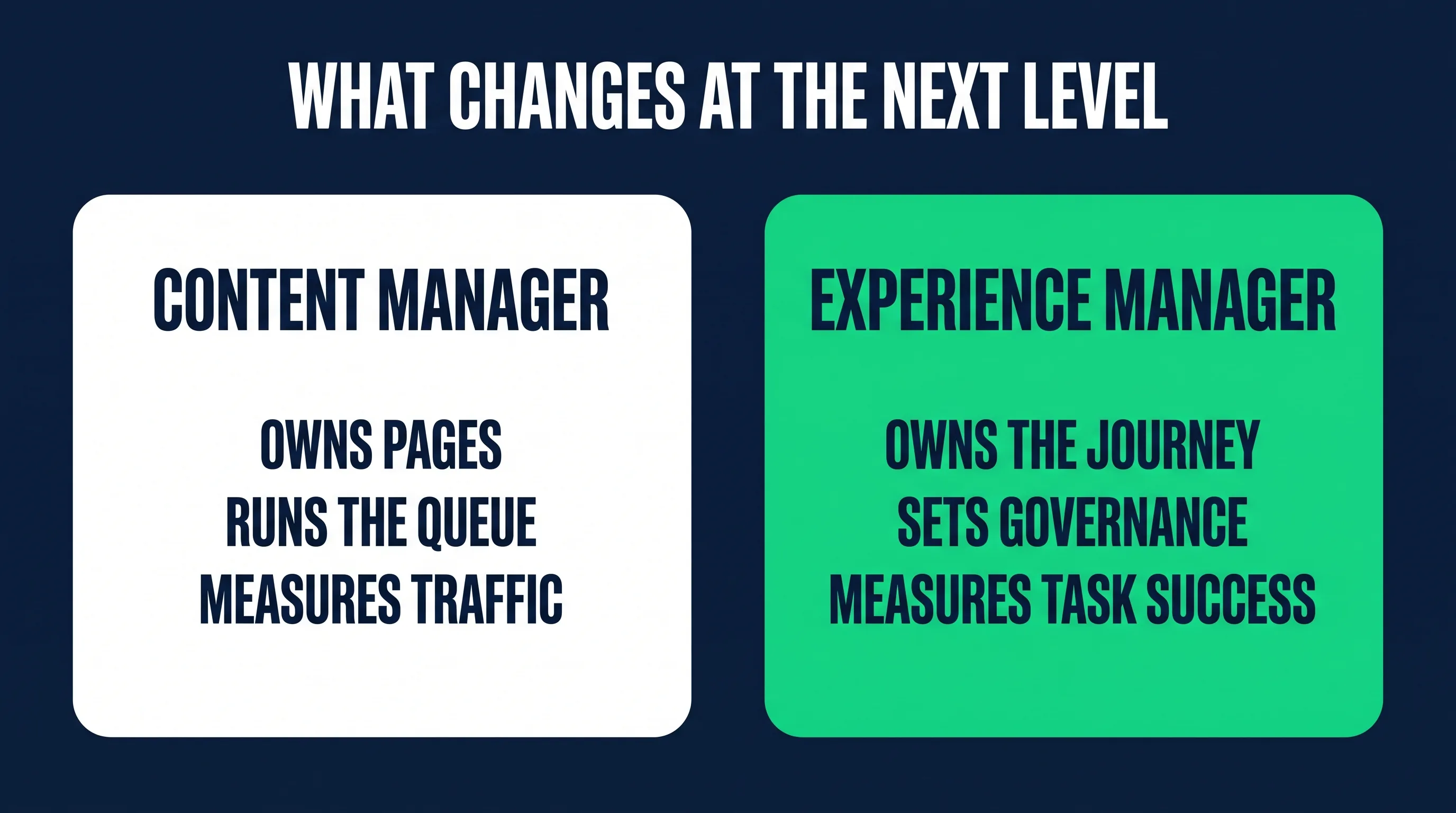
You stop being the queue. As a content manager, requests come to you and you publish them. As an experience manager, you design the system that handles requests without you, and spend your time on what the system should be.
You measure outcomes, not output. Pages published is not a metric anymore. Whether people completed the thing they came to do is.
You own the argument, not just the work. Most of your impact comes from persuading a department to give up their homepage banner, or convincing leadership to fund a replatform. This is uncomfortable if you took a web job to avoid politics.
You inherit accessibility as a legal responsibility. At scale, in public sector and regulated industries, this is genuinely serious and it lands here.
The skills that get you promoted into it
Analytics beyond traffic. Learn to measure task success and drop-off, not sessions. Anyone can report visits. Being able to say "38% of people who start the application form abandon it at the document upload step" is a different conversation.
Accessibility, properly. WCAG conformance at an organizational level, including how to audit and how to build it into a publishing process. This alone gets people promoted in the public sector.
User research basics. You don't need to be a researcher. You need to have watched five real people try to use your site, because that experience changes how you argue forever.
Technical credibility. Enough understanding of how the site is built to evaluate a vendor's claims and to know when an engineering estimate is inflated. The same technical grounding that runs through the whole web content path.
Business framing. Translating "the navigation is confusing" into "we're losing an estimated 900 applications a year at this step." That translation is the difference between being ignored and being funded.
How to get there from where you are
Own an outcome instead of a section. Pick something measurable that the organization cares about: form completions, support tickets deflected, time to find a document. Improve it and report it in those terms.
Run a real audit of the whole journey, not just the site. Follow one task from search result to completion and document every friction point. Present it. This single exercise is the job in miniature, and doing it unprompted is how most people get noticed.
Fix governance somewhere. Write the standard, build the workflow, get it adopted by two departments. Governance experience is the hardest thing to demonstrate and the most valuable.
Learn to present to executives. Short, in money or mission terms, with a recommendation rather than a list of problems.
The route from the entry level up to this point is mapped in how to become a web content manager, and the pay at each rung is in the salary guide.

Where these jobs are
Large organizations, almost exclusively, because you need enough digital surface area to justify the role. Universities, hospital systems, government agencies, banks and insurers, large nonprofits, and enterprise companies.
Those are the same sectors that hire heavily for web content manager roles, which is convenient: the promotion path frequently exists inside the organization you're already in.
Titles to watch for: digital experience manager, web operations manager, digital operations manager, head of digital, digital channels manager, and sometimes digital product manager when the site is treated as a product.
The honest downsides
Change is slow. Moving a large organization takes quarters, and you'll spend a lot of time in meetings that produce nothing visible.
You'll be responsible for outcomes shaped by teams you don't manage. If IT won't prioritize your fix, the number still doesn't move.
And you'll be further from the craft. If the satisfying part of your day is editing a template and seeing it live, this promotion trades that for influence work. Some people genuinely miss it, and staying a strong senior content manager or moving technical is a legitimate alternative rather than a failure.
FAQ
What does a digital experience manager do? Owns an organization's digital experience across sites and channels: journey design, governance, platform strategy, accessibility, and measurement of whether people can actually complete what they came to do.
How much does a digital experience manager make? Typically $85k to $115k in the US, with senior and director-level roles at $140k and above. It's the highest-paid title in the web content family.
How is it different from a web content manager? The content manager owns pages and publishing. The experience manager owns the journey, the standards, and the platform decisions, usually across several properties.
Do I need a design or UX background? No, though you need to understand the basics. Most people arrive from web content management or digital marketing rather than from design.
How long does it take to get there? Commonly four to seven years from an entry-level web role, faster in organizations that are actively maturing their digital operation.
Do I need to code? Not to do the job, but technical credibility is what lets you evaluate vendors and challenge estimates. The managers without it get told what's possible rather than deciding it.
The useful thing to know while you're still updating pages is that the ladder above you is shorter than it looks, and the rung above is not "manage more pages."
Pick one task on your site that people fail at, measure the failure, fix it, and present the result in money or mission terms. That's the job. Doing it once before anyone asks is how you get the title.