Best Ecommerce Courses for Getting Hired (Ranked)
On this page
I searched "ecommerce course" this week to see what someone in your spot would find, and one of the first schools I clicked had gone read-only.
A banner said they were moving to a new platform, so new sign-ups and exam attempts were switched off for now. Ten days before that, on October 29, Shopify Academy shut down for good and started redirecting to Shopify's blog. Two names people used to recommend were just gone that week.
The rest of page one had a different problem. Almost every result on it was built for someone opening their own store. Pick a niche, find a supplier, run some ads. Fine if that's you. But most people who write to us want something else. They want to get hired. They want a salary from someone else's store, with health insurance and a manager who isn't themselves.
So this ranking is for that goal.
Disclosure: CodingPhase wrote this post, and our Ecommerce Specialist path is pick #1.
What is the best ecommerce course?
For getting hired, the best ecommerce course is one that ends in a portfolio and a career path, which is why the CodingPhase Ecommerce Specialist path is my #1. For running your own store or learning one platform's buttons, the free platform academies below are the right companions.
How I picked these ecommerce training programs
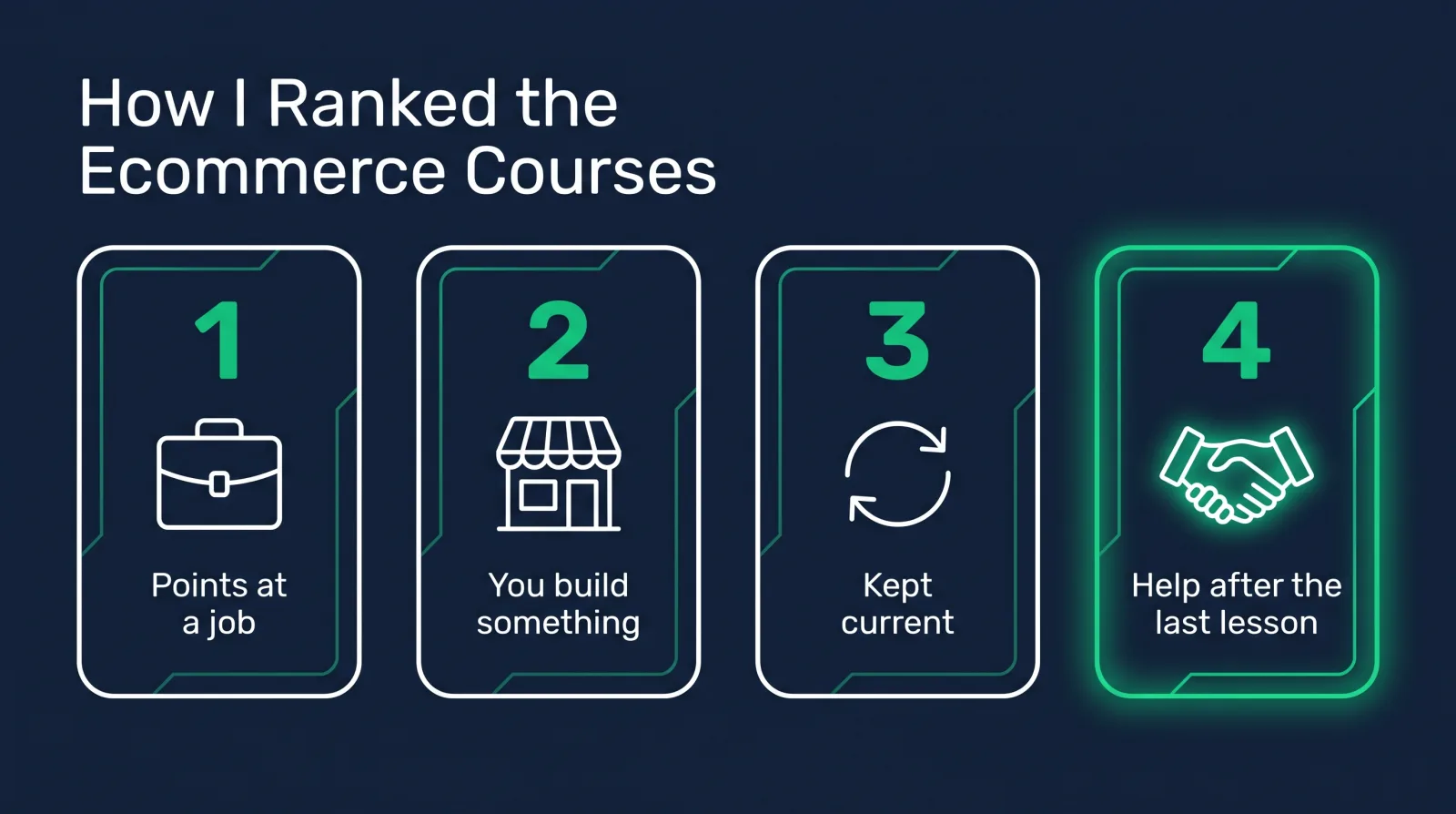
I checked every course below on its own website on November 8, 2026. If I couldn't confirm a fact there, it isn't in this post. I ranked them on four things:
- Does it point at a job? An online ecommerce class that teaches you to launch a dropshipping store isn't the same as one that teaches what an ecommerce team hires for. I care about the second.
- Do you build something? Recruiters want to click a link. A live store, a customized theme, a mock store with real product pages. Videos and quizzes don't give you one.
- Is it current? Ecommerce platforms ship changes constantly, and Shopify's own academy just closed. If the screenshots don't match your admin, nobody's maintaining it.
- What happens after the last lesson? This is where most courses stop. A certificate PDF, a "congrats," and you're on your own with the job hunt.
That last one ended up deciding the ranking more than anything else.
1. CodingPhase Ecommerce Specialist path: best overall for getting hired
The Ecommerce Specialist path takes a beginner from zero to a job-ready portfolio in a set order, then helps with the job hunt itself. If your goal is a job, this is where I'd send you. Yes, I'm biased. I built it.
It's 11 courses in a set order, so you never have to guess what to learn next. You start with the terminal and HTML and CSS (one course has you rebuild a social network interface piece by piece), move into JavaScript and Git, then into Liquid, the template language behind Shopify themes and a lot of ecommerce email. The center of the path is Shopify Theme Development 2.0, 64 lessons where you design, build and ship a custom Online Store 2.0 theme with the CLI and GitHub. There's also a course on content management systems for content editors, because a lot of ecommerce work is managing product pages and content in a CMS, not writing code.
If you've never opened a store admin before, take My First Shopify Store Course alongside it. It walks the whole admin the way a merchant lives in it: products and collections, test orders, abandoned checkouts, discounts, and setting up Google Analytics and the Facebook pixel before launch. No code at all. It's the part people skip, and then they freeze on their first client screen-share.
What makes this different from the rest of the list is everything wrapped around the lessons. Diamond Membership includes:
- Guided career paths built for beginners, so the order is decided for you.
- Portfolio templates, so the store you built looks professional when a hiring manager opens it.
- An ATS-ready résumé builder and a job board for when you start applying.
- An 80,000+ member community of people learning the same things.
- Two live calls every week: Accountability on Wednesdays at 7 PM ET, and Money Talk on Sundays at 8 PM ET.
The path is free to start, so you can open it with a CodingPhase account and see whether the work suits you. Diamond Membership lists at $60/month or $365/year, and there's always at least 30% off, so it's about $42/month or about $255/year. That covers this path plus 90+ other courses, and there's a 7-day money-back guarantee. I've been teaching since 2016.
Our students land roles at $75k+ (individual results vary).
2. Google Digital Marketing & E-commerce Certificate (Coursera)
This one's strength is the name on it.
Coursera lists it as an 8-course professional certificate built by Google, with over 190 hours of instruction. The page says it can be done in under six months at under 10 hours a week, and in the U.S. and Canada it costs $49 per month after a 7-day free trial. You use tools like Google Ads, Google Analytics, HubSpot, Mailchimp and Shopify, and one course has you set up a mock ecommerce store on Shopify.
The honest tradeoff: it's a broad marketing certificate with an ecommerce slice, not an ecommerce course from start to finish. The portfolio pieces it mentions are things like customer personas and social media calendars. That's great for a digital marketing coordinator role. If you want to be the person who builds and runs the store itself, you'll need more hands-on platform work than this gives you.
3. Klaviyo Academy (free)
Email is where a lot of online stores make their repeat revenue, and Klaviyo is the email platform many of them run on.
Klaviyo Academy is free. It has structured courses with exams, quick guides, live trainings, and certificates that you earn by passing a final exam, including a Klaviyo practitioner certificate, a deliverability certificate and a Klaviyo developer certificate. It's very good at teaching Klaviyo itself. It won't teach you the store, the theme, or how to get a job. Think of it as the email specialization you bolt on once you know your way around a store. I compared it with Shopify's built-in tool in Klaviyo vs Shopify Email if you want to see where each fits.
4. Amazon Seller University (free)
If the jobs you're looking at say "marketplace" or "Amazon" anywhere in the posting, look here. Seller University is Amazon's free education hub, and you can now use it without an Amazon selling account. It covers how to list, price, fulfill and advertise products, mostly through videos and downloadable guides.
It's written by Amazon to make you a better Amazon seller, so expect accurate platform how-tos and no career plan.
5. Meta Blueprint (free courses)
A lot of ecommerce traffic is paid social. Meta Blueprint offers free, self-paced courses and live webinars on advertising across Facebook and Instagram, with learning paths aimed at specific goals. If you want a credential, Meta runs certification exams you register for online. You prepare with their free courses, study guides and practice tests.
It's narrow on purpose. You'll understand how Meta's ad tools work, which matters at almost any store that sells online. You won't learn how to build or manage the store those ads send people to.

Ecommerce certification: which certificates employers recognize
No single ecommerce certification is required for these jobs, and most hiring managers care more about what you can show them than the certificate name. Platform certificates (Klaviyo, Meta) and recognizable brands (Google) help you get past a skim. A portfolio link gets you the interview.
A certificate tells a recruiter you finished something. A store you built shows them you can do the work, and they can open it in a new tab while they're still reading your résumé.
So stack them in that order. Do the work first, then add a platform certificate that matches the jobs you're applying for. Applying to brands that run on Klaviyo? The practitioner certificate is a nice line on the résumé. Applying to roles heavy on paid social? Meta's. Every CodingPhase career path also ends with a certificate for completing it, and it sits on top of a portfolio, which is the part that makes it mean something.
Free vs paid ecommerce courses
Free ecommerce courses are excellent at teaching one platform, usually by the company that sells that platform. Paid ecommerce training tends to earn its cost by connecting the pieces: a full path in order, projects, feedback, people to learn with, and help with the job hunt itself.
Most of the free picks above come from a vendor teaching its own product. That's why they're accurate. The people writing them ship the features. It's also why they stop at the edge of their product. Klaviyo Academy won't teach you Shopify themes, and Amazon won't teach you Klaviyo.
Someone trying to get hired needs to know how those platforms fit together: how the store, the email program, the ads and the analytics all touch each other on a normal Tuesday at a small brand. That's the gap a career path fills, and it's the reason I'd rather you spend about $42 a month on a membership that gives you a path, a portfolio, a job board and two live calls a week than spend six months stitching together tabs on your own.
Use the free stuff. I do. Just keep it next to a path instead of making it the path.
A course for your own store vs a course for an ecommerce job
A store-owner course teaches you to launch fast and sell your own products. A career course teaches the work an ecommerce team pays for and leaves you with proof you can do it. They look similar from the outside, and they're built for different people.
If you're launching your own store, you need speed. Product research, supplier setup, a theme you can customize without code, ads, and a launch. Store owner courses and the platform help centers are built for exactly that, and most of page one on Google is this type.
If you want an ecommerce job, you need depth in the work a team pays for. Running a store admin for someone else. Building and editing product pages. Theme customization in Liquid. Reading the analytics, fixing conversion leaks, and talking to a marketing manager about why the checkout is losing people. You also need proof, in the form of a portfolio, and you need to get that proof in front of hiring managers.
I'd add one honest note here. A lot of people start with "I want my own store" and end up realizing they'd rather get paid to run someone else's while they learn. That's a good outcome. The skills overlap a lot, and a steady paycheck is a much calmer place to learn ecommerce than your own savings account. If you're still deciding, read is ecommerce a good career and then the ecommerce jobs guide, which lays out the roles you'd actually be applying to.
The skills side is its own topic, and I wrote it up separately: the ecommerce skills employers hire for. Once you have a few projects, the next step is your ecommerce resume.

What does an ecommerce specialist earn?
Ecommerce pay depends heavily on the title, the company and how technical the role is, so treat any single number as a rough guide. Our students land roles at $75k+ (individual results vary). Google puts entry-level digital marketing and ecommerce pay at a $71,000 median.
A couple of sourced reference points, so you can check them yourself:
- Google's certificate page on Coursera (checked November 2026) cites a median entry-level salary of $71,000 in the U.S. for digital marketing and e-commerce jobs.
- The U.S. Bureau of Labor Statistics Occupational Outlook Handbook lists a median annual wage of $78,760 in May 2025 for market research analysts, a federal category a lot of ecommerce analytics and marketing roles sit close to.
The technical end of ecommerce, the people who can work inside themes and Liquid, tends to sit higher, because fewer applicants can do it. If you want that end, the Shopify courses roundup goes deeper on the platform side, and the ecommerce developer vs ecommerce specialist breakdown shows where the two jobs split.
A course teaches you a platform. A path gets you paid for knowing it.
FAQ
What is the best ecommerce course for beginners? For a beginner who wants to get hired, the CodingPhase Ecommerce Specialist path. It starts at zero, runs in a set order through HTML, CSS, JavaScript, Liquid and Shopify theme development, and wraps the job hunt around it with a résumé builder, a job board, a community and two live calls a week. It's free to start.
Is an ecommerce certification worth it? It helps, but it's rarely what gets you hired on its own. A recognizable certificate can get your résumé past a quick skim. A portfolio with a real store or theme is what wins the interview. Get the portfolio first, then add a platform certificate that matches the jobs you want.
Can you get an ecommerce job with an online course? Yes, if the course leaves you with proof. Most ecommerce roles care about skills and results more than degrees. Pick one that has you build real projects you can link to, and that helps you apply, not one that ends at a certificate PDF.
Are there free ecommerce courses with a certificate? Yes. Klaviyo Academy offers free courses and certificates you earn through a final exam. Meta Blueprint has free courses that prepare you for its certification exams. Amazon Seller University is free but focused on selling on Amazon. Our Ecommerce Specialist path is free to start too.
What skills does an ecommerce course need to teach? At minimum: running a store platform admin, product listings and merchandising, email and retention, analytics, and the basics of SEO and paid traffic. For better-paying roles, add HTML, CSS and Liquid, so you can customize a theme instead of waiting on a developer. I break each of these down in ecommerce skills employers hire for.
If you've read this far, you're probably already past "should I do this?" and onto "where do I start?" That's a good place to be.
Start the Ecommerce Specialist path for free, do the first lessons this week, and come say hi on a Wednesday Accountability call. A lot of people who join us are fitting this around a full-time job and a family, so you won't be the only one learning at 9 PM. We'll be there.