Klaviyo vs Shopify Email: Which One Actually Makes You Money
On this page
A guy I helped last year sold candles. Good ones. He'd been running his store for about two years on Shopify Email, sending a newsletter when he remembered to, and he was fine with that until we sat down and pulled his numbers and found that roughly four hundred people a month were putting a candle in their cart and walking away, and nobody was ever emailing them about it. Not once. Two years of that.
He did the multiplication in his head while I was still talking, and then he got very quiet.
That's the version of this question I actually care about. Not "which tool has more features," which nobody actually wants to read, but why the free thing sitting in your dashboard can end up being the most expensive decision in your store.
I've built email systems on both. And I'll tell you up front: the free one is genuinely the right call for some of you. This isn't the affiliate-link version where Klaviyo wins every round because somebody gets a commission.
The one-line verdict
Shopify Email is a fine place to start when you have almost no list and no budget. Klaviyo is where the actual email revenue gets built once you have customers worth marketing to.
The trap is staying on the free tool long after it started costing you money. Because "free" and "cheap" are not the same thing when the cheaper tool leaves your abandoned carts un-emailed.
That's the reframe I want you to keep: a free tool that recovers nothing is more expensive than a paid tool that recovers real orders.
What Shopify Email does well (and its ceiling)
A lot of comparison posts pretend the free tool is garbage so the conclusion writes itself. It isn't garbage, and I'm not going to pretend otherwise.
It's built in. No new account, no data sync, no connecting apps and praying they talk to each other. Your products, customers, and orders are already sitting there. For a brand-new store that friction matters more than people admit, because the tool you actually use beats the better tool you keep meaning to set up.
It's genuinely cheap. Shopify gives you a monthly allotment of free emails tied to your plan, and past that the per-email cost is tiny. The exact limits move around, so check your current plan before you quote me on it, but the shape holds: a newsletter to a small list costs you close to nothing.
It's dead simple. Drag a few blocks, pull in your products, send. Announcing a drop takes four clicks and no learning curve.
It has basic automations now. A welcome email, a simple cart reminder. That's real, and if you're doing your first handful of orders a month it might be everything you need.
So where's the ceiling? It shows up faster than you'd think.
Segmentation is the first wall. You can slice your list in basic ways, sure, but the segment that actually prints money looks like "people who bought product A and never came back for the refill, whose last order was 45 to 60 days ago," and building that in the free tool is a fight you will lose or quit.
Flows are the second. You get a couple of starter automations, not a flow builder. No browse abandonment. No post-purchase cross-sell, no win-back sequence, no replenishment reminder, no VIP track. The branching multi-step logic that carries an ecommerce email program mostly just isn't in there.
And the analytics will show you opens and clicks. Lovely. What they won't show you is revenue per flow, which is the only number that tells you what to cut and what to double.
None of that matters at zero customers. All of it matters at a few hundred.
Where Klaviyo pulls ahead
Klaviyo was built for ecommerce from the first line of code, and you feel it everywhere.
Flows are the whole ballgame, so let me be specific about what you get:
- Abandoned cart and abandoned checkout, multiple steps, timing you control, branching on cart value.
- Browse abandonment, for people who looked hard at a product and left without adding it.
- Post-purchase, thanking buyers, cross-selling the natural next thing, asking for the review at the moment they still love you.
- Win-back, catching customers who've gone quiet before they're gone for good.
- Replenishment, reminding people to reorder the consumable right as they're scraping the bottom of it.
Those run in the background whether or not you show up that week. For most stores they quietly become the biggest slice of email revenue, and the candle guy's cart flow made more in its first month than he'd made from every newsletter he'd ever sent combined.
Segmentation is deep and behavioral. Klaviyo watches what people do (opened, clicked, viewed, bought, ignored) and lets you build segments off any of it, so you stop blasting the whole list and start sending the right thing to the right group. That's where the lift lives.
The analytics are the underrated part. Klaviyo attributes revenue down to the individual flow and email, so you can open a sequence and read "this abandoned-cart flow made $4,200 last month," and once you can see that, you stop guessing about what to build next.
SMS lives in the same place too, coordinated with email, no stitching two platforms together.
Now the honest part. Klaviyo costs more, and it keeps costing more as your list grows, because you're billed on contacts you're marketing to. It's also more tool to learn than most people expect on day one. If you have 40 subscribers, that money and those hours buy you almost nothing. At 4,000 it's a rounding error against what the flows bring back.
For how Klaviyo stacks up against the other big names, I broke those down separately in Klaviyo vs Mailchimp and Omnisend vs Klaviyo.
The money math
Here's the part that settles most of these debates.
Say you're doing $30,000 a month. Industry-wide, a well-built email program tends to drive somewhere around a quarter to a third of total revenue for brands that actually invest in it, and the automated flows do most of that lifting. I'm rounding down on purpose.
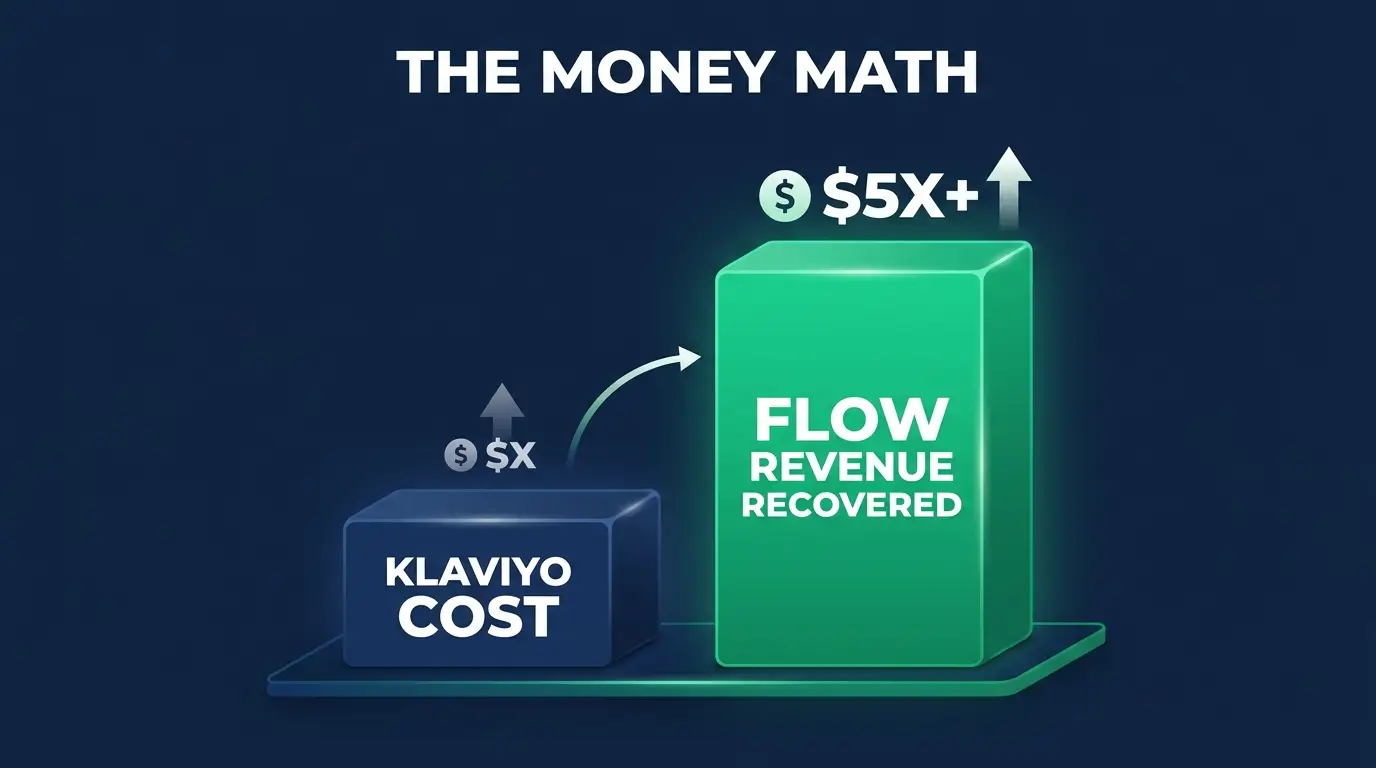
If flows recover even 10% of the revenue that would otherwise walk out, that's roughly $3,000 a month from emails you set up once.
Put Klaviyo's subscription next to that number. Even at a healthy list size you're paying a small fraction of what comes back, and the cart sequence alone usually covers the bill several times over.
On Shopify Email, that same store gets the one starter reminder. The browse-abandon revenue, the post-purchase cross-sells, the win-back saves, the replenishment reorders: most of that just never happens. The free tool doesn't charge you anything. It quietly declines to collect money that was already sitting there.
That's the whole argument in one line: the flow revenue you skip with the basic tool almost always dwarfs the subscription you avoided.
I'm hedging the percentages on purpose. Anyone quoting you a precise "email is 30% of revenue, guaranteed" is selling something, and your store isn't the average store. But the shape is real, and it's why serious stores run Klaviyo.

When to switch
You don't need Klaviyo on day one. You need it at a threshold.
Stay on Shopify Email if you're brand new, your list is tiny, budget is genuinely zero, and you're mostly sending the occasional broadcast. Learn the fundamentals there. It's free and it works for that.
Move to Klaviyo when any of these hit:
- You're doing consistent orders and your list is into the hundreds or more.
- You want real abandoned-cart, browse, post-purchase, or win-back flows instead of one reminder.
- You need to know which emails actually make money.
- You're ready to segment instead of blasting everyone the same thing.
- You're adding SMS.
Rough rule: the day your list becomes an asset worth marketing to carefully, you've outgrown the free tool. That day arrives sooner than most people expect.
The part nobody tells you: this is a career
Here's what I really want you to catch. Every store owner reading this has the same problem, and almost none of them want to learn Klaviyo themselves. They want someone to set it up and run it.
That someone gets paid well.
Building out a store's flows (the cart sequence, browse, post-purchase, win-back, welcome series) is a service people happily pay $300 to $500 for. Then the monthly management, writing campaigns, tuning segments, watching the numbers, runs $200 to $1,000 a month per client. Retainer. Every month.
Land a handful of those and you've built a real income from your laptop. This is the email developer path, and it's one of the cleanest one-person agency businesses you can start, because the work is high value, it recurs, and you can prove it with revenue numbers the client can go check for themselves.
If that's news to you, read how to become an email developer and the email developer salary guide next. The money is more real than people expect.
FAQ
Is Shopify Email enough on its own? For a brand-new store with a small list and no budget, yes. It handles broadcasts and a starter automation or two just fine. It stops being enough the moment you have a list worth segmenting and real flow revenue to capture.
When should I move to Klaviyo? When your list is in the hundreds and growing, when you want proper multi-step flows, when you need revenue-level analytics, or when you're adding SMS. Basically the point where email stops being an afterthought and starts being a channel you run on purpose.
Is Klaviyo worth the extra cost? For a store with actual traffic and a growing list, almost always. The flows typically return several times the subscription cost. For a store with 40 subscribers, no. Wait until you have a list worth the investment.
Can I start on Shopify Email and migrate later? Yes, and plenty of stores do exactly that. Start free, learn the basics, move when the numbers justify it. Just don't spend two years there like my candle guy did, watching flows you could've automated go unsent.
Do I have to learn all this myself? No. This is exactly the kind of work store owners outsource, which is why setting up and managing Klaviyo for clients is a legit income stream. You can be the person they pay.
If reading this made you realize there's a whole skill and a whole business hiding inside "which email tool should I use," you're seeing it clearly.
At CodingPhase we teach you to build these systems, the flows, the segments, the automations store owners pay real money for. Diamond membership is $42/month or $255/year with a 7-day money-back guarantee, and the Tech Accelerator gives you lifetime access for a one-time $1,500. Inside you get the guided email marketing specialist career path, plus the job board when you're ready to get hired.
Start with the free tool if you're just testing the water. Nothing wrong with that. But if you want email to actually pay you, learn to build the flows. That's the part that changes your income, whether it's your store or somebody else's.
You've got this. Go build something that sends while you sleep.