Klaviyo vs Mailchimp: Which Wins for Ecommerce in 2026?
On this page
A guy I know sells candles. His Mailchimp bill went from $30 a month to $180 over about a year, mostly because his list doubled after a decent TikTok run, and the money those emails brought in stayed almost exactly where it had been. He sent me a screenshot of the invoice at 11pm with three question marks. That gap, the one between what you're paying and what you're getting back, is why anybody types this comparison into Google in the first place.
I've helped store owners untangle this exact decision, and I've watched developers get paid good money to run these platforms for other people. The tool matters. Just not as much as most "vs" posts want you to believe.
Here's the honest version.
The one-line verdict
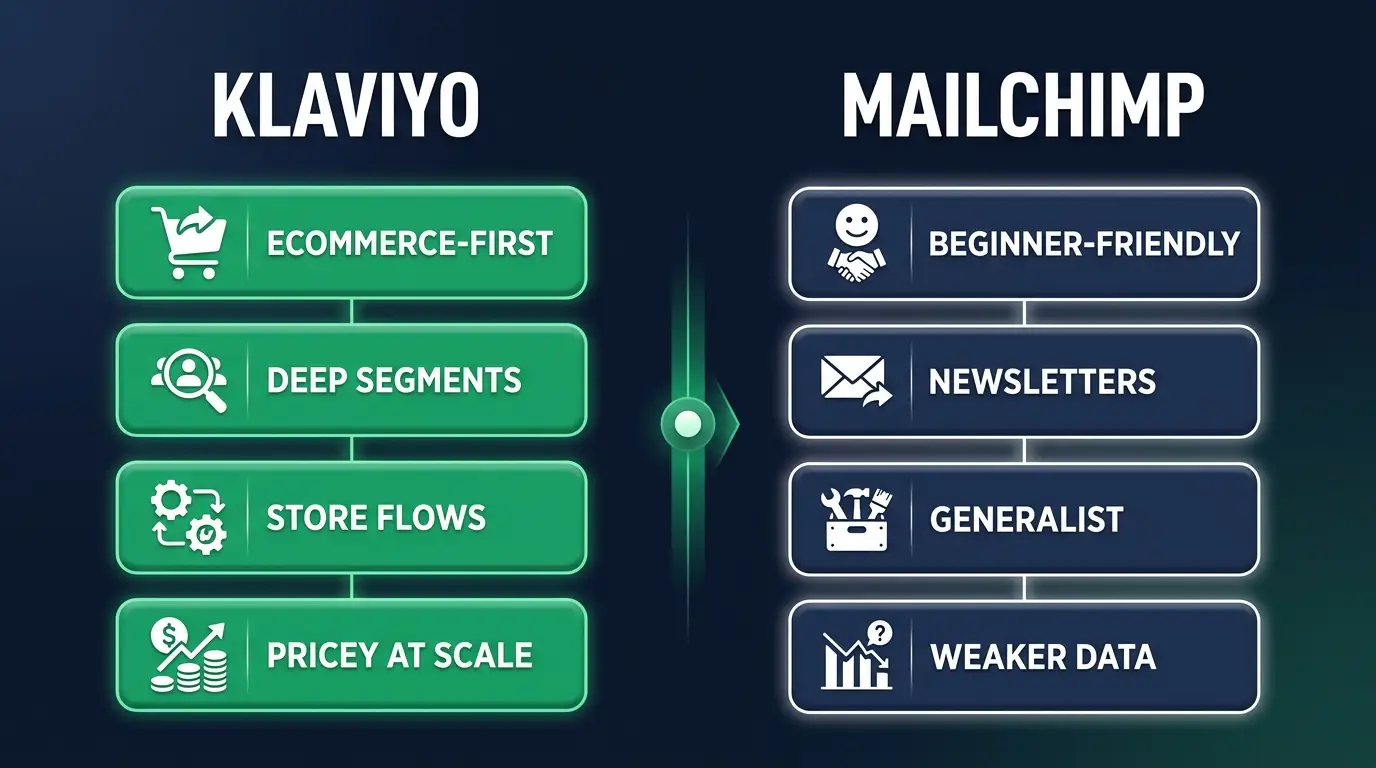
Pick Klaviyo if you sell physical products online and you care about revenue per email. It was built for stores, it plugs into your product and order data, and it turns that data into money in a way Mailchimp never quite matches.
Pick Mailchimp if you run a newsletter, a service business, a small local shop, or anything that isn't a data-heavy store, and you want something simple to start with. It's friendlier, more forgiving, and it does a little of everything.
The thing you're actually choosing is how closely your emails get to talk to your sales data. Klaviyo sits right on top of it. Mailchimp keeps a polite distance.
Everything below is me showing my work.
Ecommerce features
This is Klaviyo's home turf and it isn't close.
Connect Shopify (or WooCommerce, or BigCommerce) and Klaviyo pulls in every product, every order, every browse, every checkout somebody bailed on at the shipping step. The data doesn't just sit in a dashboard looking pretty. It runs your automations.
Abandoned cart is the obvious one. Someone adds a hoodie, wanders off, and two hours later they get an email with that exact hoodie in it and a nudge. Browse abandonment works the same way for people who stared at a product page and left. My candle guy's cart flow, once it was actually wired up, covered his entire platform bill in the first three weeks. That's not unusual. That's kind of the whole pitch.
The underrated piece is predictive analytics. Klaviyo takes a swing at guessing when a customer will order again and what they're worth over their lifetime, then lets you build campaigns on top of that guess. You can email someone a week before they'd normally reorder. The estimates aren't gospel, they get better with volume and they're pretty rough for a young store, but even a rough guess beats sending everyone the same thing on the same Tuesday.
Mailchimp does ecommerce too, and I want to be fair here, it works. It connects to stores. It sends an abandoned-cart email. It has product recommendations. The data model underneath is just shallower, and you feel it the first time you try to build a segment more specific than "bought something once." Commerce is a feature Mailchimp added to a general marketing tool. For Klaviyo it's the whole reason the company exists.
If your business is a store, that difference compounds every month you stay.
Segmentation and automation
Klaviyo pulls ahead again, and this is where it earns the price.
You can slice a list by almost anything: bought product A but not B, spent over $200 in the last 90 days, opened the last three emails and never clicked once, lives in a state where you're running a promo. Conditions stack as deep as you want and segments update in real time as people do things. That's the difference between emailing everyone 20% off and emailing the 400 people most likely to buy this week. The first one teaches your list to sit on their hands and wait for a discount. The second one just makes money.
Klaviyo's flows (its word for automations) are visual, branching, and genuinely powerful. Welcome series, post-purchase, win-back, VIP tracks. You can split a flow on whether someone opened the last email, or whether they've crossed a spending threshold, and send them down different paths.
Mailchimp has automations and segmentation as well, and for a newsletter or a simple funnel they're perfectly good. Customer Journeys handles branching. Basic segments cover the common cases. But once your logic goes conditional and behavior-based, you start reaching for a condition that isn't there.
Now the honest tradeoff. All that Klaviyo power is also a learning curve: more to set up, more to get wrong, more to keep alive six months later when nobody remembers why that flow has two exit conditions. Hold that thought. It's the whole back half of this post.
Ease of use
Mailchimp is friendlier to a beginner, full stop. Gentle onboarding, approachable editor, templates that look fine out of the box, and you can send a decent campaign your first afternoon without watching a tutorial. For a solo founder who just needs to email a list, that low floor is a real feature and I'm not going to pretend otherwise.
Klaviyo asks more of you upfront. The interface is denser because it's exposing more, and the first time you open the flow builder it looks like a cockpit. Nothing's broken. There's just more of it. Give it a week and it clicks.
So: if your priority is sending your first email today with zero friction, Mailchimp wins the opening round. If your priority is a system that grows into a revenue engine, Klaviyo's steeper start pays you back.
Pricing
Both scale by contacts. Both get more expensive as your list grows. Anybody who tells you one is flatly "cheaper" is skipping the fine print.
Klaviyo prices on list size, with SMS billed separately if you use it. Small list, affordable. Climb into tens of thousands of subscribers and the bill climbs right along with you. Klaviyo's counter-argument is that the platform is generating enough attributable revenue to make its own cost look small, and when it's working, that's usually true. You stop reading the invoice and start reading the revenue line sitting next to it.
Mailchimp scales by contacts and tiers too, and people are regularly surprised how fast it moves once they're past the free and starter plans. The features that matter for a store tend to live on the higher tiers, so the cheap reputation fades exactly when you start needing the good stuff.
Both companies rework their plans and limits constantly, so check the current pricing pages before you commit to anything. Any number I print today might be wrong by the time you read this. The shape holds though. Neither one is free at scale, and you judge the cost against revenue generated, never against the sticker.
Deliverability
Everyone wants to know which platform lands in the inbox. It's mostly the wrong question.
Both deliver fine when they're set up right. The platform is rarely what sends you to spam. What sends you to spam is missing sender authentication, a list stuffed with people who never opted in, and content that reads like junk.
Set up SPF, DKIM, and DMARC on your sending domain. Warm up gradually instead of blasting a cold list on day one. Prune the people who haven't opened anything in months, even though it hurts to watch the subscriber count drop. Do that and either platform lands where it should. Skip it and the best tool on earth won't save you, because sender reputation belongs to you, not to the logo on your dashboard.
Which should you pick
Pick Klaviyo if: you run a Shopify or WooCommerce store, your revenue depends on repeat customers, and you want abandoned-cart flows, deep segmentation, and predictive selling. It's the serious-ecommerce standard for a reason.
Pick Mailchimp if: you send a newsletter, run a service or local business, or you're a small shop that wants something simple and cheap to start with and doesn't need surgical segmentation yet. Friendlier generalist, and there's no shame in it.
Still torn? One question decides it. Does your money come from people buying products online, repeatedly? Yes points to Klaviyo. No, or "not really," points to Mailchimp.
If you want to widen the field, I've compared Omnisend vs Klaviyo and Klaviyo vs Shopify Email, since those are the other two names that come up constantly for stores.
Now here's the part nobody tells you
Read back over this whole comparison. Wiring product data. Building flows. Stacking segments. Keeping deliverability healthy so the whole thing doesn't quietly rot. That's real work, and business owners hate doing it with a passion I find genuinely funny.
So they pay somebody else.
Setting up a Klaviyo account cleanly runs $300 to $500. Managing it monthly runs $200 to $1,000, per client. My candle guy? He stopped comparing platforms about four hours into his second attempt at a welcome series and hired someone. Learn to build these systems well and you stop being the person agonizing over the tool. You're the person stores hire to run it.
The role has a name: email developer. It sits where code, marketing, and money overlap, and demand keeps climbing because every store owner reading this same comparison eventually gives up and outsources it. If you want to know how the job actually works and what it pays, I broke it down in how to become an email developer and the email developer salary guide. It's also a clean on-ramp to running your own one-person agency.
That's why I teach this at CodingPhase. We cover email development and building Klaviyo-style flows the way clients actually want them, so "which tool is better" turns into "I get paid to run both."
Membership is $42/month, or $255/year if you go annual, with a 7-day money-back guarantee so you can poke around risk-free. Want lifetime access plus live weekly mentorship? The Tech Accelerator is $1,500 one time. Either way you get the guided email marketing specialist career path, our 80,000-plus member community to ask questions in when a flow breaks at midnight, and a job board for when you're ready to get hired.
You came here to pick between two email tools. You can leave knowing how to get paid to run both.

FAQ
Is Klaviyo worth it over Mailchimp? For a real ecommerce store, yes. Klaviyo's deeper data, segmentation, and abandoned-cart flows usually generate enough extra revenue to justify the higher cost. For a newsletter or non-store business, that power is overkill and Mailchimp's simplicity wins.
Is Mailchimp good for ecommerce at all? It works, and it's fine for a small or new store. But its store data and segmentation are shallower than Klaviyo's, so you'll feel the ceiling as you grow and want more specific, behavior-based campaigns.
Which is cheaper, Klaviyo or Mailchimp? Both scale by contacts and both get pricey at higher list sizes, so there's no clean winner. Judge them by revenue generated, not sticker price, and always check current plans since both change pricing often.
Can I switch from Mailchimp to Klaviyo later? Yes, and plenty of stores do exactly that once they outgrow Mailchimp. You export your contacts and rebuild your flows in Klaviyo. It takes a weekend of focused work, which is often the moment owners decide to hire it out.
Do I need to know how to code to run Klaviyo? No, but knowing HTML email and a little logic makes you dramatically better and more hireable. That skill is the difference between someone who sends basic campaigns and someone stores pay well to build their whole system.
Whichever one you land on, the software was never the edge. Knowing how to make it sell is. Learn that once and a "vs" comparison stops being a decision you sweat and starts being a thing businesses pay you to have an opinion about. Come build that skill with us at CodingPhase, and I'll see you inside.