Ecommerce Resume: Examples and Skills That Get Interviews
On this page
I opened the top Google results for "ecommerce resume" this week, hoping to send you somewhere good. One of them was a page over 6,000 words long. When we ran it through a word counter, fewer than 70 of those words sat in ordinary paragraphs. The rest was template text and lists of sample duties.
That's the problem with most ecommerce resume help online. It gives you duties to copy. "Managed product listings." "Assisted with email campaigns." "Monitored website performance." Everyone applying has the same lines, so nobody's resume says anything.
The resumes that get interviews do something different. They show what happened to the store because you were there.
Below I go through each section of the page, then give you example layouts for a specialist, a coordinator or assistant, and someone coming over from retail or customer service.
What hiring managers look for in an ecommerce specialist resume
An ecommerce resume should show the platforms you've run (Shopify, Amazon), the numbers you moved (revenue, conversion rate, average order value), the catalog and campaign work you did, the tools you use, and a link to a store or portfolio a hiring manager can open.
Think about who reads it. At a small brand, it's often the founder or the marketing manager, someone who knows exactly how much revenue the store did last month and is worried about it. They're scanning for one thing: can this person make our store sell more, or at least stop it from breaking?
At a bigger company, a recruiter or an applicant tracking system reads it first, looking for keywords from the posting. Then a manager reads it, looking for the same thing the founder was.
So your resume has two jobs. Use the words the posting uses so you get through the filter. Then prove, with numbers and a link, that you can do the work.
Summary: lead with sales and conversion, not duties
Your summary is two or three lines at the top that say what kind of ecommerce work you do and the best result you can point to. Skip "hardworking team player." Name a platform, a result, and the job you want.
Compare these two.
Motivated ecommerce professional with a passion for online retail and strong attention to detail, seeking a role where I can grow.
Ecommerce specialist who runs Shopify stores end to end: catalog, email flows, theme edits in Liquid, and weekly reporting. Rebuilt a practice store's product pages and abandoned cart flow as a portfolio project; looking for a specialist role at a DTC brand.
The first could be anyone. The second tells a manager what you'll do on Monday. It also works fine if your experience comes from a portfolio project rather than a past job, as long as you say so honestly.
Skills section: platforms and tools recruiters search for
Your skills section is the keyword list an applicant tracking system checks first. List the platforms and tools you can actually use, grouped so a human can scan it in a few seconds, and match the wording in the job posting.
A clean way to group it:
- Platforms: Shopify (admin, theme editor), Amazon Seller Central, WooCommerce
- Email and retention: Klaviyo, Shopify Email, flow building, segmentation
- Analytics: Google Analytics, Shopify reports, conversion rate and average order value tracking
- Technical: HTML, CSS, Liquid, basic JavaScript
- Marketing: product page SEO, Meta Ads product catalogs, Google Shopping feeds
Only list what you could do in an interview if someone asked you to share your screen. If you've opened Klaviyo once, leave it off and learn it properly first.
Should you list Shopify? Yes, if you can use it, and spell it the way the posting does. A lot of ecommerce roles name Shopify directly, and it's one of the first words recruiters search for. If you want the full picture of what belongs here, I broke down the ecommerce skills employers hire for, grouped the same way.

Bullet points with numbers that matter in ecommerce
Strong ecommerce resume bullets follow one pattern: what you did, on which part of the store, and what changed in a number. The metrics that matter most are revenue, conversion rate, average order value, email revenue, repeat purchase rate, and time saved.
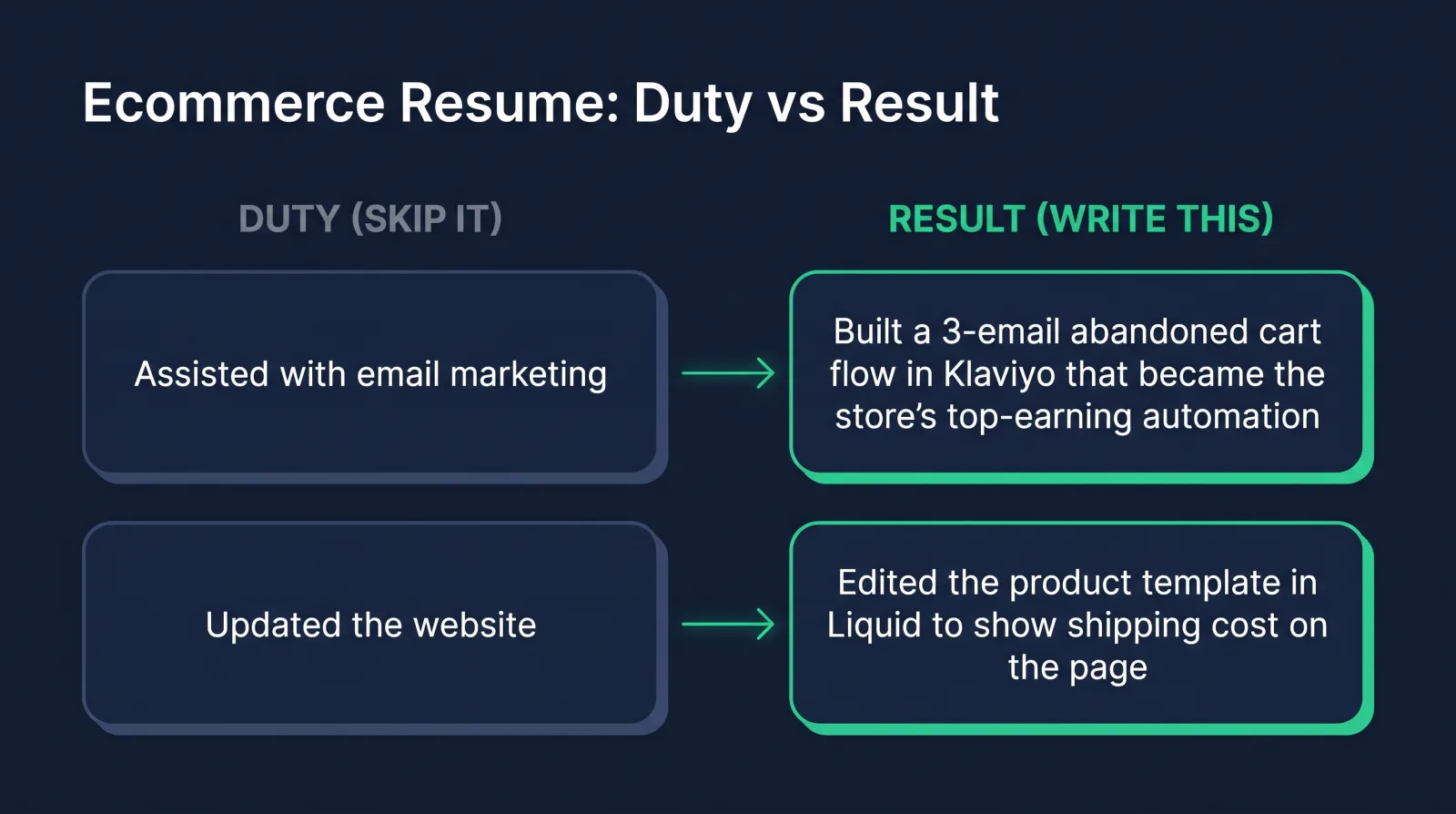
Here's the difference in practice. A duty says what you were responsible for. A result says what happened.
| Duty (skip it) | Result (write this) |
|---|---|
| Managed product listings | Rewrote titles and descriptions for 60 products and added size charts; returns for "wrong size" on those items dropped over the next two months |
| Assisted with email marketing | Built a 3-email abandoned cart flow in Klaviyo that became the store's top-earning automation |
| Updated the website | Edited the product template in Liquid to show shipping cost on the page, cutting support emails about shipping |
| Handled customer service | Answered 40+ tickets a day and turned the top 10 questions into an FAQ page that cut repeat tickets |
Those numbers are examples. Use your own, and only ones you can explain if someone asks how you measured them. If you don't have exact figures, an honest estimate with the method ("about 15 hours a month, based on the old manual process") is better than a vague claim.
If you have no job history in ecommerce yet, your bullets come from your practice store. "Built a Shopify development store with 25 products, a welcome flow and an abandoned cart flow, and customized the theme in Liquid." That's a real bullet. It's real work and it's honest about where it came from.
Example: ecommerce specialist resume
This layout fits someone with some store experience, paid or from projects, going for a specialist role. It's a layout, not a real person, so swap in your own details.
[Your Name]
[City, State] · [email] · [portfolio or store link] · [LinkedIn]

SUMMARY
Ecommerce specialist who runs Shopify stores: catalog, email flows,
theme edits in Liquid, and weekly reporting.

SKILLS
Platforms: Shopify, Amazon Seller Central
Email: Klaviyo, flows, segmentation
Analytics: Google Analytics, Shopify reports
Technical: HTML, CSS, Liquid

EXPERIENCE
Ecommerce Specialist, [Company], [Dates]
- [What you did] on [part of the store], [what changed in a number]
- [What you did] on [part of the store], [what changed in a number]
- [What you did] on [part of the store], [what changed in a number]

PROJECTS
[Store name], Shopify development store, [link]
- Custom theme sections in Liquid, abandoned cart flow, GA setup

EDUCATION AND TRAINING
[Course or career path], [Provider], [Year]
Notice where the link sits: right at the top, next to your email. That's on purpose.
Example: ecommerce coordinator or assistant resume
Coordinator and assistant roles are where a lot of people get their first ecommerce job. They care more about reliability and accuracy than about big revenue wins, so your bullets should show you keep things running.
Lead with organization. Bullets like "kept 300+ product listings accurate across Shopify and Amazon during a catalog migration" or "scheduled and QA'd weekly email campaigns with zero broken links" fit this role well. If you've done product uploads, order issues, or inventory updates, say how many and how often.
For what those jobs actually involve day to day, read my guides to the ecommerce coordinator and ecommerce assistant roles. Match your resume to the work they describe.
Example: career changer from retail or customer service
This is the one I care about most, because it's where a lot of our members start. You've worked a register, run a stockroom, or answered support tickets, and you're worried your resume reads like you don't belong.
You belong. You just have to translate.
Retail taught you merchandising, inventory, and what makes a customer buy or walk away. Customer service taught you returns, policies, and exactly which product descriptions confuse people. Those are ecommerce skills. Write them in ecommerce language.
Put a Projects section above your old jobs, with your practice store and what you built. Then compress the retail or service history into two or three bullets per job, picking only the parts that transfer:
- "Reset store displays weekly based on sales reports" (merchandising)
- "Managed stock counts and reorders for 400 SKUs" (inventory)
- "Resolved 30+ customer issues a shift, including returns and exchanges" (customer experience)
The online store manager guide is worth reading here too, because a lot of those roles sit at small shops that value retail experience.

Passing applicant tracking systems
Applicant tracking systems read your resume as text and match it against the job posting. To get through, use a single-column layout, standard section headings, real text rather than text inside images or graphics, and the same words for skills and tools that the posting uses.
A few specifics that trip people up:
- Columns and tables can scramble. A two-column design looks nice and can come out of the parser as a jumbled mess. One column is the safe choice.
- Fancy headings get missed. "Where I've Made Magic" might not be recognized as your experience section. Call it "Experience."
- Keywords need to match. If the posting says "Klaviyo" and "conversion rate optimization," use those exact words where they're true for you.
- File type matters. Send what the posting asks for. If it doesn't say, a simple PDF or Word file both usually work.
You can do all of that by hand. It's easier with a tool built for it, which is why the CodingPhase membership includes an ATS-ready résumé builder with clean single-column templates. It's part of Diamond, along with the Ecommerce Specialist path, portfolio templates, a job board, an 80,000+ member community, and two live calls a week: Accountability on Wednesdays at 7 PM ET and Money Talk on Sundays at 8 PM ET. Diamond lists at $60/month or $365/year and there's always at least 30% off, so about $42/month or about $255/year, with a 7-day money-back guarantee. You can see everything on the pricing page.
The store or portfolio link
The single most useful line on an ecommerce resume is a link to something you built. A live store, a development store with a password you include, or a short portfolio page with screenshots and a sentence on each project.
Everyone claims they can manage a Shopify store. A link lets the hiring manager check in 30 seconds, and once they've clicked around something you made, they're picturing you in the job.
Make sure the link works on a phone, because that's often where it gets opened first. Remove anything half-finished. And put it at the top of the page, not buried at the end.
If you don't have anything to link yet, that's your next step, not your résumé. The Ecommerce Specialist path is built so you finish with portfolio projects, starting with the store admin and ending with a custom Shopify theme you built yourself. If you're still choosing where to learn, I ranked the best ecommerce courses for getting hired. When the interviews start, my list of ecommerce interview questions will help you get ready.
Your resume gets you the click. Your store link gets you the interview.
FAQ
What skills should go on an ecommerce resume? Platforms you can run (Shopify, Amazon Seller Central, WooCommerce), email tools like Klaviyo, analytics like Google Analytics and Shopify reports, and any technical skills like HTML, CSS and Liquid. Match the wording of the posting, and only list what you can actually do.
How do you write an ecommerce resume with no experience? Build a practice store and make it your experience. Put a Projects section at the top with the store link and what you built, then translate past jobs into ecommerce language, like merchandising, inventory and customer experience. Honest project work beats a padded job history.
What metrics should an ecommerce resume include? The ones you actually moved: revenue, conversion rate, average order value, email revenue, repeat purchase rate, return rate, or hours saved. If you don't have exact figures, give an honest estimate and how you got it.
Should an ecommerce resume list Shopify? Yes, if you can use it. Shopify comes up in a lot of ecommerce job postings, and recruiters search for it. Be specific about what you can do in it, like admin and catalog work, theme editing, or Liquid.
How long should an ecommerce resume be? One page for most people starting out or changing careers. Two pages make sense once you have several years of ecommerce roles with results worth listing. Either way, the store or portfolio link should sit at the top.
If your resume feels thin right now, that's fine. It just means you're early, and early is fixable.
Start the Ecommerce Specialist path for free, build the store, and then come show us on a Wednesday Accountability call. We've been helping people make this switch since 2016, and we'd love to help you write the resume that gets you the interview.