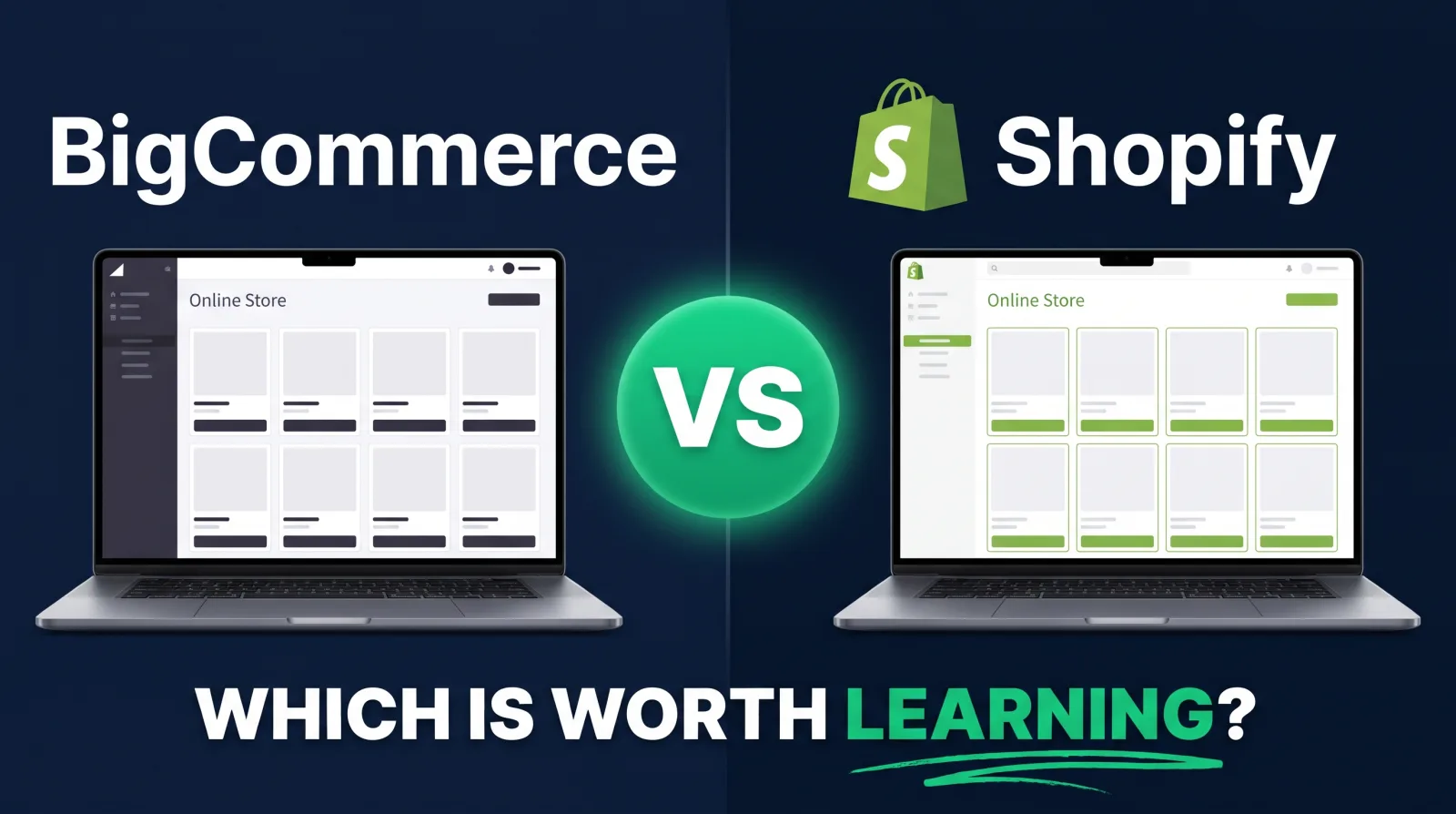
BigCommerce vs Shopify: Which Platform Is Worth Learning in 2026?
On this page
Open three BigCommerce vs Shopify articles and you'll probably read that BigCommerce charges no transaction fees.
Then go to BigCommerce's own pricing page, the way I did on November 9, 2026. There's a line called the Open Payment Provider fee: 2% of eligible order value on the Core plan, 1% on Growth and 0.6% on Scale, unless the order runs through one of its embedded payment providers. The old claim isn't completely wrong. It's just missing the part that costs money.
That's the trouble with this comparison. Most of what's written about it is aimed at someone picking a home for their store, and a lot of it hasn't been checked in a while. You might be asking something else entirely: if I'm going to spend my nights learning one of these, which one gets me hired? I'll cover both questions, because a store owner's decision is what creates the job you want.
Shopify vs BigCommerce: the short verdict
Learn Shopify first if your goal is an ecommerce job. W3Techs shows it on 32.6% of the ecommerce sites it detects, against 0.6% for BigCommerce. BigCommerce is a capable platform with real strengths for B2B and large catalogs, but it's a specialty you add later.
Those Shopify and BigCommerce shares are the figures W3Techs showed on November 9, 2026, and the survey only counts what it can detect, so read them as direction. Direction is plenty, though. The gap is around 50 to 1.
If you own a store, the answer's less lopsided, and the sections below will show you where BigCommerce earns its place. One naming note before we go on: BigCommerce's parent company became Commerce.com, Inc. in July 2025, and it trades under the ticker CMRC now. The product is still called BigCommerce, so don't let the name throw you if you see both.
Pricing and transaction fees
Shopify and BigCommerce start at the same $29 a month on annual billing, and both charge an extra fee when you skip their preferred payment setup. The biggest difference is that BigCommerce plans have annual sales caps that automatically push a growing store to a higher plan.
Here's what each vendor's pricing page listed on November 9, 2026. Plans change, so check before you quote these to a client.
| Tier, billed yearly | Shopify | BigCommerce |
|---|---|---|
| Entry | Basic, $29/mo, 2% outside fee | Core, $29/mo, 2% outside fee, $30K sales cap |
| Middle | Grow, $79/mo, 1% outside fee | Growth, $79/mo, 1% outside fee, $100K sales cap |
| Upper | Advanced, $299/mo, 0.6% outside fee | Scale, $299/mo, 0.6% outside fee, about $400K sales cap |
Look at how closely those line up. The plan prices and the outside fees match almost exactly, and Shopify's plans list no sales cap at all. That's a long way from the old pitch.
Card processing is close as well. Shopify's pricing page lists online card rates from 2.9% + 30¢ on Basic, 2.7% + 30¢ on Grow and 2.5% + 30¢ on Advanced, with no third-party transaction fee when you use Shopify Payments. BigCommerce says its processing rate begins at 2.89% + $0.29 across plans.
The sales cap is what you'd explain to a client. On BigCommerce Core, once trailing 12-month sales pass $30K, the plan upgrades to Growth. Pass $100K and it upgrades to Scale. BigCommerce measures this as gross order value minus 10%. So a store doing $150K a year sits on a $299 plan at BigCommerce, while on Shopify it could stay on Basic if the features fit. Above those tiers, Shopify Plus and BigCommerce Performance are enterprise contracts, and BigCommerce's page starts Performance at $1,499 a month.
Enterprise is where the sales conversation changes. Shopify pitches Plus at enterprise brands, and BigCommerce sells Performance as its enterprise tier. Enterprise buyers usually care more about contract terms, ERP integration and staff permissions than a $29 entry price, and an enterprise replatform almost always brings in an agency. That agency work is one reason it pays to know Shopify Plus by name, even if your first store is a small Shopify Basic shop.
For a job seeker, none of this needs memorizing. What you want is the habit of reading the fee table yourself. An ecommerce specialist who can walk into a meeting and say, "here's what this replatform really costs at our volume," is more useful than one who repeats a blog post.
Apps and theme ecosystems
Shopify has the larger ecosystem by a wide margin, with more than 21,000 apps by its own count, and that's why so many agencies and freelancers build on it. BigCommerce ships more features natively, so a store can need fewer apps, but there are fewer specialists around to help.
The 21,000+ figure comes from Shopify, so treat it as the vendor's number. BigCommerce's marketplace is much smaller. Whether that hurts depends on the store. BigCommerce has long pitched the idea of having more in the box, and fewer apps can mean fewer monthly subscriptions. On the Shopify side, you get more app choice and a bigger monthly app bill if you aren't careful.
The app side is a skill of its own. A typical Shopify store runs a review app, an email app like Klaviyo, maybe a subscription app and a loyalty app. Knowing how to choose a Shopify app, read its reviews, see what it does to page speed and remove it cleanly once the store stops getting value from it is everyday work. Bloated app lists are one of the first things I'd check on any Shopify store I took over.
For your skills, the theme layer matters more. Shopify themes use Liquid. BigCommerce's Stencil themes use Handlebars. If you want to do development work, Liquid is the one I'd spend time on, because it's tied to the much bigger pool of Shopify stores. This guide on how to become a Shopify developer lays out that route.
Headless is the other place they meet. Shopify has Hydrogen, and BigCommerce has Catalyst, a Next.js storefront. Both are real options, and both are more than a beginner needs. Get good at the normal theme first.
B2B and catalog size
BigCommerce is at its strongest for complex B2B selling, with B2B Edition offering company account hierarchies, quoting and price lists. Shopify now includes B2B on its Basic plan and up, with up to three active catalogs below Plus, which covers plenty of simpler wholesale stores.
This is the area where I'd take BigCommerce seriously. B2B Edition organizes buyers into companies with parent and child accounts, so a franchise or a global distributor can be modeled the way it actually buys. Quotes convert into orders. Credit limits can be set per company.
Shopify has closed a lot of this gap. Its help center says B2B works on Basic, Grow, Advanced and Plus, with net terms on all four, and the catalog limit goes away on Plus. If you read an older article saying wholesale needs Plus, it's out of date.
Catalog limits have shifted too. Shopify raised its variant limit to 2,048 per product, up from a long-standing 100, though it still allows only three options per product. A retailer selling furniture in dozens of fabrics and sizes used to be an easy argument for BigCommerce. It's a closer call now, and an industrial parts seller with heavy customer-specific pricing is the example I'd reach for instead.
One catch: BigCommerce's pricing page reserves price lists for its Performance plan, while customer groups start on Growth. Check which tier a B2B feature sits on before you promise it to anybody.
Checkout and payments
Both platforms offer a strong hosted checkout and accept the major payment methods. Shopify has Shop Pay, which many shoppers already use. BigCommerce drops its extra fee on orders that run through any of its embedded payment providers.
In practice, the rule to remember for each platform is short. On Shopify, the fee disappears when you use Shopify Payments. On BigCommerce, it disappears on embedded payment providers. Before you recommend either, find out which payment processor the client is locked into, since a merchant with negotiated rates or a high-risk category can't always switch.
Both vendors make loud claims about checkout conversion. Shopify's pricing page calls its checkout the "world's best-converting." I'd treat any vendor's own superlative as marketing and run the numbers on the actual store.
BigCommerce vs Shopify: which one has the jobs
Shopify has far more ecommerce jobs available because it powers far more stores, and every store needs someone to run merchandising, promotions, email and the theme. BigCommerce roles exist, often at mid-size B2B companies and agencies, but there are fewer of them to apply to.
I can't give you an honest job count, since job boards shift daily and repeat listings constantly. What I can do is reason from the installed base. With a gap of around 50 to 1 in the W3Techs figures, the number of companies needing Shopify skills is going to be much larger, and freelance work follows the same line.
Skills do transfer, which should calm you down a bit. Products, collections, promotions, shipping rules, tax settings, conversion rates and email flows work on the same logic on both platforms. Someone who's solid on Shopify can pick up a BigCommerce admin quickly, and the reverse is true. If you want a clear list of what companies hire for, this breakdown of ecommerce skills is a good place to look next. So is learning to read a store's ecommerce metrics, which are the same numbers on any platform.
Being fluent in both is a nice extra. Replatforming projects move stores from one to the other all the time, and somebody has to understand the old setup and the new one. If you get to that point, charge accordingly.

Which one is easier to learn
Shopify is easier for most beginners because the admin is straightforward and the amount of free tutorials, forum answers and developer documentation is huge. BigCommerce is learnable too, but its extra built-in options bring more settings, and you'll find less help when you get stuck.
When you're learning after work with an hour on the clock, how fast you get unstuck matters a lot. A question about a Shopify theme or a Shopify app will often have ten answers. A niche BigCommerce question might have one from a few years back.
Shopify and BigCommerce both offer free trials, so you can test this yourself. Spend an hour in each, add a product, build a collection or category, and create a discount code. You'll have an opinion by the end.
You might be thinking you should learn both to keep your options open. I wouldn't. Splitting your first few months between two admins usually means you can't talk confidently about either one in an interview. Go deep on one, build a real practice store, then branch out.
Pick Shopify if, pick BigCommerce if
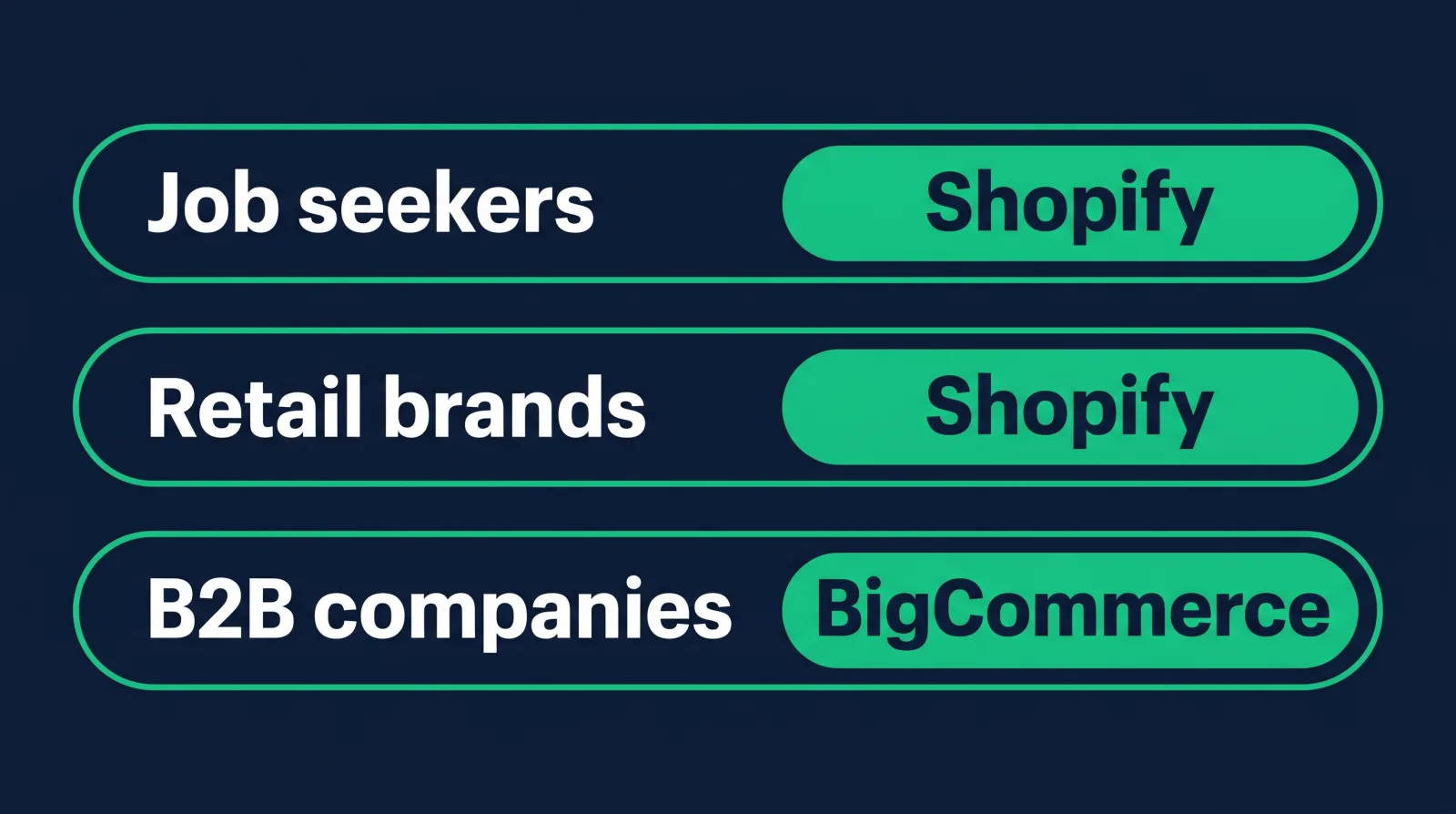
For most people reading this, the BigCommerce vs Shopify decision comes out as Shopify. Pick it if you're learning for a job or freelance clients, or you run a typical direct-to-consumer store. Pick BigCommerce if you run a complex wholesale operation or you've landed a role at a company already on it.
Pick Shopify if:
- You want the most job openings and freelance options for your effort
- You're a beginner and want plenty of help available
- You run a retail brand and want the biggest app selection
- You expect sales to grow quickly and don't want an automatic plan bump tied to revenue
Pick BigCommerce if:
- You sell to businesses with company hierarchies, quotes and customer-specific pricing
- You need multiple storefronts from one back end, and BigCommerce's setup fits
- You're already interviewing with, or working for, a company on the platform
- Your payment setup works better with its embedded providers
FAQ
Is BigCommerce cheaper than Shopify?
In a BigCommerce vs Shopify price check, the entry level comes out even, at $29 a month billed annually. The real cost difference comes from BigCommerce's sales caps, which can move a growing store to a pricier plan sooner, and from whichever apps each store ends up needing.
Which platform is better for B2B?
BigCommerce has the deeper toolkit for complex B2B, particularly company hierarchies and quoting. Shopify's B2B now reaches its lower plans and will cover many simpler wholesale stores, so look at what the business actually needs.
Is BigCommerce losing ground to Shopify?
On raw share, Shopify is far ahead, at 32.6% versus 0.6% of detected ecommerce sites in W3Techs' November 2026 figures. BigCommerce has been putting its weight behind B2B and larger merchants, and its parent company rebranded as Commerce.com in 2025.
Should I learn Shopify first?
Yes, if a job is the goal. The platform knowledge transfers, and more of the openings need it. Adding BigCommerce afterward is much easier than starting there.
Whichever way you came into this question, you're already thinking the way a good ecommerce hire thinks: reading the fee table and asking what the numbers mean for the business.
Our Ecommerce Specialist career path turns that instinct into a portfolio. It's a set order of courses you don't have to piece together yourself, and if you've never opened a store admin, My First Shopify Store Course is a friendly first step. If you'd like to compare options first, here's my ranking of the best ecommerce courses.
Diamond Membership lists at $60/month or $365/year with at least 30% off, always, which comes to about $42/month or $255/year. For that you get 90+ courses, guided career paths, portfolio templates, an ATS-ready résumé builder, a job board, and two live weekly calls: Accountability on Wednesdays at 7 PM ET and Money Talk on Sundays at 8 PM ET. Our students go after roles paying $75k+, individual results vary, and you're covered by a 7-day money-back guarantee.
There are 80,000+ people in the community who started right where you are. Come join us.