Best AI Automation Courses in 2026 (Ranked by What Actually Gets You Paid)

On this page
A guy DM'd me a screenshot last month. Two grand for an "AI Automation Masterclass," countdown timer, rented Lambo in the thumbnail, and a bonus module on "scaling to $30k/mo" from someone who, best I could tell, had opened Zapier for the first time in March. He wanted to know if it was worth it. He'd already paid.
I've watched this hype cycle land on web dev, then data science, then no-code. The pattern doesn't change much. The field is real and the money is real, and the loudest sellers are usually the emptiest ones.
This is how I'd actually learn AI automation, what each kind of course gets right and wrong, and where I'd send you if the goal is a paycheck rather than a certificate for your wall.
What a good AI automation course should actually teach
Before you spend a dollar, you need a filter. Most "courses" are a playlist of tool tutorials with a login page bolted on the front, which is a very different product from being able to sit on a client call and solve their problem in real time.
You should be building live automations in week one. If a course spends its first three modules explaining what AI is and where the future of work is heading, close the tab. That's a hype product wearing a curriculum.
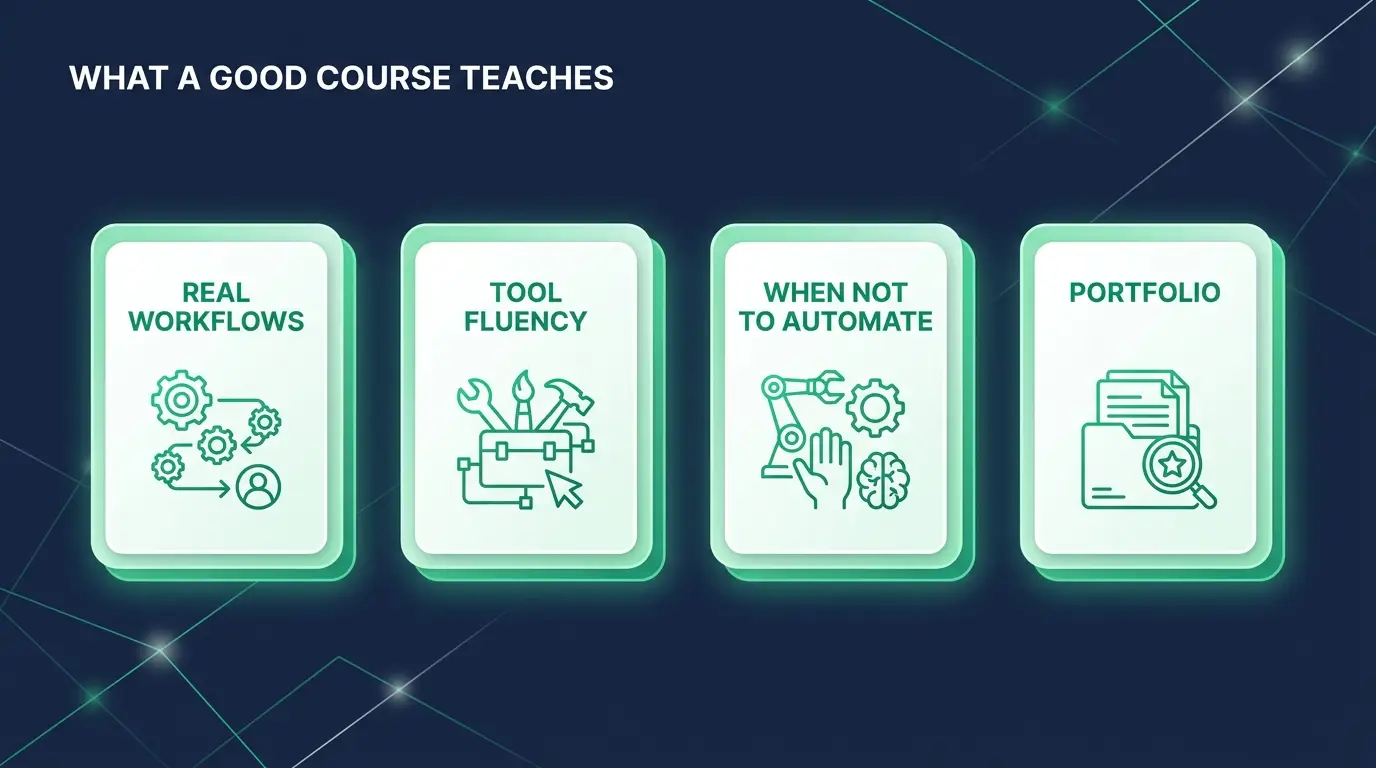
Business-process thinking. The tools are the easy part. The hard part is looking at how a business actually runs and spotting the five manual steps quietly eating twenty hours a week. A good course teaches you to map a process before you automate it, because automating a broken process just breaks it faster.
Tool fluency, not tribal loyalty. Zapier, Make, n8n. You want comfort in all of them, because each one wins in different situations and no client has ever cared about your favorite. If you're weighing them, I broke the two biggest down in Zapier vs Make, and a fuller lineup lives in my best AI automation tools roundup.
Then there's the one nobody advertises: knowing when not to automate. Sometimes the honest answer is that a human should keep doing this, or that it happens four times a year and doesn't justify the build. An instructor who teaches you to say that out loud is thinking about your reputation instead of their feature count.
The last thing you want on your way out is proof. Builds you can show, with numbers attached. "I built a lead-routing flow that cut response time from four hours to four minutes" does more for you than any certificate ever will, and if the course doesn't leave you holding that sentence, it didn't do its job. Same goes for judgment about where AI belongs in a workflow, and where a human still needs to read the output before it goes to a customer. Automation that hallucinates on a client email costs more than the labor it saved.
Hit most of that and it's worth your time. Mostly vibes and screen recordings? Keep your money.
The types of courses out there (and the honest tradeoffs)
Three categories are competing for your wallet. All three have a real place, and all three have a catch.
Free and platform academies. Zapier University, Make Academy, n8n's docs and community, plus a mountain of YouTube. These are genuinely good and they cost nothing. If you learn well on your own and mostly want to poke around, start here. You can get further than people expect without paying anyone a cent.
The catch is structure. Platform academies teach their tool, not the career, and YouTube is scattered by design, so there's no path from "I opened Zapier" to "I got paid to do this." You learn features fast and business context slowly, and you never quite know whether you're job-ready or just busy. Free costs you nothing but time, and time tends to be the expensive part.
Expensive standalone masterclasses. The $1,000 to $2,000 "become an AI automation agency owner in 30 days" products. Some of these are legitimately good, and I want to be fair here: there are real practitioners teaching real work at that price. Many others are one creator's funnel, priced high so it feels premium, taught by somebody whose actual income comes from selling the course about the business rather than doing the business. You're betting a lot of money on one person's curriculum, one point of view, one tool stack that might be stale in six months. When it's one instructor's world, you inherit their blind spots too. And that price buys a single subject.
Structured career programs. These treat automation as a career track instead of a weekend workshop: a sequenced path, projects, portfolio work, and ideally the surrounding stuff that actually gets you hired, like a résumé, a community, a job board. The good ones ask you to commit to a process rather than promising an overnight result, which is a harder sell and usually a better deal. The bad ones are expensive masterclasses wearing a nicer outfit, so read the curriculum before you read the sales page.
Short version: free is great for exploring, masterclasses are a bet on one person, structured programs win when your goal is income and you'd rather not stitch the path together yourself.

My pick for getting hired or paid: CodingPhase's AI Automation path
My bias here is total and I'm not going to pretend otherwise. I built CodingPhase, so obviously I'm about to recommend our AI Automation path. Check it against the filter above instead of taking my word for it.
It's project-first. You build the automations rather than watch me talk about building them, and the whole path is shaped around that portfolio-with-numbers idea, because that's the thing that convinces a hiring manager or a client with a budget. You also get the tool fluency plus the business-process thinking and the "don't automate this" calls, which is the part the cheap playlists skip entirely.
Then the value math, which is really why I'd point you here. The AI Automation path isn't sold as a standalone product. It's part of an all-access membership at $42/month or $255/year, with a 7-day money-back guarantee, so you're also getting the other 90+ courses. That matters more than it sounds. When a client needs a landing page built or an API touched, you go learn it that week instead of turning the work down. You get portfolio templates for every path, an ATS-ready résumé builder, a job board, and an 80,000+ member community to get unstuck in at 11pm.
Compare it honestly. A masterclass is $1,000 to $2,000 for one subject from one person. A year of CodingPhase is $255 for the automation path plus the machinery that turns skills into a paycheck. If lifetime access is what you want, the Tech Accelerator is a one-time $1,500 with live weekly mentorship, but for most people starting out the yearly membership is the obvious call.
The tradeoff I'll own: it's self-paced. There's a community, and there's mentorship on the higher tier, but nobody's standing over your shoulder every morning at 7am asking why you skipped Tuesday. If you need that pressure to show up, you'll have to build it yourself, and some people genuinely can't. That's a real reason to pay for a cohort program instead, and I'd rather say so than pretend the format fits everyone.
Here's the line I'd hang the whole decision on: a good course should pay for itself with your first automation, not cost more than your first client. Judge every option here by that.
How to choose the one for you
There's no single right answer. There's a right answer for you, and it depends on what you're actually trying to do.
If you're just poking around, start free. Zapier University, Make Academy, n8n's community, YouTube. Give it two weeks building tiny automations for your own life, the kind that move an email into a spreadsheet. If it clicks, you've lost nothing and learned whether this is your thing.
If you want a job or freelance income, stop stitching free videos together and get a structured path. Free can absolutely teach you the tools. What it won't hand you is a portfolio, a résumé that survives ATS screening, a community, and a job board. A membership like CodingPhase's at $255 a year does, for a fraction of a masterclass. For the career side, I'd also read how to become an AI automation specialist and the real numbers in the AI automation salary guide.
If you've got money to burn and you love one specific creator, buy the masterclass. Go in knowing you're paying a premium for one worldview, and check that it teaches you to do the work rather than to sell the same course to the next guy.

FAQ
Is AI automation a good career? Yes, and I don't hand that out to every hyped field. Businesses everywhere are bleeding hours on manual, repetitive work, and very few people can map a process and automate it well. That gap is the opportunity. I wrote a fuller take in is AI automation a good career, and there are remote AI automation jobs posted every week.
Can you make money with AI automation? Two ways. Get hired into a role building internal automations, or freelance and charge businesses to save them time. Most people start freelance, because you can land a small build for a local business long before you'd pass a formal interview. Your income tracks your results, not your certificate.
Do I need to know how to code to learn AI automation? No, and that's the appeal. Zapier and Make are visual, and you can build serious workflows without writing a line. A little code goes a long way once you hit n8n or custom API steps, though, which is exactly why sitting inside a membership with 90+ courses helps. You hit the wall, the next lesson is right there.
Are free AI automation courses good enough to get a job? They'll teach you the tools, genuinely. What they can't do is hand you a portfolio, a résumé built to pass ATS screening, a community, and a job board. That surrounding structure is usually what separates "I know the tools" from "I got hired," and it's the main reason to pay for a structured path.
How long does it take to learn AI automation? You can build something useful in your first week. Getting good enough to charge for it is more like a few focused months, and it depends on how much time you actually put in and whether you're building real projects or just watching someone else build them.
The field is real and the money is real. What's usually standing between you and your first paid automation is a clear path, plus the discipline to build things instead of watching videos about building things.
If you're ready to stop shopping and start building, start the AI Automation path and see if it clicks. When it does, join the whole thing at our pricing page for less than most people drop on a single masterclass. Either way, go build something this week. That first automation is closer than you think, and I'd genuinely love to see what you make.