Shopify Developer Jobs: Who's Hiring, What They Pay, and How to Get One
On this page
Shopify work splits into four completely different job markets, and most people applying don't know which one they're in.
An agency wants speed across many client stores. A brand wants someone who understands their business. An app company wants a real software engineer. A freelance client wants their theme fixed by Thursday for $400.
Same platform, four different hiring bars, four different pay curves. Aim at the wrong one and you'll conclude the market is saturated when you were simply standing in the wrong queue.

Market one: agencies
The biggest employer of Shopify developers, and where most people start.
You'll work on several client stores at once, mostly theme development, custom sections, app integrations, and migrations. The pace is high and the variety is enormous, which is exactly why it's the fastest education available. In one year at a busy agency you'll see more edge cases than in three years at a single brand.
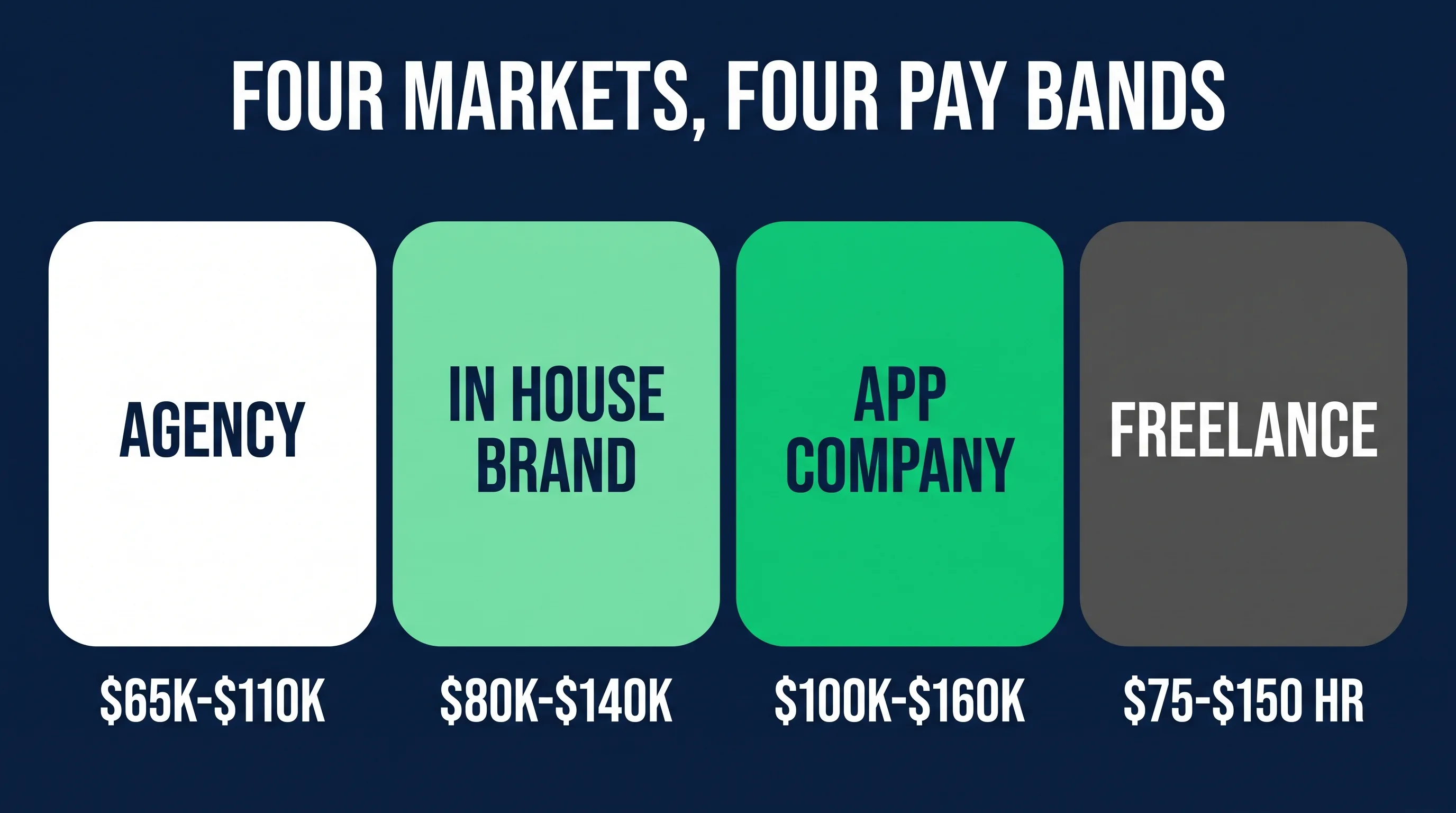
Pay: $65k to $110k in the US depending on experience and how much custom work you handle beyond themes.
What they screen for: speed and reliability. Can you take a Figma file and ship a working theme section that doesn't break the cart. Portfolio matters more than credentials, and they will look at your code.
The catch: billable hours, client deadlines that were set by a salesperson, and occasional stretches of doing the same thing repeatedly.
Market two: in-house at a brand
One store, yours, and you'll know it deeply.
The work is different from agency life. Less greenfield building, more maintenance, optimization, and integration with the systems the business runs on: ERP, warehouse, subscriptions, loyalty. You'll also sit close to the people making commercial decisions, which some developers love and others find slow.
Pay: $80k to $140k, with the top end at larger brands running Shopify Plus.
What they screen for: whether you understand ecommerce, not just code. A developer who asks about conversion, average order value, and Q4 readiness stands out immediately, because most candidates only talk about the technical work. That commercial fluency is the whole argument in ecommerce developer vs ecommerce specialist.
The catch: you're one person supporting a business that never stops. Peak season is intense and you're on call in practice if not on paper.
Market three: app and product companies
Companies that build Shopify apps hire actual software engineers who happen to work in the Shopify ecosystem.
This is the most technical market. Remix or Node, the GraphQL Admin API, webhooks, billing, App Store review, multi-tenant architecture, performance at scale. It's product engineering, not theme work.
Pay: $100k to $160k and beyond, the highest of the four markets, often fully remote.
What they screen for: software engineering fundamentals. Expect a technical interview closer to a normal developer hiring process.
The catch: the bar is genuinely higher and theme experience alone will not get you in. This is the market to grow into rather than start in.
Market four: freelance and contract
The most accessible and the most crowded, because it competes globally on price.
The bottom of this market is a race to the floor. Theme tweaks for $30, "fix my cart" jobs, and clients who want a full store for $500. Skip it if you can.
The top of it is genuinely good: retainer work with a handful of brands, custom app builds, and performance or conversion projects charged on value rather than hours. Experienced Shopify freelancers charge $75 to $150 an hour, and the ones who specialize, in subscriptions or headless builds or Plus migrations, charge more.
How to get from the bottom to the top: niche down and go where the price competition isn't. "I build subscription flows for supplement brands" beats "Shopify developer" by an enormous margin.
What actually gets you hired in all four
A store you built, live and public. Not a screenshot, a URL. If you have no client work yet, build a full store for a fictional brand and make it genuinely good: custom sections, a real product catalog, fast on mobile, and a checkout that works.
Code someone can read. A GitHub repo with a custom theme or a small app in it. Agencies especially will look, and most applicants have nothing to show.
Evidence you understand performance. Page speed is a permanent problem on Shopify because merchants install apps like they're free. A before-and-after with real numbers is an interview-winning artifact.
One deep specialty. Checkout extensibility, subscriptions, headless with Hydrogen, migrations from Magento or WooCommerce. Any of these makes you the person they call instead of one of many.
The full build order for that portfolio is in how to become a Shopify developer, and there's a set of concrete project ideas in Shopify developer portfolio examples.

Where to actually look
Shopify's own partner and job listings, the big boards under multiple titles, and, more usefully, the careers pages of agencies. There are hundreds of Shopify agencies and most of them hire directly and continuously.
Search all the title variants, because postings are inconsistent: Shopify developer, Shopify engineer, ecommerce developer, front-end developer with Shopify in the description, Shopify theme developer, and Liquid developer. The ecommerce jobs guide maps how these sit alongside the non-developer roles.
Remote is the norm rather than the exception in this market, especially at agencies and app companies. Remote Shopify developer jobs goes deeper on finding those specifically.
The honest state of this market
I'm not going to tell you it's wide open, because the entry level is crowded. Theme edits are the most commoditized work in ecommerce and the global freelance market has driven that price to the floor.
What is genuinely open is everything above that line. Developers who can build custom apps, work confidently with the API, handle Plus and checkout extensibility, or fix performance properly are in demand and hard to find. Agencies complain constantly that they can't hire them.
So the plan is not "learn Shopify." The plan is learn Shopify, then keep going for another six months into the part where most people stop. That's where the jobs that pay $110k and up are sitting.
FAQ
Are Shopify developer jobs in demand? Yes, above the theme-editing level. Entry-level theme work is crowded and competes globally on price. Custom app development, Plus and checkout work, and performance specialists are genuinely scarce.
How much do Shopify developers make? Roughly $65k to $110k at agencies, $80k to $140k in-house at brands, and $100k to $160k plus at app companies. Freelance rates run $75 to $150 an hour for experienced developers. Full breakdown in the salary guide.
Do I need a degree? No. This market hires on portfolio and code almost exclusively.
How long does it take to become employable? Six to twelve months of serious building from zero, faster if you already know HTML, CSS, and JavaScript. Liquid itself is not hard; the ecosystem knowledge takes the time.
Are Shopify developer jobs remote? Very often, particularly at agencies and app companies. In-house brand roles are more likely to be hybrid.
Should I learn Shopify or general web development? Shopify is the narrower bet with less competition and faster time to income. General web development is broader and far more crowded at the junior end. The tradeoffs are compared in Shopify developer vs web developer.
If you're at the theme-editing stage and getting nowhere, the problem probably isn't the market. It's that you're competing in the one part of it where everyone else is standing.
Pick one hard thing, build it twice, and put it somewhere public. Custom app, subscription flow, a genuinely fast store. That's the whole difference between the queue you're in now and the one where people get called back.