PHP Developer Interview Questions (What Juniors Actually Get Asked)
On this page
A student called me last spring, two days out from his first PHP interview, and told me he'd been grinding LeetCode for three weeks. Three weeks. I asked him one question: how do you stop a SQL injection? Long pause. He said he'd "sanitize the input, probably."
That's the whole problem in one phone call. Junior PHP interviews are won on fundamentals and Laravel habits, and almost everybody preps for the puzzle round that isn't coming.
I've sat on both sides of that table. I've watched candidates who could invert a binary tree freeze on the injection question, and I've hired people who couldn't do either puzzle but walked me through a request from route to database like they'd lived there.
The hiring manager at a PHP shop isn't wondering if you can pass a Google interview. They're wondering if you'll break production in month two. Every question below exists to answer that one fear.
If you're still earlier in the journey, start with how to become a PHP developer and come back when interviews are on the calendar.
What junior PHP interviews actually test
Can you explain your own code? Not recite definitions. Explain a thing you built, out loud, to another human who is going to interrupt you.
Do you have safe habits? Prepared statements, validation, escaping what you print. Nobody expects a junior to architect a system, everybody expects you not to paste user input into a query.
And will you be honest when you don't know? Interviewers push until you hit your edge on purpose. They grade what you do when you get there.
A junior interview is a preview of what you'll sound like on the team. That's it. That's the whole thing.
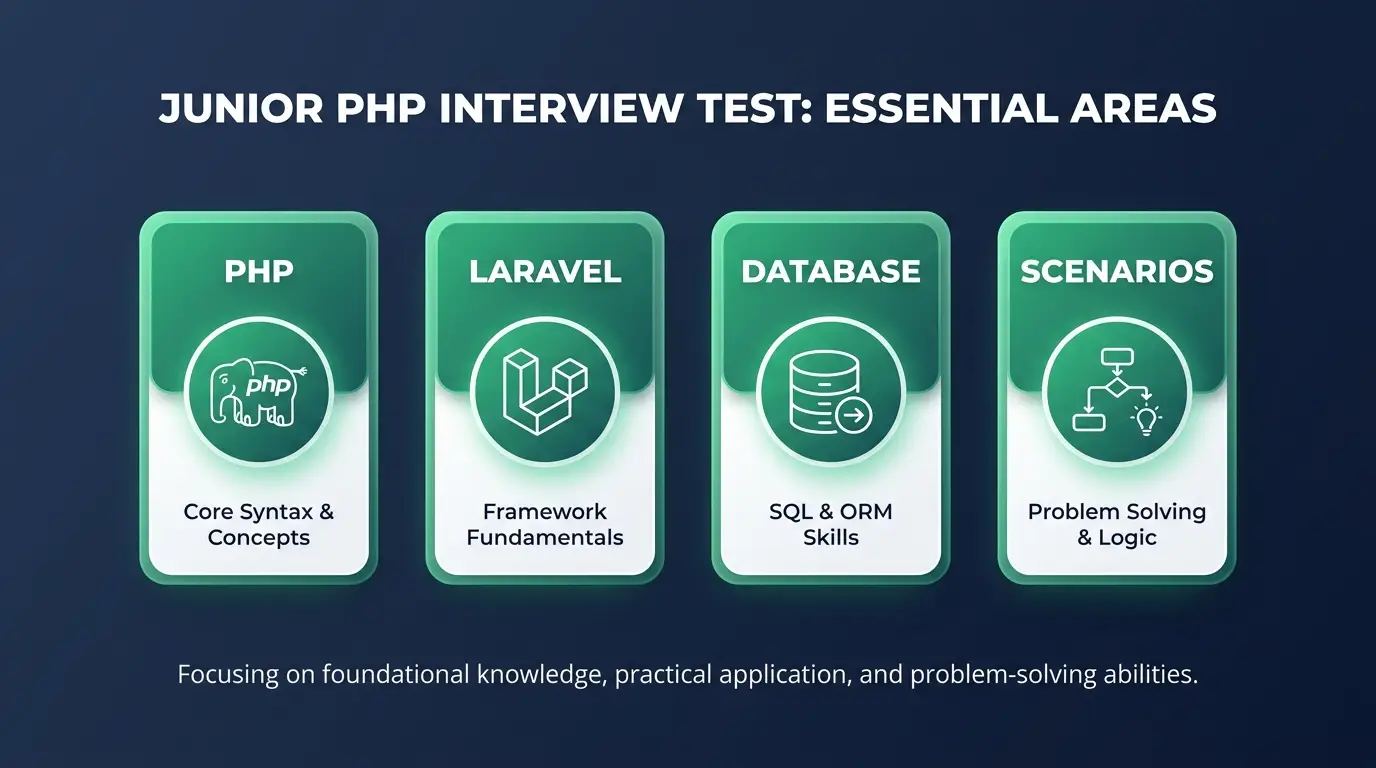
PHP fundamentals questions
Expect most of these in some form.
What's the difference between == and ===? Double equals compares values after type juggling. Triple equals compares value and type, no conversion. Default to ===, treat == as a code smell, and if you've ever watched 0 == "abc" quietly wreck a login check in old PHP, say so, because that's the answer of someone who got bitten instead of someone who read a blog post.
How do you prevent SQL injection? Prepared statements. With PDO you bind parameters, which means user input travels to the database as data and never gets interpolated into the query string. Escaping by hand is not a strategy. I've seen this one question end interviews at the eight-minute mark, so if you memorize nothing else here, memorize this.
What is XSS and how do you prevent it? Cross-site scripting is when user-supplied content gets rendered as live HTML or JavaScript in someone else's browser. So a comment field that accepts <script> and prints it raw becomes an account-stealer for every visitor who loads the page. The fix is escaping output: htmlspecialchars() in raw PHP, or Blade's {{ }}, which escapes for you. What they're listening for is output escaping. Juniors who only talk about cleaning input are thinking about it backwards.
Sessions vs cookies? Cookies live in the browser, so the user can read them and mess with them. Sessions live on the server and the cookie only carries the session ID. Sensitive state goes in the session. This one is really a question about whether you know where data physically lives, which is the root of half of web security.
require vs include? require throws a fatal error if the file is missing. include warns and keeps going. If the file matters, require it. Two sentences, move on.
Also be ready for which array functions you actually reach for (array_map, array_filter, in_array, array_column if you want to sound like you've done real work), how try/catch works, and when you'd throw your own exception rather than return false and hope somebody checks it. And Composer. The working-level answer on Composer: it installs dependencies from composer.json and generates an autoloader, so your classes load by namespace instead of a wall of require statements at the top of every file.
Laravel interview questions
If the job listing says Laravel, half your interview lives here. (If you're weighing frameworks at all, my honest rundown is in best PHP frameworks, but for jobs, Laravel is the market.)
What is a migration and why use one? Version control for your database schema, written as PHP. Every teammate and every server runs the same schema changes in the same order, and you can roll back when it goes sideways. "I edited the table in phpMyAdmin" is the answer of someone who has never worked on a team.
Explain Eloquent relationships and the N+1 problem. This is the one I'd spend real prep time on, because it's the fastest way to separate people who've used Laravel from people who've watched Laravel on YouTube.
Start simple. A User hasMany Post, a Post belongsTo User. Fine.
Now you loop over 100 posts on the index page and print each author's name. Eloquent is lazy, so it fetches the posts in one query and then goes back to the database once per post for the author. That's 101 queries to render one page. Locally, with twelve seeded rows, you will never notice. In production, with real traffic, it's the reason the page takes four seconds and nobody can tell you why.
Post::with('user') makes it two queries. That's it. That's the fix, and it's called eager loading, so say those words out loud, because that's the phrase the interviewer is waiting to hear. If you can also mention that you spotted it in Debugbar or the query log rather than by reading the code, you've just answered the "can you debug" question without being asked.
What is middleware? Code that runs before or after a request hits your controller: auth checks, CORS, logging, rate limiting. Describe it as layers the request passes through on the way in and back out. That framing shows you understand the request lifecycle, which is what they're actually probing.
How does validation work? Inline $request->validate() for quick cases, Form Request classes when the rules get long or get reused. Failures redirect back with the errors automatically. Bonus points if you say validation is protecting the database, not the form.
Queues, and when do you use them? Anything slow the user shouldn't sit and wait on. Sending email, processing an upload, calling some third-party API that might take six seconds on a bad day. Dispatch a job, return the response fast, let a worker handle it. It signals you think about what the app feels like under load.
Also expect route model binding (Laravel resolves /posts/{post} into a Post model, or 404s for you), Blade views vs JSON API responses and when each one fits, and why .env values get read through config() instead of env() in your app code. That last one has a real answer: config:cache in production freezes the config and skips the env file entirely, so a stray env() call comes back null on the server and works perfectly on your laptop.
Database and practical questions
What's an index and when does a query need one? An index lets the database find rows without scanning the whole table. Any column you regularly filter, join, or sort on is a candidate, and WHERE email = ? on a million-row users table is the textbook case. Then say the tradeoff out loud: indexes slow down writes and take space, so you don't just carpet the table with them. That sentence is what makes a junior answer sound senior.
Explain JOIN types conversationally. INNER JOIN gives you rows that match in both tables. LEFT JOIN gives you everything from the left table, with nulls where there's no match on the right. That's 95% of daily work. Don't panic about the exotic ones.
They'll probably also ask how you'd debug a slow endpoint, and the winning answer is a process, not a guess: reproduce it, open the query log or Debugbar, look for N+1s or a missing index, then measure again after the fix so you know you actually fixed it.
Scenario questions
These are where offers get decided.
"Users report the app is slow every day around noon, where do you look?"
Start with data, not code. Server metrics and logs at that hour, first. Noon spikes usually mean either a traffic peak or a scheduled job sitting on the database, so I'd pull the cron schedule, check the slow query log, and find out whether somebody's daily report or email blast fires at 12:00. The interviewer does not need you to name the right culprit. They need to watch you investigate instead of guess.
"A teammate pushed a migration that dropped a column in production. What now?"
Stop the bleeding first. Is data actually gone, or just the column definition? Is there a backup, and when did it last run? Restore from the most recent one, tell people loudly and early instead of quietly trying to fix it in the dark, and don't spend a single second on whose fault it was. Then fix the system that allowed it: a staging environment that mirrors prod, review required on migrations, backups you've actually tested by restoring one.
They're testing your temperament under fire more than your SQL.
Also floating around: "a feature works locally but not in production" (environment config and caching, almost always), and "how would you add a feature to a codebase you've never seen" (read the routes file, trace one request through it).
Questions YOU should ask them
Asking nothing reads as not caring. Ask:
- "What does code review look like here?" Tells you if you'll get mentorship or be alone in a room with a legacy codebase.
- "What's the deploy process?" One-command deploys vs FTP-and-pray tells you everything about the codebase you're inheriting.
- "What would my first two weeks look like?" Companies that can answer have onboarding. Companies that can't, don't.
- "How do juniors here grow into mid-level?" Signals ambition, and it helps you later when you negotiate. Know your numbers from the PHP developer salary guide before that conversation.
- "Is the team remote, hybrid, or in-office day to day?" If you're hunting remote PHP developer jobs, you want the real answer, not the listing's.

How to prepare in the week before
Skip the puzzle grind. One deployed Laravel app you can walk through end to end beats fifty solved algorithm problems, because it turns every question above into a story you lived instead of a definition you memorized.
Rehearse explaining one feature out loud: route, controller, model, view. Literally say it to a wall, and notice how bad you are at it the first time. That's the point. The first time you narrate your own code should not be in the interview. If you don't have a project worth walking through yet, steal a shape from these PHP portfolio examples and ship a small one this week.
Then reread your own résumé, because everything on it is fair game and people forget that. Our members run theirs through the CodingPhase résumé builder to get past ATS screening, then pull real openings from the job board so their prep matches listings that actually exist.
The honest part: you can't prep for everything. Every interviewer has a pet question, and some of them will ask you about something you've never touched. That's fine. "I haven't used that, but here's how I'd figure it out" has gotten more of my students hired than a bluffed answer ever has.
FAQ
Do PHP interviews include live coding? Sometimes, but for juniors it's usually small and practical: a FizzBuzz-level exercise, a bug hunt, or a take-home CRUD feature. Full whiteboard algorithm rounds are rare outside big tech.
How many interview rounds do junior PHP jobs have? Usually two or three: a screen, a technical conversation, and a culture or founder chat. Small agencies sometimes do it all in one call.
Do I need to know Laravel for a PHP interview? For most PHP jobs in 2026, yes, at a working level. Plain-PHP-only shops still exist, but Laravel is the default assumption in job listings.
What should I say when I don't know an answer? Say so, then reason out loud about how you'd find out. Interviewers grade the recovery, not the gap.
How long should I prepare for a PHP interview? If you've built and deployed real projects, one focused week reviewing the topics above is plenty. If you haven't built anything, no amount of question-memorizing is going to cover for it.
If you're staring down your first PHP interview, remember you're talking to a future teammate, not a judge. Walk in with one project you know cold and honest answers for the rest, and you're already ahead of most of the room. And if you want the full roadmap with courses, projects, and people who've done this before you, that's what the PHP developer career path is for. I'm rooting for you.