Email Marketing Skills Companies Actually Pay For

On this page
Pull up ten email marketing job posts and read just the requirements. Not the company blurb, not the perks. The requirements.
The email marketing skills they ask for follow a pattern you'll spot fast. Hardly anyone asks for passion for storytelling. They ask for experience building automated flows in a platform like Klaviyo, for someone comfortable editing HTML templates, for a person who owns list health and deliverability and can report on the revenue email brought in.
That's a very different list from the one most career guides hand you.
Most articles about email marketing skills read like a general marketing syllabus: creativity, communication, analytics, "a data-driven mindset." None of that is wrong. It just doesn't separate the person who gets the offer from everyone else in the pile.
Here are the email marketing skills companies actually pay for, roughly from foundation to the paid edge, and how I'd learn each one well enough to prove it.
The email marketing skills that get people hired
The skills an email marketer needs are segmentation, automation and lifecycle flows, copywriting and subject lines, HTML email basics, deliverability, and testing and reporting. Working well with design, ecommerce and sales teams ties it together.
Two of those are where most candidates fall short. HTML email and deliverability are technical, they don't fit neatly into a marketing degree, and they're exactly what breaks when nobody on the team understands them. If you're good at those two, you stand out.
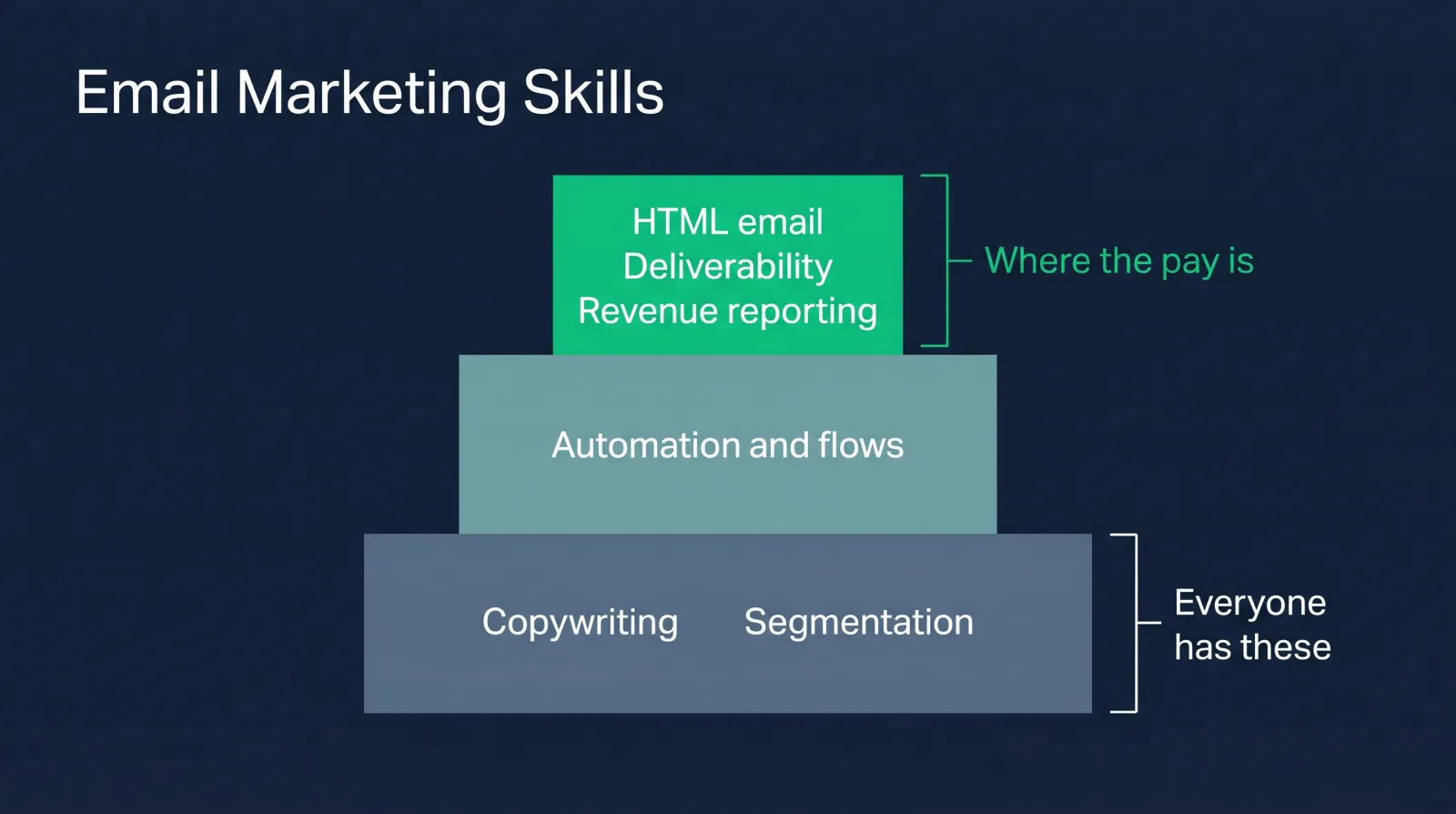
The rest are the foundation. You need them, and so does everyone you're competing with. Think of it like a pyramid: copy and segmentation at the bottom, automation in the middle, and HTML, deliverability and revenue reporting at the top where the pay is.
Segmentation and list strategy
Segmentation means splitting your list into groups based on behavior, purchase history or profile data, so each group gets email that fits. It's the single biggest lever on relevance, and relevance is what drives opens, clicks and sales.
Sending one email to everyone is how you train a list to ignore you.
A good email marketer thinks in segments by default. People who bought in the last 30 days. People who've opened but never bought. VIPs who've ordered three or more times. Subscribers who haven't opened in four months. Each one needs a different message, and some shouldn't get this week's campaign at all.
Every platform has a segment builder, so knowing that segments exist won't impress anyone. What gets you hired is picking the segments that matter for this business, and being willing to send to fewer people to make more money.
Automation and lifecycle flows
Automation is building emails that send themselves when something happens: a signup, an abandoned cart, a first purchase, a long silence. Lifecycle marketing is planning those flows across the whole customer relationship, from first visit to repeat buyer.
For a lot of companies, especially ecommerce stores, automated flows bring in a big share of email revenue, because they reach people at the moment they're most likely to act.
You should be able to sketch the core flows from memory: welcome series, abandoned cart, browse abandonment, post-purchase, winback and sunset. More importantly, you should be able to explain the timing and the logic. Why does the abandoned cart email wait a few hours? Who exits the welcome series after they buy?
I wrote a full breakdown of the Klaviyo flows every store needs with the build steps. Even if your future employer uses a different platform, the logic transfers.
Copy and subject lines that get opened
Email copywriting is writing subject lines, preview text and body copy that get opened, read and clicked. It's shorter and more direct than most marketing writing, and it has to work in a crowded inbox on a phone screen.
Good email copy sounds like one person writing to another. It gets to the point in the first line. It has one clear thing for the reader to do.
The subject line and preview text work as a pair. A lot of people write the subject line and leave the preview text empty, so the inbox shows "View this email in your browser" instead. That's a free line of persuasion, wasted.
To practice, rewrite emails you get. Take a promo from a brand you like, write three alternative subject lines, and say which you'd test and why. That exercise belongs in a portfolio.
HTML email basics (the skill most marketers don't have)
HTML email is the code behind every designed email. It's built with older techniques than websites, like tables and inline styles, because email clients such as Outlook render code inconsistently. Knowing the basics means you can fix a broken template yourself.
Of all the email marketing skills here, this is the one I'd push you toward hardest, and it's the reason our email career path starts where it does.
Here's what happens on a lot of teams. A campaign goes out. On Gmail it looks great. In Outlook on Windows, the columns collapse, the button turns into a blue link, and the hero image is cut in half. Nobody on the marketing team can tell why. They file a ticket with a developer, or an agency, and wait.
If you can open the HTML and fix it, you're suddenly the most useful person in that meeting, even if you're the newest one there.
You don't need to be a software engineer. You need to understand tables for layout, inline CSS, how images behave when they're blocked, bulletproof buttons, and how to test across clients. That's learnable. Our email marketing course built for technical learners goes through it step by step.

Deliverability: getting to the inbox at all
Deliverability is the skill of getting email into the inbox instead of spam. It covers sender authentication (SPF, DKIM and DMARC), list hygiene, sending reputation and engagement. If deliverability fails, nothing else in the program matters.
It's the least glamorous of the email marketing skills and invisible when it works, which is why it's undervalued until something goes wrong.
Gmail and Yahoo now require bulk senders to authenticate their email and make unsubscribing easy, and they watch spam complaint rates. A company that ignores this can see open rates sink with no obvious cause.
An email marketer who understands deliverability can spot the warning signs (opens dropping on one provider, a spike in bounces) and fix the causes: authenticate the domain properly, suppress people who haven't engaged in months, slow down a sudden jump in volume. If you can explain the difference between SPF and DKIM to a hiring manager in plain English, you're ahead of a lot of applicants.
Testing, metrics and reporting revenue
Testing means running A/B tests on subject lines, content, offers and timing to learn what works. Reporting means connecting email to revenue as well as opens and clicks, so the business can see what the program earns.
Open rates got less reliable after Apple's Mail Privacy Protection, which preloads images and can count an open that never happened. That pushed good email marketers toward clicks, conversions and revenue per recipient.
The reporting skill employers want is simple to describe and harder to do. Can you tell your boss what email made last month, which flows earned it, and what you're going to change? That's the conversation that gets an email marketer a raise.
Practice by setting up a test with one clear variable, write down what result would change your mind before it runs, then report it in three sentences a busy manager would actually read.
Soft skills: working with design, ecommerce and sales
Email sits between several teams, so the softer email marketing skills are about working across them: briefing designers clearly, aligning with ecommerce on launches and inventory, and giving sales or product teams what they need without breaking the calendar.
You'll hear "can we just add one more email this week?" a lot. Part of the job is saying no nicely, with a reason.
You'll also be the person who notices that the campaign promoting a product is going out the same day it sells out. Or that the designer's beautiful mockup will break in Outlook. Speaking up early, kindly and with a fix, is a skill that gets noticed.
How to learn these skills and prove them in a portfolio
The best way to learn email marketing skills is to practice each one on real tools and save the work as portfolio pieces: coded templates, a flow map with timing, a segmentation plan and a short test write-up. Hiring managers want proof more than they want a list.
A portfolio for an email marketer doesn't need to be huge. Four or five pieces is plenty:
- A coded email template that works on desktop and mobile, with a screenshot from an Outlook test.
- A flow map for a realistic store, with timing and the reason behind each email.
- A segmentation plan for the same store: which segments, what each one gets.
- Three subject line rewrites for real emails, with the test you'd run.
- A one-page report on a test, even a hypothetical one, written for a busy boss.
Those pieces also make your résumé stronger. I wrote a separate guide on writing an email marketing resume that shows how to turn this work into bullet points.
If you want a structured path instead of piecing it together, that's exactly what our Email Marketing Specialist career path is. It starts with HTML email, the technical edge, and builds up through flows, copy, deliverability and reporting, with a portfolio piece at each stage. If you're still comparing options, here's my roundup of the best email marketing courses.
The path is part of Diamond Membership. That's listed at $60 a month or $365 a year, and there's always at least 30% off, so it works out to about $42 a month or $255 a year, with a 7-day money-back guarantee. For that you get 90+ courses, portfolio templates, an ATS-ready résumé builder, a job board, an 80,000+ member community and two live calls a week. Accountability is Wednesdays at 7 PM ET, Money Talk is Sundays at 8 PM ET.
As for where it leads: I cover the role, the day-to-day and the pay in the email marketing specialist guide. For a public number, the Bureau of Labor Statistics puts the median annual wage for market research analysts and marketing specialists at $78,760 in May 2025. Our students land roles at $75k+, individual results vary.
FAQ
What are the most important skills for an email marketer?
Segmentation, automation, copywriting, HTML email basics, deliverability, and testing with revenue reporting. Of those, HTML and deliverability are the ones most candidates lack, so they set you apart fastest.
Do email marketers need to know HTML?
You don't need to be a developer, but knowing HTML email basics is a real advantage. It lets you fix broken templates, build emails that render in Outlook, and stop waiting on developers for small changes. Plenty of job posts list it.
How do you get email marketing experience with no job?
Build portfolio pieces with free tools. Open a free account on a platform like Klaviyo or Mailchimp, code a template, map out flows for a made-up or real store, and offer to run email for a local business or nonprofit. Document everything.
Which tools should an email marketer learn first?
Learn one major platform well, like Klaviyo for ecommerce or HubSpot for B2B, plus a way to code and test HTML email. The concepts transfer, so once you know one platform, the second goes much faster.
Is email marketing a good skill to learn now?
I think email marketing skills are a good bet. Email is a channel the company owns, with no algorithm deciding who sees the message, so businesses keep investing in it. AI tools help with drafts, but someone still has to plan the program, fix the code, protect deliverability and own the revenue number.
If you've read this far, pick one skill from the list and practice it this week. Code one email. Map one flow. Rewrite three subject lines. Small, real pieces add up faster than you'd think.
And if you want a plan, feedback and people doing the same thing, come join us on the Email Marketing Specialist path. I've been teaching since 2016, and the people who get hired are almost always the ones who kept building. Bring your first template to a Wednesday call. We'll help you make it better.