Klaviyo Flows: The 7 Every Store Needs (and How to Build Them)
On this page
Open the Klaviyo flows tab on a lot of small Shopify stores and you'll find one entry. A welcome email. One email, sent the second someone signs up, with a 10% code in it.
That's the whole automated program, sometimes for a store shipping orders every single day.
Everything else is campaigns. Somebody sits down each week, picks a product, designs a newsletter and hits send. Campaigns matter, so that part is fine. But it means every shopper who abandons a cart, buys once and vanishes, or browses six products and leaves gets nothing. The money is just sitting there.
That's why I think Klaviyo flows are the most valuable skill an ecommerce email marketer can have. Campaigns need you every week. Flows keep earning after you've built them, as long as somebody checks on them. And stores pay people who can set them up properly.
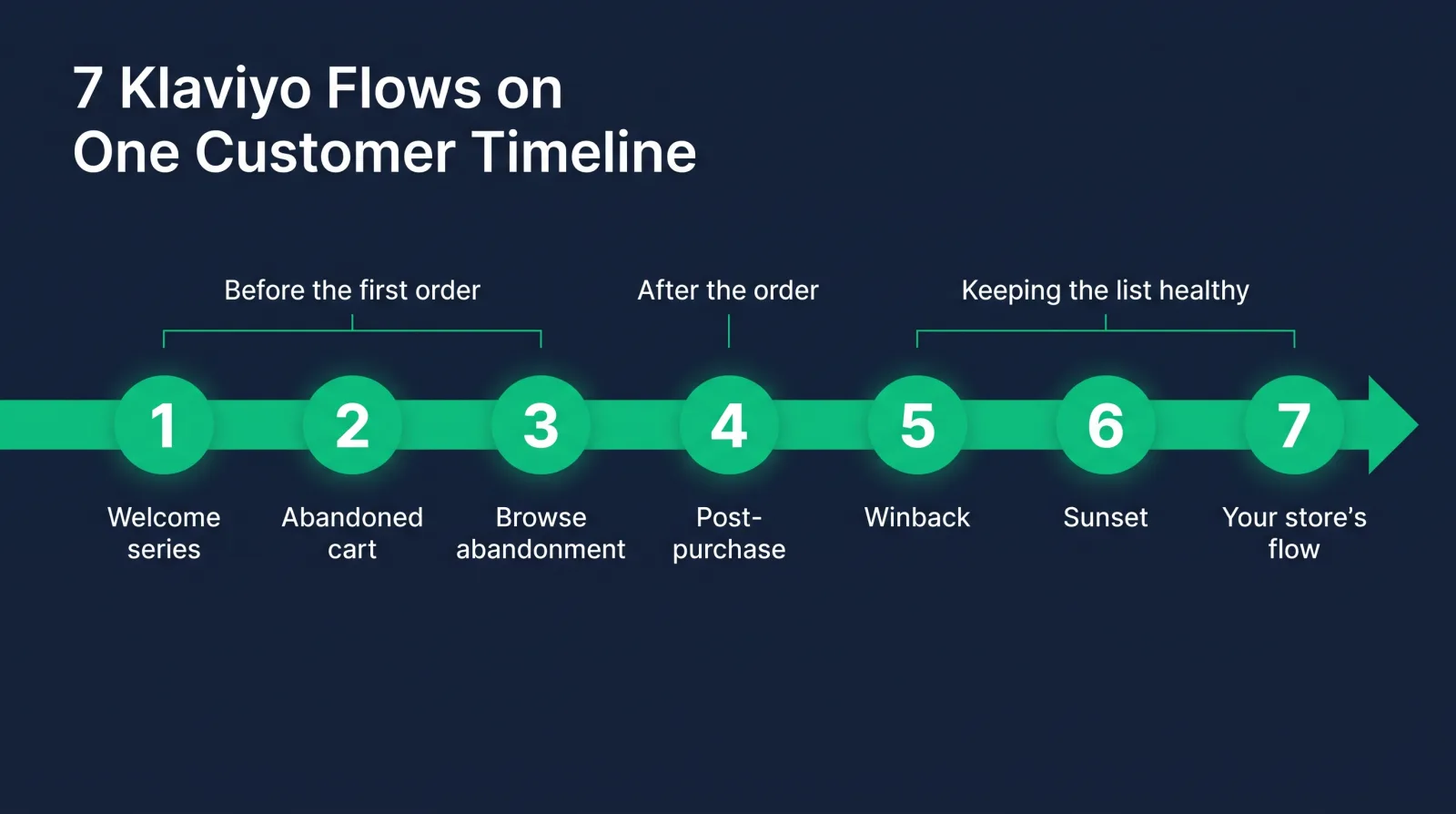
Here are the seven I'd build for almost any store, roughly in the order I'd build them, plus a walkthrough for your first one and the mistakes that cost the most.
What a Klaviyo flow is, and how it differs from a campaign
A Klaviyo flow is an automated sequence of emails or texts that fires on its own when a trigger happens, like someone joining a list, starting checkout or placing an order. A campaign is a one-time send you schedule to a list or segment.
A campaign goes to whoever is on the list at the moment you send it. A flow goes to each person at the moment it's relevant to them. The abandoned cart email arrives a few hours after that specific shopper left, not on Tuesday because Tuesday is newsletter day.
Klaviyo's help center lists the triggers you can start a flow from. The common ones are someone joining a list, someone entering a segment, and a metric, meaning an action like placing an order or viewing a product. There are also date-property triggers (a birthday on their profile comes up) and two newer ones that watch items a shopper viewed or started checking out with: price drop and low inventory.
Inside the flow you add time delays, conditional splits (send this branch to people who bought, that branch to people who didn't), and trigger splits. Each message also has a status. Klaviyo's own docs list three: Draft (nobody gets it), Manual (it queues for review instead of sending) and Live (it sends automatically). That Manual setting is your friend when you're testing, and I'll come back to it.
1. The welcome series
The welcome series is a short sequence of emails that starts when someone joins your list, usually through a sign-up form. It introduces the brand, delivers whatever was promised on the form, and aims for a first purchase.
It's also the flow most stores underbuild. One email with a code isn't a welcome series. It's a receipt.
A solid starting structure is three to four emails:
- Immediately: deliver the promise. If the form said 10% off, the code goes in the first line, not the fourth paragraph.
- A day or two later: the brand story or the reason the product exists. Founders, materials, why it's different.
- A few days after that: social proof and best sellers. Real reviews from the store, not made-up ones.
- Near the end: a reminder that the offer expires, if it does.
Add a conditional split after the first email that checks "has placed order since starting this flow." Anyone who bought exits the discount track. Nothing annoys a new customer like getting a "still thinking about it?" email the day after they paid full price.
2. Abandoned cart
An abandoned cart flow emails shoppers who started checkout but didn't finish. On a Shopify store connected to Klaviyo, it usually triggers from the Started Checkout metric and includes the exact items they left behind.
If a store has only two flows, this should be one of them. These shoppers picked a product and got to checkout before something interrupted them (the card was in the other room, the shipping cost surprised them).
The structure I'd start with:
- First email a few hours after, plain and helpful. Here's your cart, here's the button. No discount.
- Second email about a day later, answering the likely objection: shipping, returns, sizing.
- Third email a couple of days after that, optional, where you can test a small incentive if the store's margins allow it.
Set a flow filter so anyone who places an order drops out immediately. And don't lead with a discount in email one. Shoppers learn fast, and if they learn that abandoning a cart gets them 15% off, you've trained your whole list to abandon carts.
3. Browse abandonment
Browse abandonment emails people who viewed a product but never added anything to their cart. It triggers from the Viewed Product metric, which needs Klaviyo's onsite tracking, and it's gentler than abandoned cart because their intent is weaker.
This one is easy to overdo. Someone looked at a jacket for eight seconds, so keep it to one or two emails, keep the tone light ("still looking?"), and show the product they viewed plus a couple of related ones. Add a filter so people already in the abandoned cart flow don't get both at once, and so nobody receives this more than once every week or two.
4. Post-purchase and review request
The post-purchase flow starts when an order is placed. It thanks the customer, sets expectations for delivery, helps them use the product, and later asks for a review. It's the flow that turns one-time buyers into repeat buyers.
A useful version branches by customer type:
- First-time buyers get a thank-you and a "here's how to get the most out of it" email. Care instructions, a how-to video, a sizing tip.
- Repeat buyers get a shorter thank-you and maybe early access to something.
- Everyone gets a review request timed to after the product has arrived and been used. For a T-shirt, maybe a week or two. For skincare, longer.
Then a cross-sell a few weeks out. Someone who bought running shoes is a good person to tell about socks.
5. Winback
A winback flow targets past customers who haven't bought in a while. It triggers off time since their last order, and the "while" depends on how often people normally rebuy that product.
The timing is the whole skill here. A coffee subscription customer who hasn't ordered in six weeks is slipping. A mattress customer who hasn't ordered in six weeks is perfectly normal.
Look at the store's data first. If most repeat customers come back within about 60 days, start the winback a little after that. Klaviyo can show predictive analytics on profiles once a store has enough order history, including expected date of next order, which is a better trigger than a guess.
The emails themselves go from soft to direct. "We miss you" with new arrivals, then something they'd actually value, then a last, honest "should we keep emailing you?"
6. Sunset and list cleaning
A sunset flow finds subscribers who haven't opened or clicked in a long time, gives them one or two chances to re-engage, and then suppresses the ones who don't. It protects deliverability, so every other email has a better chance of reaching the inbox.
It hurts to shrink a list, but mailbox providers like Gmail and Yahoo watch engagement. If you keep sending to thousands of people who never open, more of your email starts landing in spam, including the abandoned cart emails going to people who really do want them. A smaller, engaged list makes more money than a bloated one.
Build it off a segment: subscribed, hasn't opened or clicked in, say, 120 or 180 days, and hasn't bought recently. One email asking if they still want to hear from you. A second with a clear "click here to stay." Anyone who doesn't respond gets suppressed. They aren't deleted, so the data stays. They just stop getting mail.
7. The seventh flow: whatever this store needs most
The seventh flow depends on the business. Common picks are a price drop or back-in-stock alert, a birthday or anniversary flow, a replenishment reminder for consumables, or an SMS version of the abandoned cart flow.
A store selling supplements needs a replenishment flow timed to when the bottle runs out. A store with frequent sellouts needs back-in-stock. A gift shop gets a lot from a date-based flow around a customer's birthday. Klaviyo's price drop trigger is good for stores with sales and higher-priced items people think about for a while.
When you interview for an email job or pitch a store, this is the flow that makes the conversation interesting. "Here's the one I'd add for you, and here's why" is a lot more convincing than reciting the standard six.
How to build your first flow, step by step
To build a Klaviyo flow, open Flows, create a new flow from scratch or from Klaviyo's flow library, choose a trigger, add filters, add emails with time delays between them, test with the messages set to Manual, then switch them to Live.
Here's the walkthrough for a welcome series, because it's the simplest to get right:
- Make sure the form feeds a list. Your sign-up form should add people to a list like "Newsletter."
- Create the flow. In Flows, either pick a welcome template from the library or start from scratch. Templates save time, but rename and rewrite everything, because they're written to fit every brand, which means they fit none.
- Set the trigger to "added to list" and pick your newsletter list.
- Add a flow filter if needed, for example excluding people who've already placed an order.
- Drop in the first email with no delay. Write the subject line, preview text and the email itself.
- Add a time delay, then a conditional split checking if they've placed an order since starting the flow.
- Add the remaining emails on the "hasn't purchased" branch, each separated by a delay.
- Set every message to Manual and sign up with your own test email to watch it fire. Check it in Gmail on your phone and in Outlook on a desktop.
- Switch to Live once each email looks right everywhere.
Then leave it alone for a few weeks and look at the numbers. Flow analytics in Klaviyo show opens, clicks and placed-order revenue per message, so you can tell which email is doing the work and which is dead weight.
Mistakes that quietly kill flow revenue
The most expensive mistakes are missing exit filters, discounting too early, overlapping flows that hit the same person twice, untested templates that break on mobile or in Outlook, and flows nobody has looked at in a year.
No exit filter. A shopper buys, and the abandoned cart flow keeps chasing them anyway. It looks sloppy and it trains people to ignore you.
Discounts in the first email. I covered this above and I'm saying it again because it's the one I see most. Save incentives for later in the sequence and test whether you need them at all.
Overlapping flows are sneakier. Browse abandonment, abandoned cart and a welcome series can all fire on the same new visitor in the same afternoon, and from the inside of the account it looks like everything is working. Use Smart Sending and flow filters so one person isn't buried.
Broken emails. A template that looks great in Klaviyo's preview can fall apart in Outlook. If you can read and fix email HTML, you catch this. Most marketers can't, which is one reason the ones who can tend to be the first hired.
Set and forget. Products change, prices change, offers expire. A flow written two years ago might still be sending a discount code that no longer works. Put a recurring check on your calendar.
Why stores pay people who can run Klaviyo flows well
Stores pay for flow skills because flows produce revenue every day without someone sending each email. A specialist who can build, test and improve them is attached to a number the owner already watches.
That's the pitch, whether you're applying for a job or going freelance. Offer to take the store's welcome series from one email to four, set up abandoned cart properly and stop the list from rotting. An owner can picture that. "I know Klaviyo" is much harder to picture.
The email marketing skills employers pay for post goes wider, and if you're thinking about the badge too, I wrote up whether the Klaviyo certification is worth your time. Short version: get it, then build flows like these so you have something to show.
On pay, the Bureau of Labor Statistics groups this work under "market research analysts and marketing specialists," with a median annual wage of $78,760 in May 2025. At CodingPhase, our students land roles at $75k+, individual results vary.
If you want to learn this with a structure around you, our Email Marketing Specialist career path covers flows, coded email templates, deliverability and the portfolio that proves it. It's part of Diamond Membership, listed at $60 a month or $365 a year with at least 30% off all the time (about $42 a month or $255 a year), and a 7-day money-back guarantee. You get the 80,000+ member community, the job board, the ATS-ready résumé builder, and two live calls each week: Accountability on Wednesdays at 7 PM ET and Money Talk on Sundays at 8 PM ET.
Weighing platforms? I compared Klaviyo vs Mailchimp and Klaviyo vs Shopify Email, and there's a wider guide to ecommerce email marketing.
FAQ
How many flows should a Klaviyo account have?
Start with the core six: welcome, abandoned cart, browse abandonment, post-purchase, winback and sunset. Add a seventh that fits the store, like back in stock or replenishment. Big accounts often run many more, but six done well beat fifteen done badly.
What is the difference between a Klaviyo flow and a campaign?
A flow is automated and fires for each person when a trigger happens, like a signup or a started checkout. A campaign is a one-time send to a list or segment at a time you choose. Most stores need both.
How long should a welcome flow be?
Three to four emails is a reasonable starting point: deliver the offer, tell the brand story, show best sellers and reviews, then remind them before the offer ends. Let the flow analytics tell you whether to add or cut.
Can you test flows in Klaviyo before they go live?
Yes. Set each message to Manual so nothing sends automatically, trigger the flow with your own email, and review what queues up. Klaviyo also lets you preview messages and send test emails before you switch them to Live.
Do Klaviyo flows work with Shopify?
Yes. Klaviyo integrates with Shopify, and store events like viewed product, started checkout and placed order sync over, which is what powers browse abandonment, abandoned cart and post-purchase flows.
If you've got a free Klaviyo account and a test store, build the welcome series this week. Then build abandoned cart. Screenshot both, write two sentences on why you chose the timing you did, and you've started a portfolio.
When you want people to look at it with you, come join us. Bring your flow to a Wednesday Accountability call, and you'll leave with fixes. I've been teaching since 2016, and building things and showing them to people is still the fastest way I know to get good at this.