Klaviyo Certification: Is It Worth It for Your Email Career?
On this page
"Will a Klaviyo certification get me hired?"
Some version of that question lands in our community all the time, usually from someone who already has the badge on LinkedIn and is wondering why the applications aren't turning into calls. My first reply is always the same: "Can you show me a flow you built?"
That's the honest answer in one line. The Klaviyo certification is worth getting. It's free, it's quick next to almost any other credential in marketing, and it tells a recruiter you speak the platform. But it answers "do you know Klaviyo?" and the hiring manager is asking something else, which is whether you can make them money with it.
Below is what each certificate covers, how I'd prepare, and what to build next to the badge so it pulls its weight.
What the Klaviyo Academy certification actually is
A Klaviyo Academy certificate is a free credential Klaviyo issues after you finish a set of short courses and pass a final exam with 80% or higher. The badge comes through Accredible, it's valid for 24 months, and it proves you know the platform's features.
That's straight from Klaviyo's own Academy credentials page, which I read the week I wrote this. The FAQ there says it outright: "Klaviyo certificates are offered free of charge." You do need a Klaviyo account to register (a free one works, and you'll want it for practice anyway). And the credential expires. It's good for 24 months from the issue date, and renewing means retaking the certificate.
People still search for the old "Klaviyo Product Certification" name, and you'll see it in older blog posts. Klaviyo now calls its main track the practitioner certificate. Same idea, newer packaging. If a guide you're reading uses the old name, check the date on it.
Who should get Klaviyo certified, and who can skip it
Get it if you're applying for ecommerce email roles, pitching store owners as a freelancer, or switching careers with nothing email-related on your résumé yet. Skip it, for now, if you've never sent a campaign and don't know what a segment is.
The second group isn't being told "never." I'm saying the order matters. The practitioner course assumes you already have a basic feel for email marketing. Klaviyo's own page says to take it if you "have a basic understanding of Klaviyo's core features," and points brand-new users to its getting-started content first.
If you're already in a marketing job and your company uses Klaviyo, this is an easy yes. It costs you a few evenings and you'll find features you didn't know were there.
If you're a career changer coming from retail, admin or customer service, it's also a yes, with one condition. Do it alongside real practice in a real account, never instead of it. I'll explain why in a minute, because it's the part most people get wrong.
The Klaviyo certification options, and how to get each one
Klaviyo currently lists five certificates: practitioner, strategist, service practitioner, deliverability and developer. Most email marketers should start with the practitioner certificate, then add strategist or deliverability depending on the jobs they want.
Here's how they break down, using the course lengths Klaviyo publishes:
Klaviyo practitioner certificate. The core one. Klaviyo lists the material at about five and a half hours across nine courses: account settings and integrations, sign-up forms, profiles, lists and segments, templates, campaigns, automated flows, performance analysis, then the final exam. If you only get one Klaviyo certification, get this one.
Klaviyo strategist certificate. Around two hours and forty-seven minutes. This one is about building an omnichannel strategy, so email plus SMS and the other channels working together. It's the better pick once you're past the button-clicking stage.
Klaviyo service practitioner certificate. About two hours, focused on Klaviyo's Customer Agent and Helpdesk tools. Useful if you're aiming at customer experience or retention roles. Less relevant for a pure email job.
Deliverability certificate and developer certificate. Klaviyo lists both in the Academy. Deliverability is worth a look for anyone who wants to own inbox placement, which is a skill companies quietly pay extra for. The developer track is for people building integrations through Klaviyo's API.
To get any of them: create or log into a Klaviyo account, register on academy.klaviyo.com, complete the courses in the certificate, and pass the final exam at 80% or higher. Your badge and certificate arrive by email.
One more thing. Klaviyo Partner Program members get extra partner-only certificates. If you end up working at an agency that's a Klaviyo partner, you'll get access through them.

How to prepare without wasting a month
The fastest way to pass is to build each thing in a real Klaviyo account right after you watch the lesson on it. Watching alone feels productive and leaves you guessing on scenario questions.
This is where I'd push you hardest. Most people binge the videos, take the exam, and either scrape by or fail on the questions that ask "what would you do if." Those questions are easy if you've clicked through the screen. They're tricky if you've only seen someone else click through it.
Here's the routine I'd follow:
- Open a free Klaviyo account and connect a test Shopify store, or just add a few test profiles by hand.
- After each module, build the thing. Sign-up form module? Build a form. Segments module? Make three segments: engaged in the last 30 days, purchased twice or more, never opened.
- Build one flow end to end before you get to the flows module, so the lesson lands on something you've already fought with.
- Take notes in your own words on anything with a number in it: timing, thresholds, settings you'd have to remember cold.
- Sit the exam when the hands-on part feels boring. That's the sign you're ready.
If you fail, retake it. Klaviyo's exam materials say you can try again, and nobody looking at your badge will ever know how many attempts it took.
What the badge does for a job application
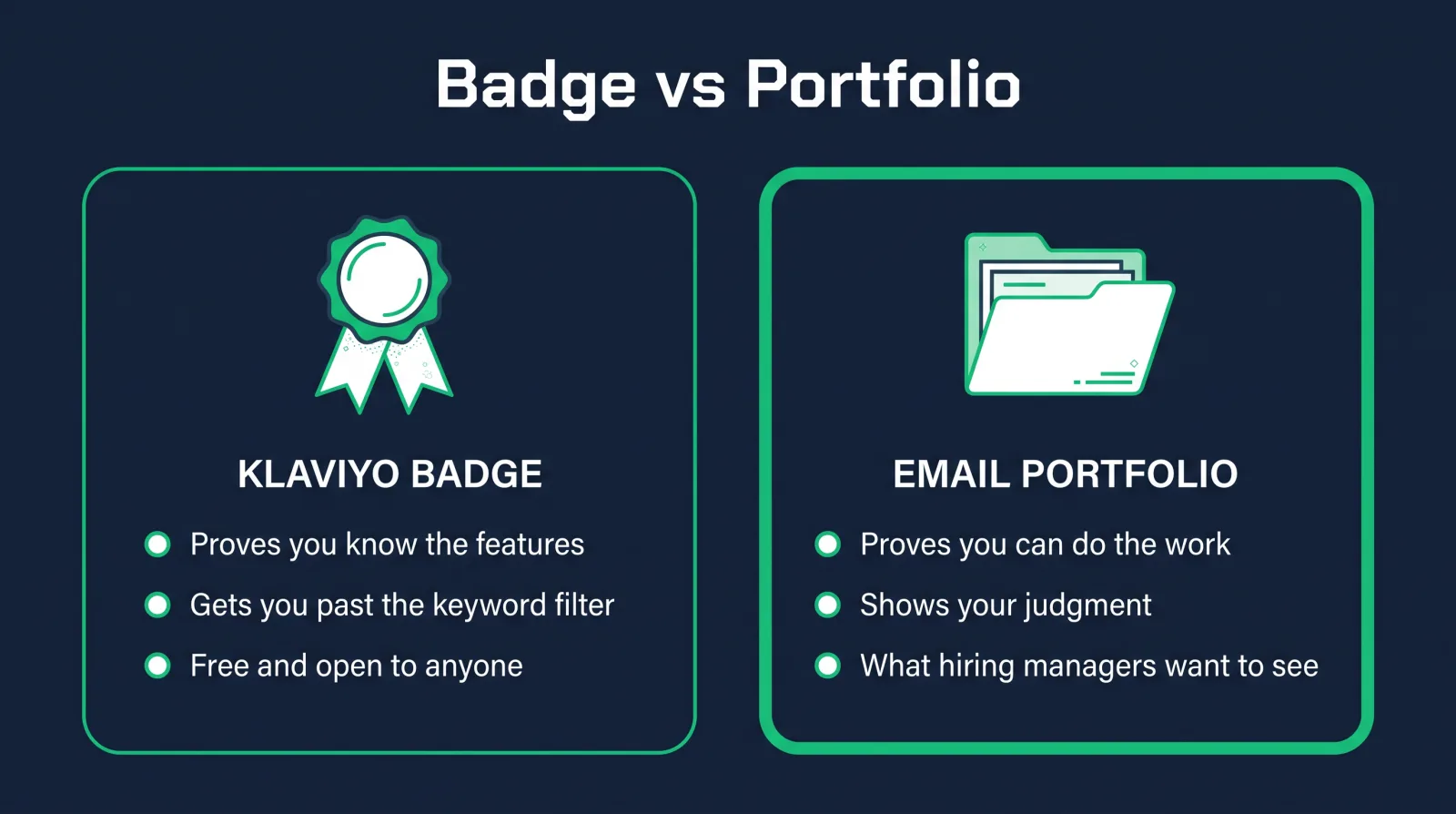
On a job application, the Klaviyo certification mostly helps you clear the first filter: the recruiter's keyword scan and the applicant tracking system. It shows tool fluency. It rarely decides who gets the offer.
That first filter is real, though. Ecommerce email job posts name Klaviyo constantly, and a recruiter screening 200 applications is scanning for that word. A certificate under your skills section gives them the match they're looking for, in a form they recognize.
It also helps you in a quieter way. In an interview, "I'm Klaviyo certified" lets you skip the "have you used it?" questions and get to the interesting ones faster. Like what flow you'd fix first in their account.
It stops helping the moment someone senior looks at your application. A hiring manager who runs email knows the exam is free and open to anyone. They're glad you took it. Then they want to see work.
What it does for freelance clients and store owners
For freelancers, a Klaviyo certification is a trust signal on a proposal or profile. Store owners can't judge your skill directly, so a badge from the platform they use lowers the risk of saying yes to a call.
I think this is where the badge earns the most. A store owner on Shopify doing a few hundred orders a month knows they "should be doing more with Klaviyo." They don't know how to judge an email marketer. A Klaviyo badge on your profile is something they can recognize without needing to understand it.
Pair it with a short audit offer and it gets much stronger. Something like: "I'll review your welcome, abandoned cart and post-purchase flows and send you three fixes." The certificate gets you the reply. The audit gets you the client.
What the certification won't prove: the portfolio gap
A Klaviyo certification proves you know where the features are. It doesn't prove you can write an email people open, plan a flow that recovers revenue, or fix a template that breaks in Outlook. A portfolio proves those.
Back to the person from the top of this post. They knew Klaviyo. What they couldn't show was judgment: why the welcome series sends three emails and not five, why the abandoned cart email waits a few hours instead of minutes, which segment gets the discount and which doesn't.
That judgment is what a hiring manager is buying, and there's no exam for it. You have to show it.
A starter email portfolio doesn't need to be big. Three pieces does it:
- A flow map for a real or realistic store: welcome, abandoned cart, post-purchase, with the timing and the reason for each email.
- Two or three designed emails built in Klaviyo's editor or coded by hand, shown on desktop and mobile.
- A short write-up of a test you'd run and what result would change your mind.
If you want the full list of what to build, I wrote about the seven Klaviyo flows every store needs. Building those for a practice store covers most of a portfolio.
Klaviyo certification vs learning the whole email job
The Klaviyo certification teaches one platform. An email marketing job also needs copywriting, segmentation strategy, deliverability, HTML email and reporting revenue to a boss. That broader skill set is what you're actually hired for.
Klaviyo is one tool. A lot of companies use it, especially Shopify stores. Plenty of others run Mailchimp, HubSpot, Braze or Iterable. If you want to see how they stack up, I compared Klaviyo vs Shopify Email and Klaviyo vs Mailchimp for exactly this reason.
The skills underneath travel between all of them. A segment is a segment. A welcome flow is a welcome flow. HTML that renders in Outlook renders in Outlook no matter which platform sent it.
This is why we built the Email Marketing Specialist career path at CodingPhase the way we did. Klaviyo is in there, because employers ask for it by name. But the path starts with what no single platform teaches you, like how email renders across inboxes and how to code a template that doesn't fall apart in Outlook, then moves into planning campaigns that move revenue and building the portfolio that proves you can. Our email marketing course built for technical learners goes deep on the HTML side.
You also get people. The path comes with Diamond Membership, which includes an 80,000+ member community, a job board, an ATS-ready résumé builder, portfolio templates, and two live calls every week: Accountability on Wednesdays at 7 PM ET and Money Talk on Sundays at 8 PM ET. Bring your flow map to a Wednesday call and you'll get real feedback on it.
Diamond is listed at $60 a month or $365 a year, and there's always at least 30% off, which puts it around $42 a month or $255 a year. There's a 7-day money-back guarantee if it's not for you. If you're comparing it to other ways to learn, I put together a list of the best email marketing courses too.
So get the free badge. Put it on your résumé. Then learn the job around it.
Where Klaviyo skills take you: email marketing roles and pay
Klaviyo skills lead to ecommerce email marketing specialist, retention marketer and lifecycle roles, plus freelance work for Shopify stores. Our students land roles at $75k+, though individual results vary.
For a public benchmark, the U.S. Bureau of Labor Statistics groups this work under "market research analysts and marketing specialists," and reports a median annual wage of $78,760 in May 2025 (BLS Occupational Outlook Handbook). BLS also projects that occupation to grow 7% from 2025 to 2035, which it calls much faster than average.
Titles vary a lot. You'll see "email marketing specialist," "CRM specialist," "retention marketing manager" and "lifecycle marketer" for overlapping jobs. I break down the differences and the pay ladder in the email marketing specialist guide.

FAQ
Is Klaviyo certification free?
Yes. Klaviyo's Academy FAQ says its certificates are offered free of charge. You need a Klaviyo account to register, and a free account is enough.
How long does it take to get Klaviyo certified?
Klaviyo lists the practitioner certificate's course material at about five and a half hours, and the strategist certificate at under three. Add practice time in a real account on top of that. How long it takes you depends on how much hands-on building you do, which is the part I'd never skip.
Does a Klaviyo certificate help you get a job?
It helps you pass keyword screens and shows tool fluency, especially for ecommerce email roles where job posts name Klaviyo. On its own it rarely wins the offer. Pair it with a portfolio of flows and emails you built.
Is Klaviyo certification harder than HubSpot's email certification?
They test different things. HubSpot Academy's email marketing certification leans toward general strategy and inbound concepts. The Klaviyo practitioner exam is about using the Klaviyo platform itself: forms, segments, flows and reporting. If you've practiced in a real Klaviyo account, the Klaviyo exam feels more concrete. Both are free, so plenty of email marketers take both.
Does the Klaviyo certification expire?
Yes. Klaviyo's credentials page says certificates are valid for 24 months from the issue date, and you renew by retaking the certificate.
If you've been putting off the Klaviyo exam because you weren't sure it was worth it, go get it this week. It's free, and it'll teach you things about the platform you'd otherwise learn the slow way.
Then come build the rest with us. The Email Marketing Specialist path walks you from your first coded email to a portfolio you can send with an application, and the Wednesday call is a good place to show your first flow map to people who'll tell you the truth about it. I've been teaching this stuff since 2016, and the people who get hired are the ones who show their work. You can be one of them.