Abandoned Cart Email Examples That Bring Buyers Back (and Why They Work)
On this page
You've done it yourself. Put a pair of shoes in a cart at 11 PM, saw the shipping cost, and closed the tab.
Baymard Institute's running average of 50 studies puts cart abandonment at 70.22%. Roughly seven of every ten carts never get bought. Some of those people were only browsing and no email will change that. The rest had a reason, and that reason is what a good abandoned cart email answers.
Most abandoned cart email examples online are screenshot galleries. You scroll past 30 pretty designs, and you still don't know why any of them worked. I wrote four abandoned cart email examples below for a made-up candle company, Harbor & Wick, so we can go through them line by line and you can borrow them as a template. They're my own drafts and not real campaigns, the reviews included, so I won't claim they earned a dollar. What I care about is that you can see the thinking and reuse it.
Why cart abandonment emails work
Cart abandonment emails work because they reach someone who has already picked a product and nearly paid. In Klaviyo's 2026 benchmarks, abandoned cart flows brought in $6.77 per email recipient on average, the highest of any automated flow it measured there.
That Klaviyo report looked at more than 110,000 of its customers, and the top 10% of brands reached $13.70 per recipient, with an average click rate of 6%. Keep in mind that it's a vendor measuring its own customers, and revenue credit depends on attribution settings, so some of those buyers may have come back anyway. It's still a strong reason this is usually one of the first flows a store sets up.
Baymard's cart abandonment survey is even more useful for writing, because it tells you what your email has to answer. After removing people who were just browsing, the top reasons US shoppers gave for leaving were:
- Extra costs too high (40%), meaning shipping, tax and fees
- Delivery too slow (20%)
- Didn't trust the site with card details (19%)
Read those again, then read most cart emails. "You forgot something!" doesn't answer a single one. Nobody forgot. People got a surprise at checkout and left.
Here's the line I'd tape above your desk: a cart email has one job, and it's answering the reason they left.
Example 1: the plain reminder
The plain reminder is the first abandoned cart email in most sequences. It shows the item, links straight back to the saved cart and adds nothing else, because some shoppers were only interrupted and all they need is one easy way back.
Subject: Your candles are still here
Preview: We saved your cart for you.
Hi Dana,
You left the Cedar & Smoke candle in your cart. It's still there whenever you want it.
[Cedar & Smoke, 8 oz, $28]
[Back to my cart]
Questions about scents or shipping? Just reply. A real person reads these.
Maya at Harbor & Wick
Short on purpose, in a plain template. There's one call to action, it goes directly to the restored cart, and the product image does most of the talking.
Notice what it leaves out: no discount, urgency or countdown timer. That last line about replying is doing quiet work too. It opens a door for the person whose real objection is a question.
This reminder will probably be the highest-performing email in your abandoned cart sequence, simply because it arrives first and the interest is still warm.
Example 2: social proof
A social proof abandoned cart email answers doubt about the product or the store by showing what other customers said. It suits the second slot in a sequence, once a simple reminder hasn't worked, and it's strongest when the reviews are real and specific to the item in the cart.
Subject: "The only candle my husband has ever noticed"
Preview: What people say about Cedar & Smoke.
Still thinking about Cedar & Smoke? Here's what other customers told us.
★★★★★ "Burned it for three weeks and the scent held the whole time." Priya R.
★★★★★ "Smells like a cabin. Bought two more for gifts." Tom L.
[See my cart]
A quote in the subject line reads like something from a person, which gets it noticed in an inbox full of brand announcements.
Pull reviews that handle a specific worry. For candles, that's scent strength and burn time. For shoes, it's fit. For a supplement, it's taste. Generic praise like "great product!" barely moves anyone.
One firm rule: use only real customer reviews, and only with permission where the law or your review platform requires it. Faking a testimonial is the sort of thing that gets a company in legal trouble and gets you fired. For a portfolio piece, label invented quotes as placeholders.
Example 3: objection handling
An objection-handling abandoned cart email takes the most common reason people leave, usually shipping cost, delivery time or trust, and answers it directly. It's the example most stores never write, and I think it's the most useful of the four.
Subject: A quick answer about shipping
Preview: Probably the question you had.
Hi Dana,
When people leave a cart with us, it's usually about shipping. So here's the straight version.
Cost: Flat $5, free over $50. You're $22 away.
Speed: Orders leave our Portland shop within 2 business days.
If it arrives broken: Send a photo and we'll replace it. No return needed.
[Finish my order]
See how it lines up with Baymard's top three? Extra costs, delivery speed, then trust. One email covers all of them in about 50 words.
"You're $22 away" works as a nudge toward free shipping, and it needs a bit of dynamic content so the amount is calculated from the cart. In Klaviyo or a similar tool, you'd build that with the cart value from the event data. Your first time will be fiddly. It's also a concrete thing you can say you've built.
Everything in that email has to be true for the actual store. Before you write it, ask the support team what customers really ask. I'd take five minutes with a support inbox over any list of email tips.
Example 4: the discount, and when not to use one
A discount abandoned cart email offers money off to close the sale, usually as the last message in a sequence. Use it sparingly, because shoppers who learn that cart abandonment earns them a coupon will keep doing it, and you end up paying for sales you'd have made at full price.
Subject: 10% off, if it helps
Preview: Good through Friday.
Hi Dana,
If price was the thing, here's 10% off your cart. Use CEDAR10 by Friday at midnight.
If it wasn't, no hard feelings. Your cart will be here for a bit longer.
[Use my 10%]
There's a soft kind of urgency here, with a real deadline, and no fake countdown clock. If that code still works next Tuesday, your deadlines stop meaning anything to repeat customers.
Here's how I'd decide whether to include a discount at all:
Skip it if your margins are thin, if you're a premium brand trying to hold your price, or if the buyer already bought from you recently. Consider it when you've got healthy margins and a new customer who stalled at price. Better still, test it: split your audience, send half the discount and half no discount, and compare revenue per recipient instead of order count. A discount can raise orders while lowering what you actually keep. Free shipping is a fine alternative when shipping cost is the known blocker, and it often feels more generous than a small percentage.
You'll probably hear, "But everyone sends a discount." Plenty do. That's no reason to train your customers to wait for one.
Timing a three-email abandoned cart sequence
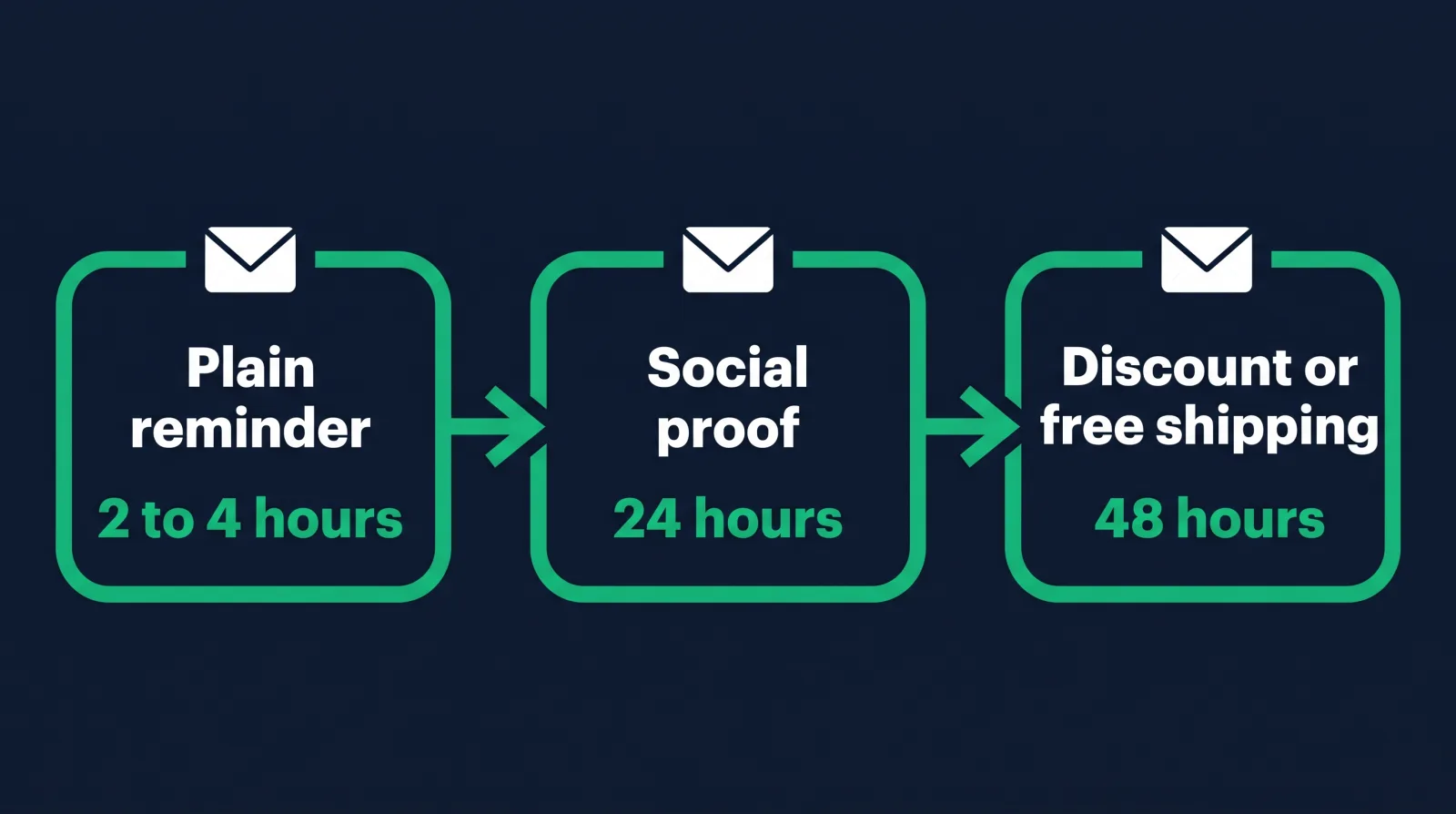
A common abandoned cart sequence sends three messages: a reminder a few hours after the cart is left, a follow-up around 24 hours later, and a final message at about 48 hours. Klaviyo gives a pattern like that as a starting point, and you should test from there.
Klaviyo's own example is a reminder at 2 to 4 hours, a follow-up at 24 hours and a last message at 48. Applied to the examples above, it could look like this:
| When | Job | |
|---|---|---|
| 1. Plain reminder | 2 to 4 hours | Catch the interrupted shopper |
| 2. Social proof or objection handling | 24 hours | Answer the doubt |
| 3. Discount or free shipping (optional) | 48 hours | Close on price |
The flow settings matter as much as the words. Add an exit condition so anyone who buys stops getting emails. Nothing makes a brand look sloppier than asking for an order that's already been placed. Set a filter so people who've received the flow recently don't get it again each time they add something to a cart. Only email people who've agreed to hear from you, and follow the consent rules for the countries you sell in.
There's a difference between tools here as well. Shopify's built-in abandoned checkout email only fires when someone reaches checkout and enters contact details. Klaviyo and other email platforms can build separate triggers on an earlier added-to-cart event for known subscribers, so check what your platform tracks. If you're working out which tool fits, see Klaviyo vs Mailchimp, and for the setup itself, my walkthrough of Klaviyo flows covers the build.
Subject lines for abandoned cart emails
A good abandoned cart subject line is short, specific and sounds like a person wrote it. Name the product or the concern when you can, keep the most important words near the front for mobile, and avoid fake urgency that the email can't back up.
Some patterns worth trying, each with a different job:
- Product name: "Cedar & Smoke is still in your cart"
- Plain and human: "Did something go wrong?"
- Answering an objection: "Free shipping, you're $22 away"
- A customer's voice: "The only candle my husband has ever noticed"
- Offer up front: "10% off, if it helps"
Klaviyo suggests personalization as a good place to start. I'd add that a product name usually beats a first name, since everybody's seen Hi {first_name} a thousand times.
Avoid "URGENT: Your cart is expiring!" unless it's really expiring. Most carts aren't. Avoid guilt, too. "Don't you want this?" makes a customer feel scolded by a candle company.
Test one thing at a time, with enough volume to mean something. On a small list, several weeks of a flow may not reach a clear result, and that's fine. Choose your best guess and put your attention on the offer and timing, which are likely to matter more.
Rebuild one for your portfolio
To turn these abandoned cart email examples into a portfolio piece, build a three-email sequence for a real or fictional brand in a free email tool, write up your reasoning, and show the flow diagram, the templates and the test you'd run first.
This is the part that matters if you're trying to get hired. You can't get real results from a store you don't have, and hiring managers know that. They're looking at how you think.
Build yours in this order:
- Pick a brand you actually like and study its checkout. Note the shipping cost and return policy.
- Name the top objection, and say how you identified it.
- Build the three emails as a responsive template, in Klaviyo's free tier if you can.
- Screenshot the flow with its triggers, time delays and exit conditions.
- Write half a page: what each email does, why it's timed that way, and what you'd A/B test first.
Then be upfront that it's a spec project. Saying "no client, here's my reasoning" reads as confident. Inventing a 40% recovery rate reads as a lie, and experienced managers can smell it.
Slot it into your email marketing portfolio, and add the numbers you'd watch after launch. These email marketing KPIs will tell you which ones belong in that write-up. If you're not sure what else a hiring manager wants to see, here's a rundown of the email marketing skills that get people hired.

FAQ
When should the first abandoned cart email go out?
A few hours after the cart is left is the usual starting point, and Klaviyo's sample sequence uses 2 to 4 hours. Test earlier and later for your store, since a $20 impulse buy and a $2,000 sofa are very different decisions.
How many abandoned cart emails should you send?
Three is a common starting point. More than that tends to feel like pestering unless each one has something new to say, and every email needs an exit condition for people who've already bought.
Should an abandoned cart email include a discount?
Not automatically. Try without one first, or test it against a no-discount version and compare revenue per recipient. Regular discounts teach repeat shoppers to wait for the coupon.
What's a good abandoned cart recovery rate?
It varies a lot by industry, price and list quality, so be careful with any single figure. Klaviyo's 2026 report is a reasonable reference for revenue per recipient, at $6.77 on average and $13.70 for the top 10%, but your own baseline matters most.
Abandoned cart email examples like these make a great first project because the job is so clear: someone almost bought, and you're writing to find out why they didn't. If you enjoyed picking apart those four emails, email marketing might suit you very well.
Our Email Marketing Specialist career path takes you from beginner through real flows in a set order, and Email Marketing for Developers goes deep on building emails that hold up in every inbox. Diamond Membership lists at $60/month or $365/year with at least 30% off, always, so you're looking at about $42/month or $255/year. That covers 90+ courses, portfolio templates, an ATS-ready résumé builder, the job board and an 80,000+ member community. It also gets you onto two live calls a week: Accountability on Wednesdays at 7 PM ET, and Money Talk on Sundays at 8 PM ET. Our students go after roles paying $75k+, individual results vary, and there's a 7-day money-back guarantee.
Bring your first draft to a Wednesday call. We'd love to help you make it better.