Email Marketing Resume: Examples, Skills and What Recruiters Scan For
On this page
The most common email marketing resume I see reads like a job description.
"Responsible for weekly newsletters." "Managed the email calendar." "Worked with design on templates." Every line is true, and none of it tells a recruiter whether that person made the company a dollar.
The person reading your resume is trying to picture you doing the job, and a list of duties gives them nothing to picture. Results do. Email marketing is a lucky field for this, because every send has numbers attached to it.
Below is what the page needs, section by section, plus two example layouts: one entry level, one for a career changer coming from retail, admin or customer service. I won't invent a fake "Jane Doe" with fake numbers. The examples show the structure, with brackets where your real numbers go.
What an email marketing specialist resume needs to show in seconds
An email marketing resume has to show three things almost instantly: which platforms you've used, that you've moved a number like revenue or conversions, and where to see your work. Everything else on the page supports those three.
Recruiters skim. The best-known data point here is from Ladders, whose 2018 eye-tracking study found recruiters spent an average of 7.4 seconds on an initial resume screen. You don't have to trust the exact number to accept the point. The top third of the page does most of the work.
So the top third should contain your name and contact line, a link to your portfolio, a two-line summary with a result in it, and a skills line with the platforms named. If someone reads only that and stops, they should still know what you do.
The summary line: lead with revenue, not duties
Your summary should be two lines, not a paragraph. Name the role you want, the platforms you know, and one result or specific piece of work. Skip "passionate, detail-oriented team player." Everyone writes that.
Compare these two openings.
A weak summary says you're a "creative email marketer passionate about building customer relationships." It could describe anyone.
A strong one names the role, the tool and the outcome: "Email marketing specialist with hands-on Klaviyo experience. Built welcome, abandoned cart and post-purchase flows for a Shopify store and coded responsive templates tested in Outlook and Gmail." If you have a real revenue or conversion number, put it in.
If you don't have real-world numbers yet, that's fine. Lead with the specific thing you built. Specific beats impressive.
Skills section: tools and abilities recruiters search for
The skills section is where an applicant tracking system and a recruiter both look for keyword matches, so name exact platforms and abilities from the job post: Klaviyo, Mailchimp, HubSpot, segmentation, A/B testing, HTML email, deliverability and reporting.
Split it into two short lines so it scans:
- Platforms: Klaviyo, Mailchimp, HubSpot, Shopify, Litmus or Email on Acid, Google Analytics
- Skills: segmentation, lifecycle automation, A/B testing, HTML and CSS for email, deliverability (SPF, DKIM, DMARC), campaign reporting
Only list what you could talk about in an interview. If you've opened HubSpot once, leave it off. A sharp hiring manager will ask.
Match the wording in the posting too. If the job says "marketing automation," use that phrase somewhere, not only "flows." I wrote a whole guide to the email marketing skills companies pay for if you're not sure what belongs here or which to learn next.

Turning campaigns into bullet points with numbers
Each bullet should follow one pattern: action, what you did, and the result. "Built a three-email abandoned cart flow in Klaviyo that recovered [X] orders in its first month" beats "Responsible for abandoned cart emails" every time.
Email gives you more numbers than almost any marketing job. Use them:
- Revenue from a flow or campaign
- Conversion rate or click rate, and the change you caused
- List growth from a form you built
- Deliverability improvements, like bounce rate going down after a cleanup
- Time saved, like building a reusable template that cut production time
Be careful with open rates. Since Apple's Mail Privacy Protection, opens are inflated and less trusted, and hiring managers who know email will notice if your whole resume rests on them. Clicks, conversions and revenue are stronger.
And never invent a number. If you didn't measure it, describe the work precisely instead. "Coded and tested a modular template system used for every weekly campaign" is honest and still says a lot.
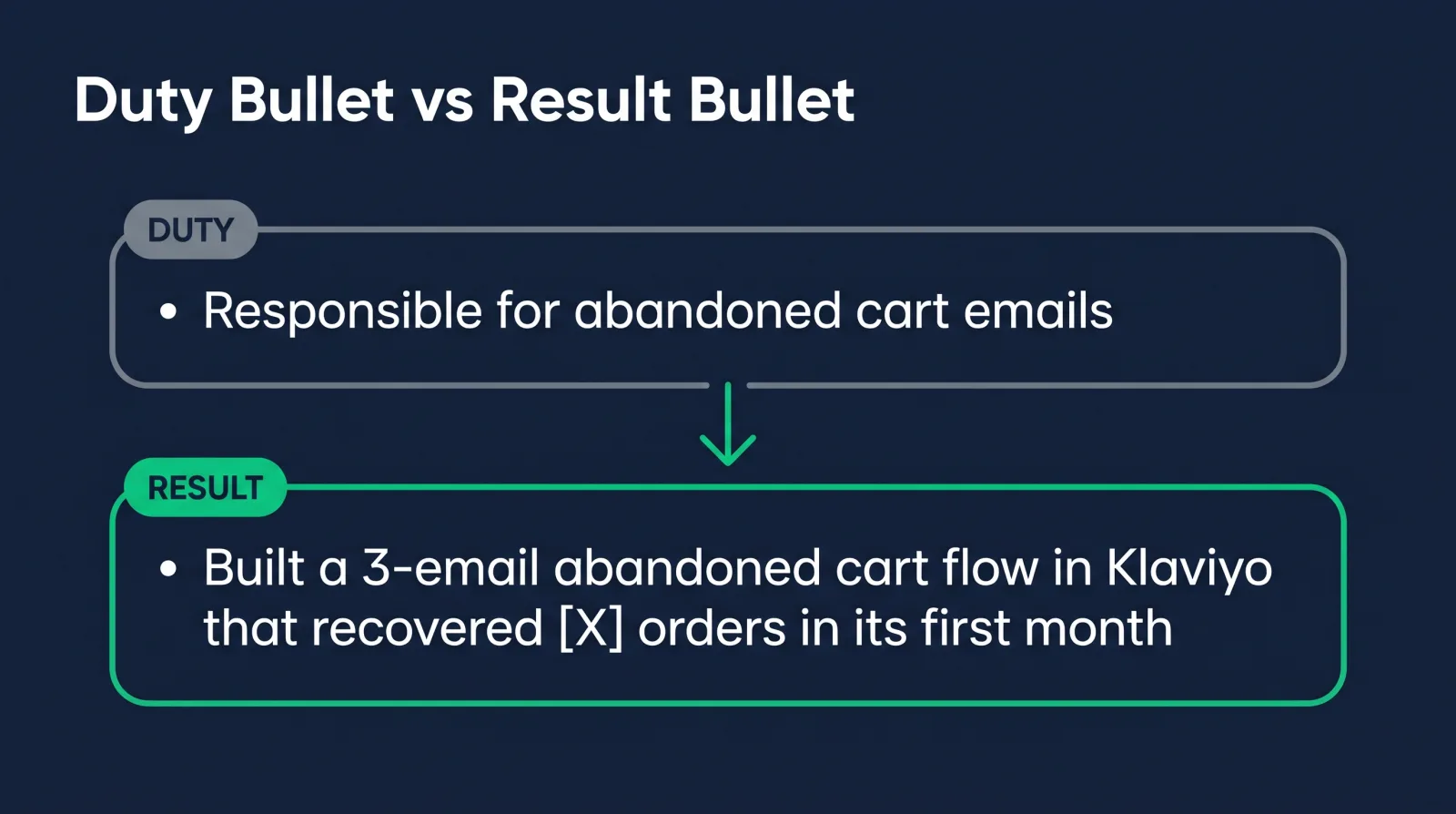
Example: entry-level email marketing resume
An entry-level email marketing resume leads with a portfolio link and projects, because you don't have a long work history yet. Put the work you've built in the place where experience usually goes.
Here's the layout, top to bottom:
- Header: name, city or "Remote," email, phone, LinkedIn, portfolio URL.
- Summary (two lines): "Entry-level email marketing specialist trained in Klaviyo and HTML email. Built [number] coded templates and a full lifecycle flow set for a practice Shopify store."
- Skills: the two lines described above.
- Projects: two or three, each with a one-line description and two result-style bullets. For example, a "welcome and abandoned cart flows for [store type]" project with bullets on the timing logic and the segment rules you set.
- Experience: your actual jobs, even if they aren't marketing. One or two bullets each, focused on anything transferable (more on that below).
- Education and certifications: degree if you have one, plus things like the Klaviyo certification or course certificates.
Keep it to one page. Nobody needs two pages from an entry-level candidate.
Example: career-changer resume (retail, admin or customer service to email)
A career-changer email marketing resume reframes past work as transferable skills, puts email projects above old job duties, and uses the summary to explain the switch in one line. Treat your old job as evidence for the new one.
People coming from these jobs usually have more relevant experience than they give themselves credit for. If you've worked a register, you've watched which promotions actually make people buy. Support work is maybe the best training of all, because you already know what confuses customers, and good email answers those questions before anyone has to ask.
The layout:
- Header with portfolio link, same as above.
- Summary: "Email marketing specialist moving from [your field]. [X] years of customer-facing work, now building Klaviyo flows and coded email templates. Portfolio below."
- Skills in two lines.
- Email projects before work history.
- Experience, rewritten. A store associate might write "Ran in-store promotions and tracked which offers moved the most units." Someone in support might write "Answered [X] customer questions a week; wrote the help articles that cut repeat tickets." Only claim what you actually did.
- Education and certifications.
The web content manager resume guide uses a similar structure for a different role, if you want to see the pattern applied elsewhere.
Getting through applicant tracking systems
To get an email marketing resume through an applicant tracking system, use a simple one-column layout, standard section headings, a text-based PDF or Word file, and the exact keywords from the job post. Avoid putting key information in tables, text boxes, headers or images.
Many companies run applications through an ATS before a person sees them. Some of these systems parse your file into fields, and fancy layouts can come through scrambled.
The safe version:
- One column, standard fonts
- Headings named plainly: Summary, Skills, Experience, Projects, Education
- No skill bars, icons, photos or graphics carrying information
- Dates in a consistent format
- Keywords from the post used naturally, not stuffed in white text (that trick gets caught and looks bad)
This is the main reason I'd steer you away from a heavily designed resume for email roles. Save the design for your portfolio, where it belongs.
At CodingPhase, the Diamond Membership includes a résumé builder built to pass ATS screening, so you don't have to fight a template to get this right.
The portfolio link that does the heavy lifting
The portfolio link is the most important line on an email marketing resume. It lets a hiring manager see your emails, flows and results instead of taking your word for them, and it's often what gets you from "maybe" to "let's talk."
For email, a portfolio can be a simple site or even a clean shared folder. What matters is what's in it:
- Two or three coded emails, shown on desktop and mobile
- A flow map with timing and the reasoning behind it
- A short case study: the goal, what you built, what happened
- A segmentation plan or test write-up
Put the link in your header, and again in the summary if it fits. Make sure it works on a phone, since a lot of recruiters check from one.

Mistakes that get email marketing resumes skipped
The mistakes that sink email marketing resumes are duty-only bullets, no portfolio link, typos (in a job that's all about sending careful copy), designed layouts that break in an ATS, and listing tools you can't actually use.
Typos hurt more here than in most fields. You're applying to write emails that go to thousands of people. A typo in the resume tells the reader you'll send one to the list.
Also watch for a generic resume sent everywhere. Five minutes of tailoring per application (adjusting the summary and moving the most relevant project up) beats sending the same file to fifty jobs.
And don't bury the platform the job asks for. If the post says Klaviyo, Klaviyo should be visible in the top third.
Building the skills behind the resume
If you're still building the skills behind the resume, our Email Marketing Specialist career path takes you through coded email, flows, deliverability and reporting, with portfolio pieces along the way. It's part of Diamond Membership, which comes with the ATS-ready résumé builder, portfolio templates, a job board and an 80,000+ member community. Diamond is listed at $60 a month or $365 a year with at least 30% off all the time (about $42 a month or $255 a year), plus a 7-day money-back guarantee. You can see the full details on the pricing page.
There are also two live calls every week. Bring your resume to Accountability on Wednesdays at 7 PM ET, or to Money Talk on Sundays at 8 PM ET, and get it reviewed by people who've been through it.
For where you'll apply, I put together a guide to email marketing jobs and what they pay, and the email marketing specialist job description shows what employers usually list. Our students land roles at $75k+, individual results vary.
FAQ
What skills should go on an email marketing resume?
List the platforms you've used (like Klaviyo, Mailchimp or HubSpot) and skills like segmentation, automation, A/B testing, HTML email, deliverability and reporting. Match the wording in the job post, and only list what you can discuss in an interview.
How do you write an email marketing resume with no experience?
Lead with projects. Build coded email templates and flows for a practice store, put them in a portfolio, and list them above your work history. Then rewrite past jobs to show transferable skills like customer insight, writing or organization.
Should an email marketer's resume be designed or plain?
Plain. A simple one-column layout gets through applicant tracking systems more reliably. Show your design and coding skills in your portfolio, and link to it in your header.
How long should an email marketing resume be?
One page for most people, especially entry-level candidates and career changers. Senior email marketers with long track records sometimes use two, but every line still has to earn its place.
Do you need a portfolio for email marketing jobs?
You don't strictly need one, but it makes a big difference, especially without direct experience. A few coded emails, a flow map and a short case study let a hiring manager see your work instead of guessing.
If your resume reads like a list of duties right now, don't panic. Pick your three best bullets and rewrite them as action plus result tonight. That alone changes how the page reads.
Then keep building the work behind it. That's what we help with at CodingPhase, and I've been doing this since 2016. Bring your resume to a Wednesday call and we'll go through it together.