Web Content Manager Resume: What to Put On It When You've Never Had the Title
On this page
The most common mistake on these resumes is treating a career change as something to explain.
Someone comes from retail management, or an office admin job, or teaching, and their resume reads like a defense. Three paragraphs about being a fast learner. A skills section listing Microsoft Word. The one genuinely relevant thing they've done, running a site for a community group, buried at the bottom under "Other."
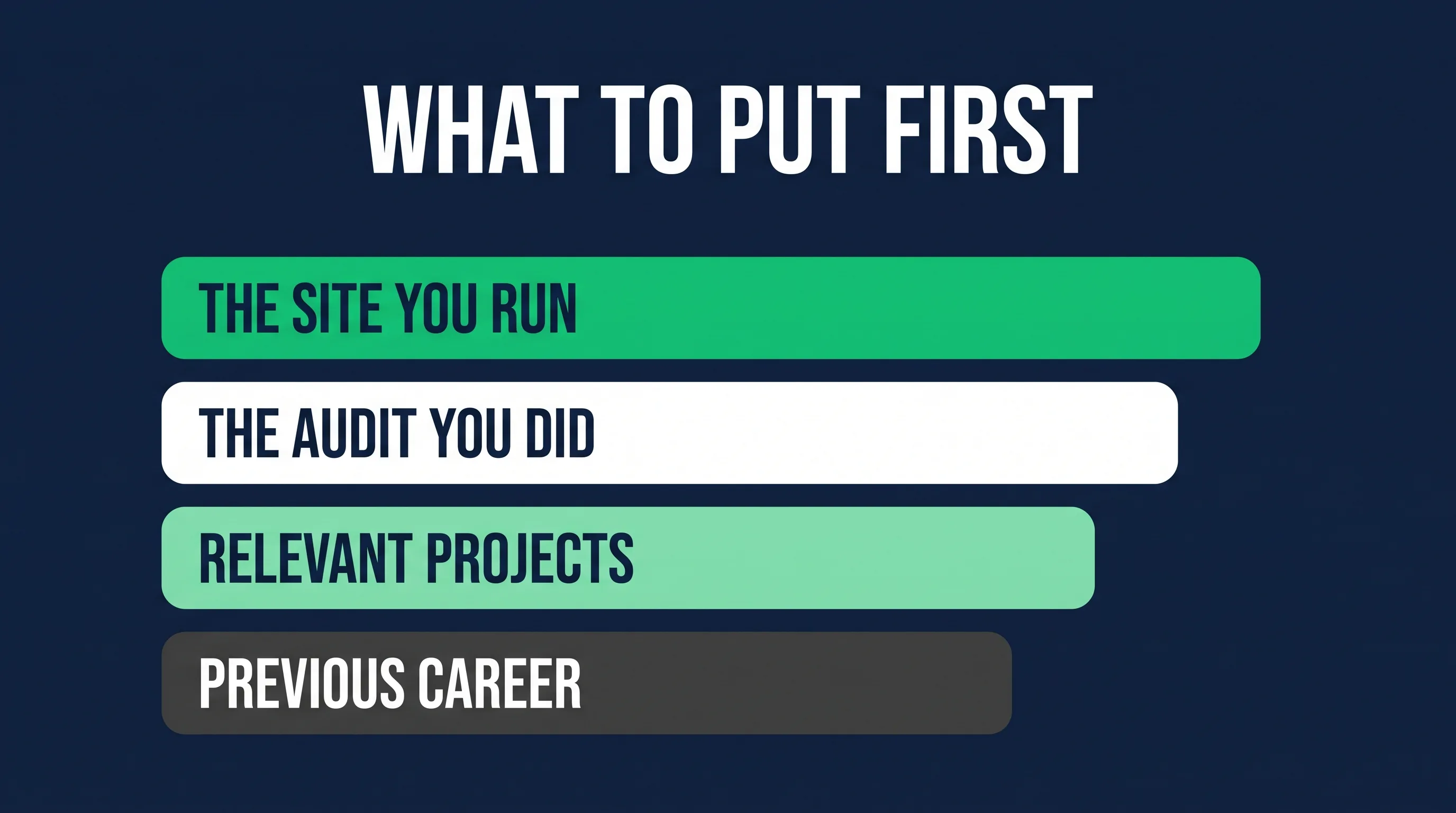
Flip it. The relevant work goes first, whether or not anyone paid you for it, and the rest of your history sits underneath as supporting evidence that you're a functional adult who shows up.

The structure that works
Name, location, one line of contact. Include a link to the site you run. That link is doing more work than anything else on the page.
A two-line summary, not a paragraph. Something like: "Web content manager with hands-on WordPress and Drupal experience, including a 400-page site migration and an accessibility remediation project. Comfortable in HTML and CSS." Concrete, specific, no adjectives about passion.
Relevant experience. Paid or not. A site you run for a nonprofit belongs here, described exactly like a job. Include the organization, what you were responsible for, and what changed.
Other experience. Your previous career, compressed. Two or three bullets each, and only the parts that transfer: coordinating stakeholders, managing deadlines, owning a process, catching errors.
Skills. Grouped and honest. Platforms, technical, and the rest.
Education and certifications. Small, at the bottom, unless you're applying to a university that requires a degree.
What the bullets should look like
The rule: what you did, what changed, and a number where one exists.
Weak: "Responsible for updating the company website."
Better: "Managed publishing across a 300-page WordPress site, cutting average request-to-publish time from four days to same day."
Weak: "Helped with SEO."
Better: "Rewrote titles and meta descriptions across 60 service pages and restructured internal linking; organic clicks to that section rose 34% over three months."
Weak: "Made the site accessible."
Better: "Audited the site against WCAG 2.1 AA, fixed contrast and heading structure issues on 120 pages, and documented standards for future publishing."
You do not need enormous numbers. "Cut broken links from 240 to 6" is a perfectly good bullet and it tells a hiring manager exactly what kind of person you are.
What to include if you have no direct experience
This is the situation most readers are actually in, so let's be specific.
The site you run. Build one if you don't have one. Real content, real structure, live. List it as a project with the same formatting as a job.
The audit you did. Pick a real organization, audit their site, and list it: "Conducted an accessibility and SEO audit of a 90-page nonprofit site, identifying 40 issues and delivering a prioritized remediation plan." That's real work whether or not they hired you.
Volunteer work. Almost every small nonprofit has a website nobody maintains. Six months of maintaining one is legitimate experience and nobody cares that it was unpaid.
The transferable parts of your old job. Retail managers coordinate people and catch errors under time pressure. Teachers manage stakeholders and explain things clearly. Admins own processes. Say those things in the vocabulary of this job rather than the old one.
The route to generating all of this in about three months is laid out in how to become a web content manager.
Keywords that matter
Many of these roles, especially at universities, hospitals, and government agencies, go through an applicant tracking system before a human reads them. Use the actual words from the posting where they're true.
Commonly screened terms: the CMS by name (WordPress, Drupal, Sitecore, Contentful, Adobe Experience Manager), HTML, CSS, SEO, Google Analytics, Google Search Console, accessibility, WCAG, content migration, taxonomy, information architecture, redirects, and content governance.
Two rules. Only claim what you can discuss for five minutes in an interview. And write them into real bullets rather than dumping them in a skills block, because a bullet proves context and a list proves nothing.
Our résumé builder inside the membership is built around getting through these screens, which matters more in this job family than in most.
What to cut
The objective statement. Nobody has read one since 2009.
Soft skill lists. "Detail-oriented, team player, self-starter" occupies space and persuades no one. Show it in a bullet instead.
Jobs older than about ten years, unless directly relevant.
Every task from your old job. You're not describing your history, you're arguing for a specific role.
References available on request. Assumed.
Tailoring, quickly
You don't need a bespoke resume per application, but you do need two things per posting.
Match the title. If they say "web content specialist," use that phrasing in your summary rather than insisting on "manager." The titles are interchangeable, as the 26 job titles guide lays out, and matching theirs reads as relevant while matching yours reads as generic.
Lead with their platform. If the posting says Drupal and you know Drupal, that word belongs in your first two lines.

Send the audit with it
The most effective thing I know for this particular job family, and it takes an hour.
Before you apply, run through their live site. Find three specific problems: pages failing contrast checks, missing meta descriptions, a broken mobile menu, orphaned pages, a redirect chain. Write them up in a short document with what you'd do about each.
Attach it. Reference it in the first line of your email.
It works because it's the exact deliverable the job produces, and because most organizations hiring for this role already know their site is a mess. You're not claiming you'd be useful, you're demonstrating it before they've paid you anything.
FAQ
What should a web content manager resume include? A short factual summary, relevant experience including unpaid site work, bullets with outcomes and numbers, a grouped skills section naming your CMS, and a link to a site you actually run.
How do I write one with no experience? List the site you built and the audit you produced as projects, formatted like jobs. Then translate the transferable parts of your previous work into this job's vocabulary.
How long should it be? One page for under ten years of experience, two at most. Nobody reads the third.
Do I need a portfolio as well? A live URL is enough for most of these roles. An audit document alongside it is stronger than a designed portfolio site.
Which keywords get past applicant tracking systems? The CMS by name, HTML, CSS, SEO, accessibility and WCAG, Google Analytics, migration, taxonomy, and governance. Only include what you can defend.
Should I use the same resume for web administrator and web content specialist postings? Same content, adjusted title language. They're the same job with different labels, and matching the posting's wording helps at the screening stage.
If you take one thing from this page, make it the first section. The site you run belongs at the top, before your job history, even if nobody paid you for it.
Hiring managers for these roles are looking for evidence that you have already had your hands on a website. Everything else on the page is context.