AI Automation Certifications: My Honest Take on the Badge Wall
On this page
Eleven AI badges in the certifications section of a LinkedIn profile I looked at this week. "Certified AI Practitioner." "Prompt Engineering Fundamentals." "Generative AI for Business Leaders," which is a real thing somebody paid for. All eleven earned between February and April, most of them from outfits whose names I had to google, and the googling turned up webinar landing pages with countdown timers on them.
Right underneath that profile in the same search results was another one. Certifications section: basically empty. But the headline said "Built 14 automations that save a logistics company 30+ hours a week."
Guess which one gets the interview.
If you're trying to break into automation work you're probably staring at a wall of courses wondering which certificate unlocks the door. I have opinions here, because I've sat in the hiring conversations where both of those profiles came up, and I'd rather save you the money.
The honest truth: this field is too new for certs to gatekeep
AWS certifications can gatekeep cloud jobs because AWS has been the default for fifteen years and everybody agreed on it. The CPA gatekeeps accounting because a licensing board with legal authority says so.
AI automation has none of that. Nobody owns the credential layer yet. There is no "the" certification that a hiring manager filters résumés by, and in my experience anyone telling you otherwise is selling one.
That cuts both ways and you have to hold both halves at once.
The bad half: because nobody's gatekeeping, badges are cheap. Any company with a landing page can mint an "AI Automation Certificate" by Friday, and thousands of them have. Infinite supply, so the market price of a generic badge sits somewhere around zero.
The good half: the platform credentials, the ones issued by tools that companies actually run their business on, do something a generic certificate can't. They plug you into a partner ecosystem. Directories, referral networks, agency listings. Places where the client goes looking for you instead of the other way around.
That's the lens for the rest of this. Forget whether a certificate is impressive. Ask whether it connects you to anyone who hires.
Zapier certifications and the Zapier Experts program
The closest thing to a standard in this space is probably Zapier's credentialing, and only because Zapier is the tool non-technical teams already have opinions about. A hiring manager will recognize it on sight. That alone puts it ahead of most of this list.
The bigger prize is the Zapier Experts program, which is their vetted partner directory. Companies with broken automations and no internal talent go there to find someone, so it's one of the very few credentials that can generate inbound work instead of decorating a profile. Requirements, tiers, and the application process all shift around, so go read Zapier's current partner page instead of trusting a blog post about it. Including this one.
What you get: the widest brand recognition of anything here, plus a directory with real client demand sitting behind it. The certification process will also genuinely make you better at Zapier, which I did not expect the first time through.
What you don't: the Experts side is built for freelancers and agencies, not job seekers, and getting in means showing real client work. Zapier skills are also the easiest thing in the world for an employer to test in an interview, so the paper matters a lot less than the reps.
Worth it if you're freelancing or building an automation side business, or you're going after ops roles at companies you already know run on Zapier. If you haven't picked a platform yet, my Zapier vs Make breakdown will help you choose before you sink weeks into a credential path for the wrong tool.
Make Academy and partner credentials
Make (formerly Integromat) runs the same play. Free training through Make Academy, certifications stacked on top, partner program above that for agencies and consultants.
Make's ecosystem is smaller than Zapier's and more technical, which is exactly why the credential can be worth more in the right room. Agencies that build gnarly multi-branch scenarios standardize on Make, and when they hire, "Make certified" functions as a real filter because so few people bother to get it. The training teaches architecture rather than button-clicking, which shows up in how people talk in interviews. Same caveat as before: verify the current program details on Make's site.
The cost is recognition. Outside Make-heavy shops it lands with a thud, and the partner tier is an agency play, not a résumé line for a W-2 job. Worth it if you want agency or freelance work, or a specific shop you're targeting builds in Make. Skip it if everyone on your list is Zapier or n8n.
HubSpot certifications (Marketing Hub, workflows, automation)
Here's the sleeper. HubSpot Academy certifications are free, and HubSpot is wedged into so many marketing and sales teams that the credential shows up in actual job descriptions, which almost nothing else on this list can claim.
For automation work the Marketing Hub and workflow certifications map straight onto RevOps-flavored roles: marketing ops, sales ops, lifecycle automation. Those postings literally contain the string "HubSpot certified," so the certificate doubles as an ATS keyword. Free, recognized issuer, real keyword match. That ratio is hard to argue with.
The catch is that it certifies you inside HubSpot's world, and because it's free and quick it can't carry a résumé by itself. Everyone in RevOps already has it. Nobody gets hired because of it, they just don't get filtered out. Aiming at marketing ops or anything where the stack includes HubSpot? Get it. At a price of zero I'd say get it anyway.
Cloud and AI vendor learning paths (Google Cloud GenAI badges and friends)
Google Cloud's generative AI badges, Microsoft's AI fundamentals paths, whatever AWS is calling theirs this quarter. These are proof of curiosity. Nobody has ever handed out an automation project because someone finished a badge path.
They're free or close to it, the issuers are names everyone knows, and the conceptual grounding in how the AI layer works is fine. That's the whole value. A hiring manager sees a GenAI badge and thinks "okay, this person is paying attention," which counts for a little if you're pivoting in from a non-technical background and need to show momentum. But stacking five of them reads worse than having one plus a project. One, if you're brand new and want the structure. Then stop.
The badge trap
Now the part that annoys me.
There is an entire industry of "AI certification" mills whose actual product is the feeling of progress. Weekend webinar, forty-question multiple choice, shiny PNG, $300. The premium tier charges $2,000 and adds the word "Master" to the title, and the curriculum is the same webinar with a slower narrator. They advertise to exactly the person who is anxious about being left behind, which is everybody right now, and they know it. That's the business model. Not education. Anxiety, monetized, with a certificate stapled to the receipt.
I've watched people collect six of these and then wonder why the phone never rings. It's genuinely painful, because the effort was real. Those weekends were real. The money was real. That badge wall on the profile I opened with? Every certificate on it was legitimately earned and completely worthless, and the person who earned them did nothing wrong except believe the wrong story about how this field works.
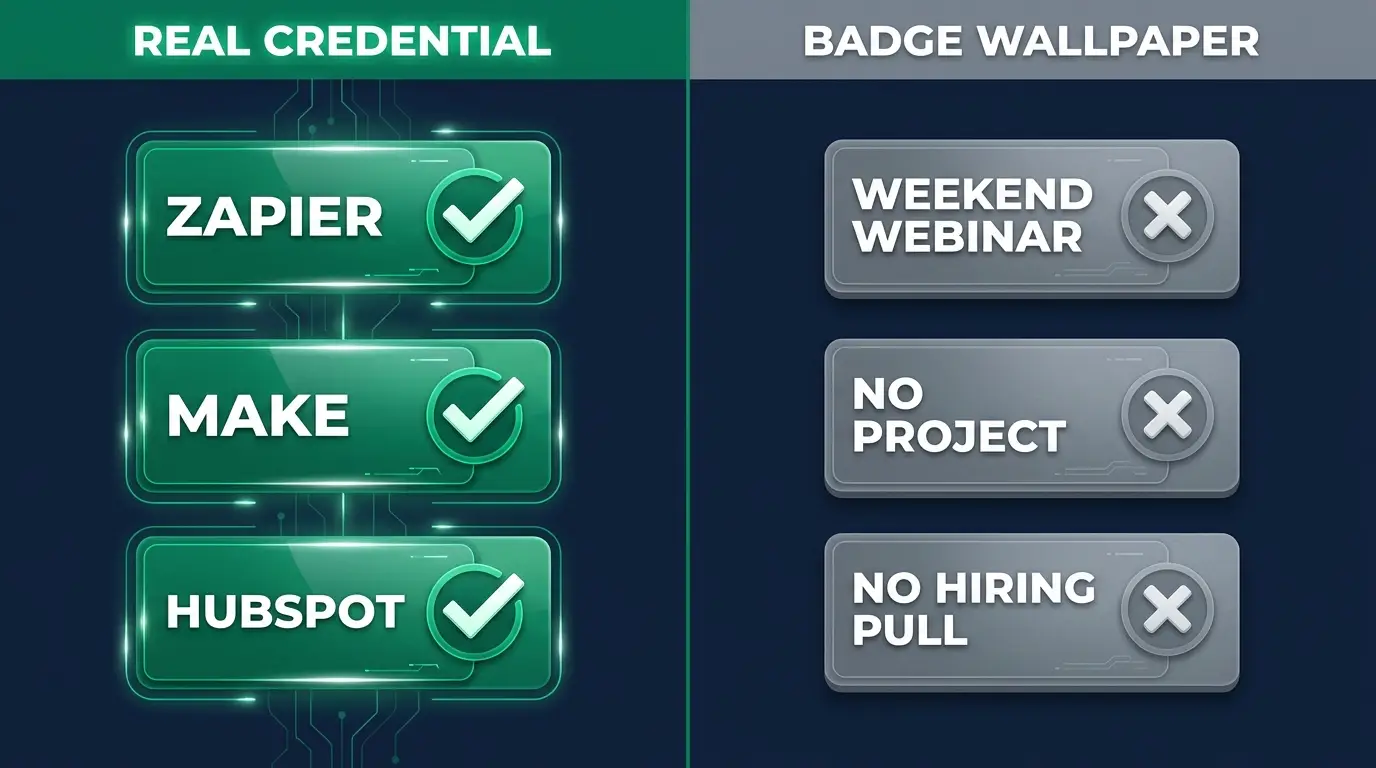
Two questions sort a real credential from LinkedIn wallpaper.
Did it require building something? Real credentials make you ship a working automation, a scenario, an artifact that a human being evaluates. If the assessment is a quiz you can pass with the docs open in another tab, the badge certifies that you can open a tab.
Does the issuer have hiring pull? Zapier has a client directory. HubSpot's name appears in job postings. Google is Google. If the issuing company's only product is certificates, there's no ecosystem behind the badge, and a credential without an ecosystem is a JPEG.
A badge says you watched something. A number says you built something. "Certified AI Practitioner" is a badge. "Cut invoice processing from 6 hours to 40 minutes a week" is a number, and hiring managers believe numbers because numbers are checkable.
Which is why two or three documented automations with real time-saved figures beat every credential in this post put together. If you're not sure what that looks like in practice, I broke down real AI automation portfolio examples piece by piece.

The order I'd do them in
Starting from zero today, this is my order:
- Learn one platform deeply and build first. Pick your tool (here's my current tool rundown), then build three automations for a real business, even a free one for the barbershop down the street. Write down the hours saved.
- HubSpot workflow and automation certs next. Free, fast, gets ATS keywords on the page while your portfolio is still growing.
- Zapier certification once you have builds to show. Chase the Experts directory only if you're going freelance or agency. Make's track instead, if that's your ecosystem.
- One vendor GenAI badge, maximum. Signal that you understand the AI layer, then quit collecting and go build.
Certificates support a portfolio. They don't replace one.

FAQ
Do I need a certification to get an AI automation job? No. There's no required license and no default credential in this field. Working automations with measurable results get you interviews. Certifications mostly help you clear keyword filters and give a hiring manager a reason to trust the portfolio a little faster.
Which AI automation certification is the most recognized? No single standard exists yet. Zapier's credentials have the broadest name recognition, HubSpot's turn up most often in real job postings, and Make's carry weight inside Make-focused agencies. Recognition depends almost entirely on what the company you're targeting actually runs.
Are free certifications taken seriously? The good ones, yes. HubSpot Academy and the vendor learning paths are free and still respected, because the issuers have hiring pull behind them. Price isn't the signal. Whether you had to build something, and who issued it, is.
How long does it take to get certified? Most platform certifications take days to a few weeks of study, not months. The slow part is the building experience underneath, which is also the part that's worth anything. If you want the full path from zero, read how to become an AI automation specialist.
Will certifications help me pass interviews? They help you get the interview. Passing it means talking through real builds: what broke, what you'd do differently, what it saved the business. I collected the AI automation interview questions that actually come up, so you can prep against the real thing instead of a guess.
If you want a structured way to get there, the AI Automations career path at CodingPhase takes you from your first workflow to portfolio-ready builds, with completion certificates for every course and a résumé builder designed to get those credentials and projects past ATS screening and in front of an actual human.
Skip the badge wall. Build the fourteen automations. Be the profile with the number on it.
I'm rooting for you.