Shopify Developer Certifications and the Proof That Beats Them
On this page
A student messaged me last year in a small panic. He'd spent three weeks studying for what he thought was the Shopify certification exam, couldn't find where to register for it, and wanted to know if he was missing something obvious.
He wasn't. There isn't one. Not the way there's an AWS Solutions Architect exam with a testing center and a proctor watching you through your webcam.
If you're coming from that world, Shopify feels weirdly quiet here, and the silence makes people assume they've overlooked a page somewhere.
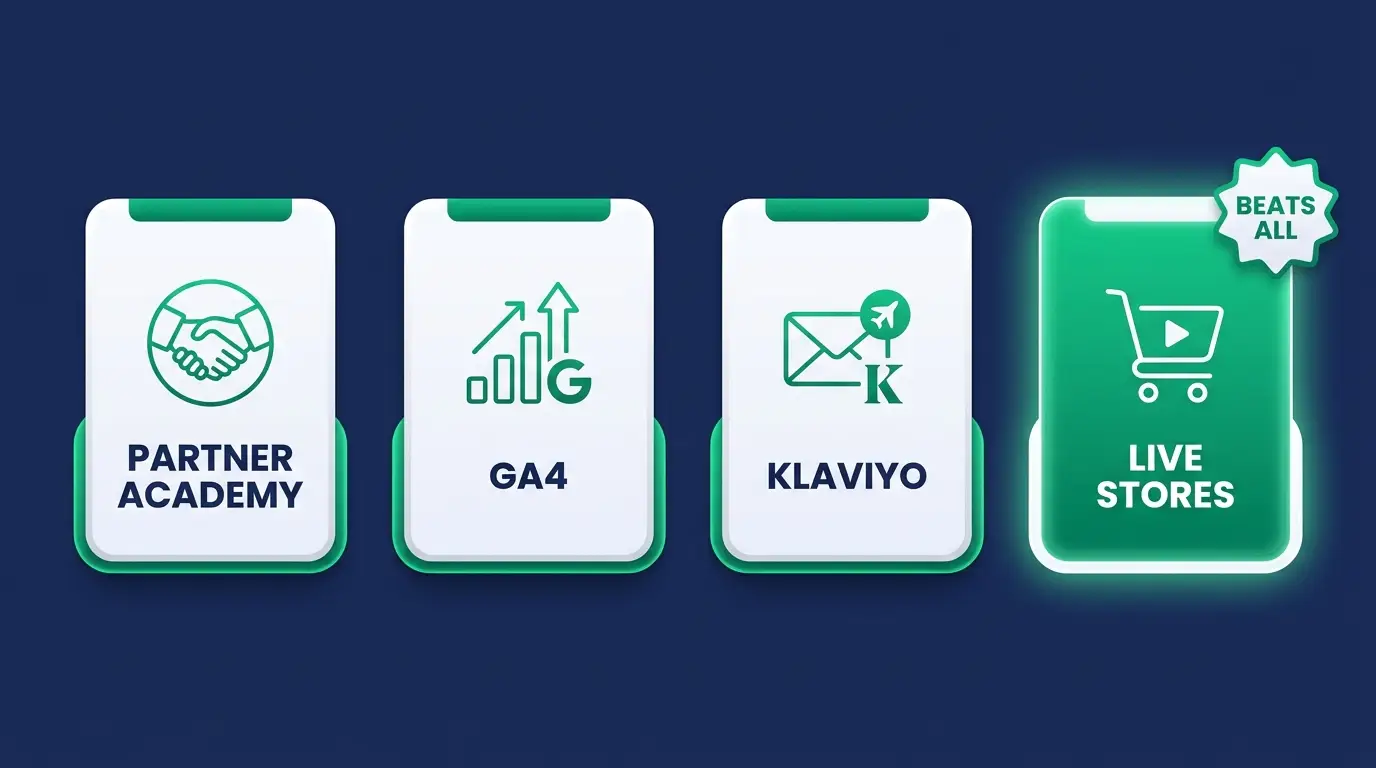
So here's the answer up front. Shopify's credentialing exists, it lives inside the Partner ecosystem, and it's smaller than you'd expect. Most of the badges worth having in this career aren't Shopify badges at all. And none of them will do as much for you as one live store a client can click on.
The honest truth about Shopify credentials
Shopify's approach to credentials has been renamed, retired, folded into the Partner program, and rebuilt more than once. That's what happens when a platform ships this fast. It also means any post promising the definitive list of Shopify certifications goes stale, this one included, so check the current Partner program pages before you plan around a specific badge.
What hasn't changed is where it lives. Sign up as a Shopify Partner (free), and from there you get training, development stores, and an actual business relationship with the company.
Now the part I need you to sit with. I had a client back in my agency days, a candle company doing maybe $40k a month, and across two calls and a signed contract she never once asked what I'd studied. She asked one thing: "Can I see stores you've built?" I sent three links. That was the whole interview.
Clients hire proof, not paper.
Every credential below matters only in how it gets you to proof faster, or how it breaks a tie when two developers both have it.
Starting from zero? Read how to become a Shopify developer first. This post assumes you're already building.
Shopify Partner Academy and Partner program credentials
Closest thing to official that exists. Inside the Partner Dashboard, Shopify has offered training and assessments covering theme development, app development, and store setup. The exact lineup shifts around, so verify on the current Partner pages, but the shape has held: free training, tied to your Partner account, aimed at people doing client work.
Now, I want to argue with the way most people frame this one, because they treat the badge as the point and it isn't.
Join for the ecosystem. Unlimited development stores means you can build practice stores and client builds without paying for a plan, which for a beginner is the difference between practicing and not practicing. There's revenue share when you refer merchants. There's a Partner community where merchants show up looking for help, and I've watched people land their first paid work there before they finished a single course.
That's the value. Free, made by Shopify, and it matches how the platform actually behaves rather than how a third-party course thinks it behaves. The assessments themselves are not hard enough to filter for real skill and hiring managers know it, so nobody's hiring you off the badge alone. Merchants mostly don't know it exists.
Do it anyway if you're freelancing or chasing agency work, because agencies run their whole business through that dashboard and they'll recognize it instantly. Going merchant-side instead? It's a resume line. Fine, but a line.
Shopify's developer docs and changelog: the invisible certification
No badge, no exam, nothing for your LinkedIn. It's also the credential interviews actually test.
You'll get grilled on how the Storefront API differs from the Admin API, what metaobjects are and when you'd reach for them, how Functions work, and whether the tutorial you learned from is now three deprecations behind. None of that comes from a certification course. It comes from living in the developer docs and reading the changelog like it's your morning news.
I call it the invisible certification because senior developers can smell it on you in about five minutes. Someone who tracks the platform knows what shipped last quarter. Someone who doesn't will confidently recommend an approach Shopify quietly killed in March.
It's free and it's always current, which is more than any exam can say. The catch is you can't frame it. It only shows up under questioning, which is exactly why you should drill Shopify developer interview questions out loud instead of just reading them.
Worth it if you plan to get paid to write Shopify code. So, always.
Klaviyo Academy certification
Leaving Shopify's walls now, and this is where the money conversation starts.
Almost every serious Shopify store runs email and SMS, and Klaviyo owns a big share of that market. Klaviyo Academy offers free training and certifications, and here's the thing that matters: merchants recognize the name, because they're writing Klaviyo a check every month.
Why I rate this so highly for freelancers is that it changes what you can sell. A store build is a one-time project, you deliver it, you invoice, you go find another one. Email flows are ongoing. When you can say "I'll build your store and set up your welcome flow, your abandoned cart sequence, the post-purchase emails," you've moved out of the pile of people who tweak themes for $500.
The honest downside: it's marketing-adjacent. If your dream is deep app development, building on Functions all day, writing Rust for a living, this is a detour and you'll feel it.
Worth it if you freelance or want agency work. Email is often a third of an ecommerce client's revenue.
Google Analytics (GA4) certification
Google's free GA4 cert through Skillshop takes a weekend and impresses nobody, and I still think most Shopify freelancers should have it, because merchants live and die by conversion rate and most of them are staring at a GA4 dashboard they cannot read.
The badge is worthless. The fluency is what pays: being the person who says "your mobile checkout drop-off is double your desktop drop-off, let's fix that" is how you stop being priced like a contractor. That conversation is also how you raise your rates, which I break down in the Shopify developer salary guide.
General ecommerce and CRO credentials
There's a tier of paid programs, CXL-style conversion optimization courses and things in that neighborhood, that go deep on experimentation and buyer psychology. Programs and pricing change often, so verify before you pay anyone.
My take: optional, and probably later than you think. They're built for the developer who already has clients and wants an edge in the revenue conversation. I'd never tell a beginner to spend hundreds of dollars here before shipping three stores.
Worth it if you're established, selling optimization retainers, and the cost is a business expense against real income.

The order I'd do them in
If I were starting today:
- Join the Shopify Partner program on day one. Free, and you need the dev stores to build anything.
- Live in the developer docs while you build your first practice store.
- Ship two or three real stores. Steal ideas from these Shopify developer portfolio examples.
- Take the Partner Academy training that matches your lane, themes or apps.
- Add Klaviyo Academy when you start talking to actual clients.
- Grab the GA4 cert once client conversations turn to conversion.
- Consider a paid CRO program only after the income justifies it.
The portfolio sits at step three, not step seven. That's on purpose.
What a badge can't do for you
A certification can't make a slow theme fast. It can't calm a nervous client at 9pm the night before their launch, when she's convinced the checkout is broken and it's actually her ad account. It can't show taste, and taste is half of what merchants are buying.
I've watched developers collect badges like Pokemon cards while avoiding the scary part, which is putting real work in front of real people who might not like it. The badge feels like progress because it comes with a score at the end. Do the scary part instead.
Credentials do earn their keep in one place: presentation. Two candidates, both with solid portfolios, and the one whose resume cleanly lists relevant certifications wins the coin flip. That's why CodingPhase courses come with completion certificates, and why the membership's resume builder puts your credentials where ATS scanners actually look. The badge frames the proof. It never replaces it.
FAQ
Is there an official Shopify developer certification? Sort of. Shopify offers training and credentials through the Partner program, but there's no single famous industry exam like AWS has. Check the current Partner program pages, since the lineup changes.
Do Shopify certifications get you hired? Alone, no. Agencies and clients hire based on stores you've built. Certifications break ties and get you past resume filters, especially at agencies.
How much do Shopify certifications cost? The core ones here are free: the Partner program, Partner Academy training, Klaviyo Academy, and Google's GA4 cert. Paid CRO programs exist but are optional.
How long does it take to get certified? Each free certification takes a weekend to a couple of weeks of casual study. Genuine fluency in Shopify's docs and APIs takes months, and that's the part that pays.
Should I get certified before building my portfolio? No. Build first. A certification with no portfolio reads as theory. A portfolio with no certification gets hired every day.
Take one thing from this post: clients hire proof, not paper. Go build the proof, and let the badges be the bow on top.
If you want a structured path from your first Liquid file to a portfolio that closes clients, the ecommerce specialist career path walks you through it, with certificates waiting at the end of every course. I built it for the guy who messaged me in a panic about an exam that doesn't exist. I'd love to see what you ship.