PHP Developer Certifications: What I Tell My Students
On this page
Somewhere right now there's a hiring manager with two PHP resumes open in two browser tabs. The first one has a credentials section, centered, with "Zend Certified PHP Engineer" in it. The second one has a URL in the third line of the summary: a live Laravel app, real users on it, and under that a GitHub profile with eight months of commits that aren't all named "update."
You already know which tab stays open.
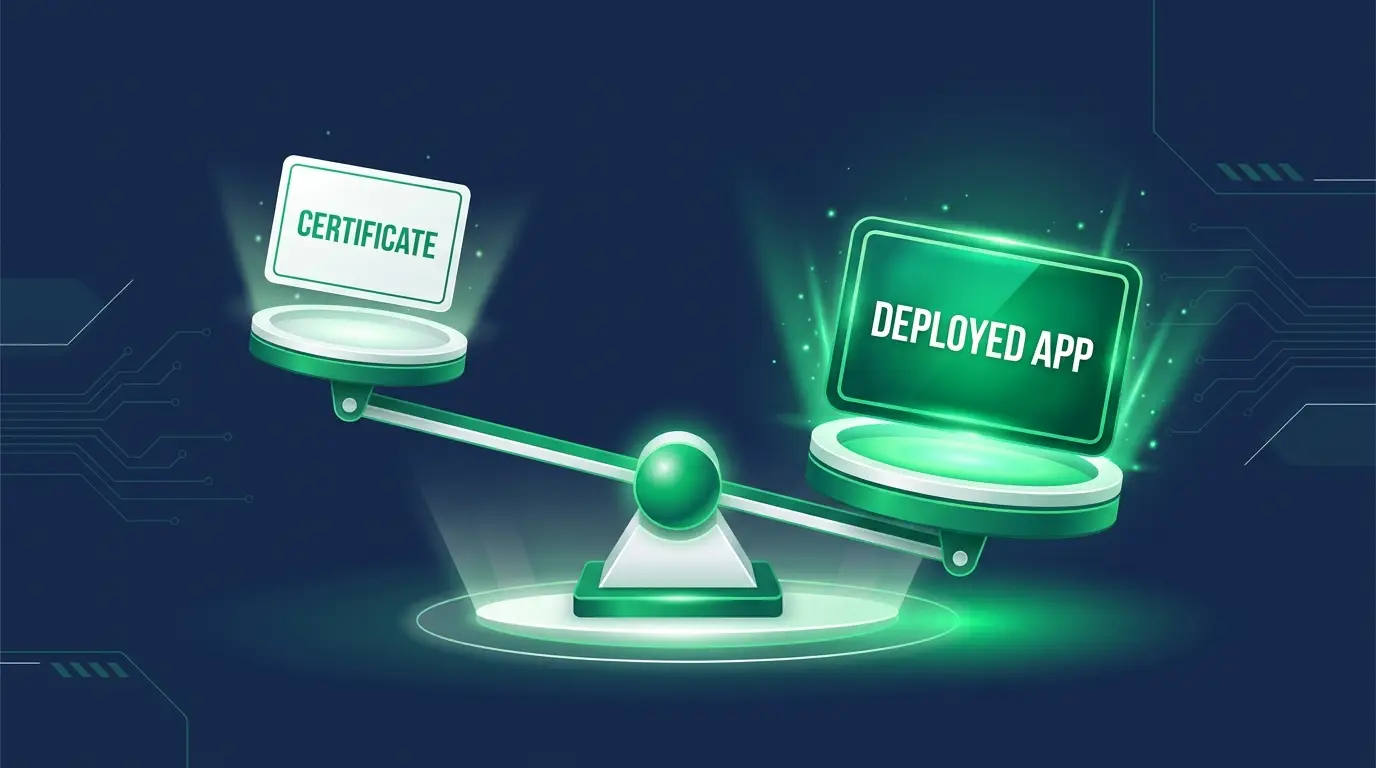
I've been on both sides of that desk. I've hired developers, I've watched thousands of students go through the whole thing, and I'm going to tell you what nobody selling exam prep will: in PHP, the deployed app wins almost every time.
Which doesn't make certifications useless. It makes them a specific tool for a specific job, and most people buy one without knowing what job they're hiring it for. So here's the whole list, honestly.
The honest truth: PHP hiring barely looks at certs
Some fields are credential-driven. Networking has Cisco baked into the job descriptions. Security has CISSP quietly gatekeeping entire career levels.
PHP isn't one of those fields. I'd argue web development with PHP is more portfolio-first than almost any other corner of tech.
Here's why. Most of the companies hiring PHP developers are agencies and product companies shipping real things on deadlines that were already tight last week, and the person interviewing you is usually a working developer who has a ticket open in another window. What they want to know is whether you can build and whether you can ship.
A certification answers "did you study?" A live project answers "can you do the job?" Different questions, and hiring managers know it.
So if you're a junior weighing three months of exam prep against three months of building and deploying a real Laravel application, build the app. I have never once seen a student lose an offer because they lacked a certificate. I've watched plenty lose offers because there was nothing to click on. If you need ideas for what to build, I put together PHP portfolio examples that actually get interviews.
Certs do have real uses, though, and I want to be fair to each one.
Zend Certified PHP Engineer
This is the granddaddy, and I want to make the real case for it before I knock it down.
The Zend exam is legitimately hard. It goes underneath the frameworks: language internals, OOP, security, arrays, string handling, the parts of PHP that Laravel politely hides from you. Developers who hold it usually know the language cold, and you can tell within about ten minutes of talking to them. In enterprise shops and legacy-heavy environments, especially the ones maintaining a codebase somebody started writing in 2008, there is a senior person on that team who respects this cert, because they took it, or they wanted to.
Now the downside. For most junior web roles it's overkill. The exam tests language trivia that day-to-day framework work barely touches, and the agencies and startups doing most of the hiring will not pay you a dollar more for it. The prep time could have produced two portfolio projects with your name on the domain.
Worth it if: you're targeting enterprise PHP teams, or you're doing consulting where a formal credential helps close a deal, or you're mid-career and want to prove you know more than the framework. Availability and pricing shift, so check Zend's official page for the current format before you commit to anything.
Laravel certification programs
Big asterisk on this one. An official Laravel certification has existed in a few forms over the years, and availability has been genuinely spotty: programs launched, paused, changed hands. Verify what's actually on offer the day you go looking, because I honestly can't promise what you'll find next quarter.
The honest take. In the Laravel community, no badge carries as much weight as visible work. Laracasts progress, contributions to open source packages, an app built the way Laravel is meant to be used: that's the currency, and Laracasts and the official docs quietly carry more community weight than any credential ever has. Taylor Otwell's ecosystem rewards builders. Hiring managers in that world open your GitHub first, and sometimes only.
If a certification exists when you look and the price doesn't sting, it's a decent structured way to confirm you've covered the whole framework instead of the four features you happen to use. Treat it as a syllabus with a receipt.
Cloud provider certs (AWS Cloud Practitioner and similar)
Here's the sleeper pick. Cloud certs aren't PHP certs at all, but I keep seeing them on PHP job listings, and there's a reason.
Nobody gets hired to write PHP in a vacuum. They get hired to deploy things. A developer who can push a Laravel app to production on AWS, wire the database, and not take the site down on a Friday is worth more than one who's only ever run php artisan serve.
The good. AWS Cloud Practitioner is entry-level, affordable, and it teaches you the vocabulary of modern deployment. You stop being the person who goes quiet when someone says "check the S3 bucket." Exam details and pricing change, so confirm on the official AWS certification page.
The honest downside. It's foundational, not deep. Nobody hires you because of Cloud Practitioner. It complements PHP skills and never substitutes for them.
Worth it if: you've already shipped projects and want to round out your resume for full-stack roles, or you keep seeing "AWS experience a plus" on the jobs you actually want.
Database credentials (MySQL-oriented certs)
Oracle offers MySQL certifications, and a few other database credentials float around.
For a web developer, these have limited pull. Almost every PHP job expects SQL, but they test it by making you write a query in the interview, not by scanning your credentials line. The common PHP interview questions will squeeze your database knowledge harder than a certificate ever will.
Worth it if you're drifting toward DBA or data engineering work, or an enterprise employer names it specifically. Otherwise, learn SQL deeply and let a project prove it.
Where a cert actually helps
I've been tough on certs, so let me be fair about where they earn their keep.
Enterprise and agency HR filters. Big companies sometimes have non-technical recruiters screening resumes against a keyword list. A recognized cert can get you past that first gate on a day when your portfolio link would have been skimmed past. This is the strongest practical argument for Zend, and it has nothing to do with the exam being good.
Visa and contract paperwork abroad. If you're chasing work visas or government and corporate contracts in some countries, formal credentials carry documented weight that "check out my GitHub" doesn't. Immigration paperwork loves an official certificate with a date on it.
Structured learning. This might be the best reason of all. A syllabus makes you cover your blind spots instead of only building what's comfortable, and nobody ever has to ask about the badge for that to have been worth it.
Which is why every course at CodingPhase comes with a completion certificate, and why we built a resume builder designed to pass ATS screening. The certificate documents the structured learning. The resume builder makes sure a keyword filter never bounces you before a human gets to see the projects.

The order I'd do them in
If you're going to collect any of these, here's my sequence for a PHP developer:
- None, at first. Build and deploy two real projects. Step one, not optional. If you're starting from zero, my guide to becoming a PHP developer lays out the full roadmap.
- AWS Cloud Practitioner. Cheapest, fastest, and it directly improves your ability to deploy the projects from step one.
- A Laravel certification, if one is currently offered and you're working in that ecosystem. Use it as a structured review.
- Zend Certified PHP Engineer, only when you're targeting enterprise or consulting work and the depth genuinely serves your path.
- MySQL certs only if your career is bending toward data.
Projects first. Credentials as accessories, never the reverse.

FAQ
Do I need a certification to get a PHP developer job? No. Most PHP developers working today have zero certifications. A deployed application and a clean GitHub profile are the standard proof of skill in this field.
Is the Zend certification worth it for beginners? Usually not. It's deep, focused on language internals, and built to prove mastery you don't have yet. As a beginner your time pays back far more in projects. Come back to it if you end up targeting enterprise teams.
Is there an official Laravel certification right now? It has existed in various forms with inconsistent availability. Check the official Laravel site for the current status before planning around it, and remember the community values shipped Laravel work over any badge.
Which certification pays the most for PHP developers? None of them move salary the way experience does. If any credential nudges your number, it's a cloud cert, because it supports the full-stack and DevOps-adjacent work companies actually pay a premium for.
Do certifications expire? Many do, or get pinned to a specific version. AWS certs need renewal every few years, and version-specific certs age as the technology moves. One more reason to treat them as accessories.
If you keep one line from this, keep this one: certifications prove you studied, shipping proves you can build.
That's the whole philosophy behind the PHP developer career path at CodingPhase. Every course pushes you toward real projects you can deploy and link to, because I've watched what gets people hired for years now and it has never once been a badge. It's the work.
Go build something with a URL. I'm rooting for you.