Email Marketing for Small Business: Start Here
On this page
A woman who runs a small candle shop showed me her email list a few months back. Eight hundred and twelve contacts. Real people, real emails, collected at checkout over three years.
She had never sent a single one.
"I didn't know what to say," she told me. "And I didn't want to be annoying."
I hear a version of that constantly. You've got customers who already gave you money. They liked what you sell enough to hand over a card and an email address. And that list is just sitting there, doing nothing, while you pour money into ads trying to find strangers who might do the same thing those eight hundred people already did.
That's the whole reason I want you to read this. Email is the one marketing channel where you already own the audience. Nobody can throttle it. Nobody changes an algorithm and cuts your reach in half overnight. If you have the emails, you can reach the people. Full stop.
Let me walk you through how to actually start, without the jargon and without spending money you don't have.
Why email beats social for a small business
Most people get this backwards. They spend all their energy on Instagram followers and forget that a follower is a rental. You don't own that relationship. Instagram does. The day they tweak the feed, your posts reach a fraction of the people who chose to follow you.
An email list is different. It's yours. You export it, you keep it, you take it with you if you ever switch tools or platforms. When you send an email, it lands in an inbox. Not a feed where an algorithm decides whether it's worthy.
And the money math leans hard in email's favor. I won't throw a fake-precise stat at you, because the studies bounce around and half of them are quoting each other. But the direction isn't in dispute: a warm list of past buyers converts far better than cold traffic, because those people already trust you.
Social media is how people find you. Email is how you turn them into repeat customers. You want both eventually, but if you can only build one muscle first, build this one.
I go deeper on the revenue side in how to use email marketing for sales if you want the money angle spelled out.
Building a list the right way
Before you send anything, you need people to send to. And I need to be blunt about one thing: do not buy a list. Ever. Purchased lists are full of dead addresses and people who never asked to hear from you, and they'll wreck your ability to land in inboxes at all. One good way to torch your sender reputation on day one is to blast a thousand strangers who never opted in.
Build it honestly instead. It's slower. It works.
Start with the people already in front of you:
- At checkout. If you sell anything, online or in person, ask for the email. Online, make it a checkbox at the register. In a physical shop, a tablet on the counter or a small sign works.
- A reason to sign up. "Join our newsletter" is weak. "Get 10% off your first order" or "Be the first to know when we restock" gives someone a reason to hand over their address today.
- Your existing contacts. The candle shop already had 812. Look in your point-of-sale system, your old order records, your inbox. You probably have more than you think, as long as those people actually bought from or contacted you.
One honest caveat on the discount thing. A first-order coupon pulls in signups, but some of those people only want the coupon. That's fine. A percentage of them become real customers, and the math still wins. Just don't be shocked when not every signup turns into a loyal fan.
If you want a deeper playbook on the mechanics of clean list growth and deliverability, I put the fundamentals in email marketing best practices.
The first flows to set up
A "flow" is just an automated email that fires when someone does something. You set it up once and it runs forever without you touching it. This is where email stops being a chore and starts being a machine that works while you sleep.
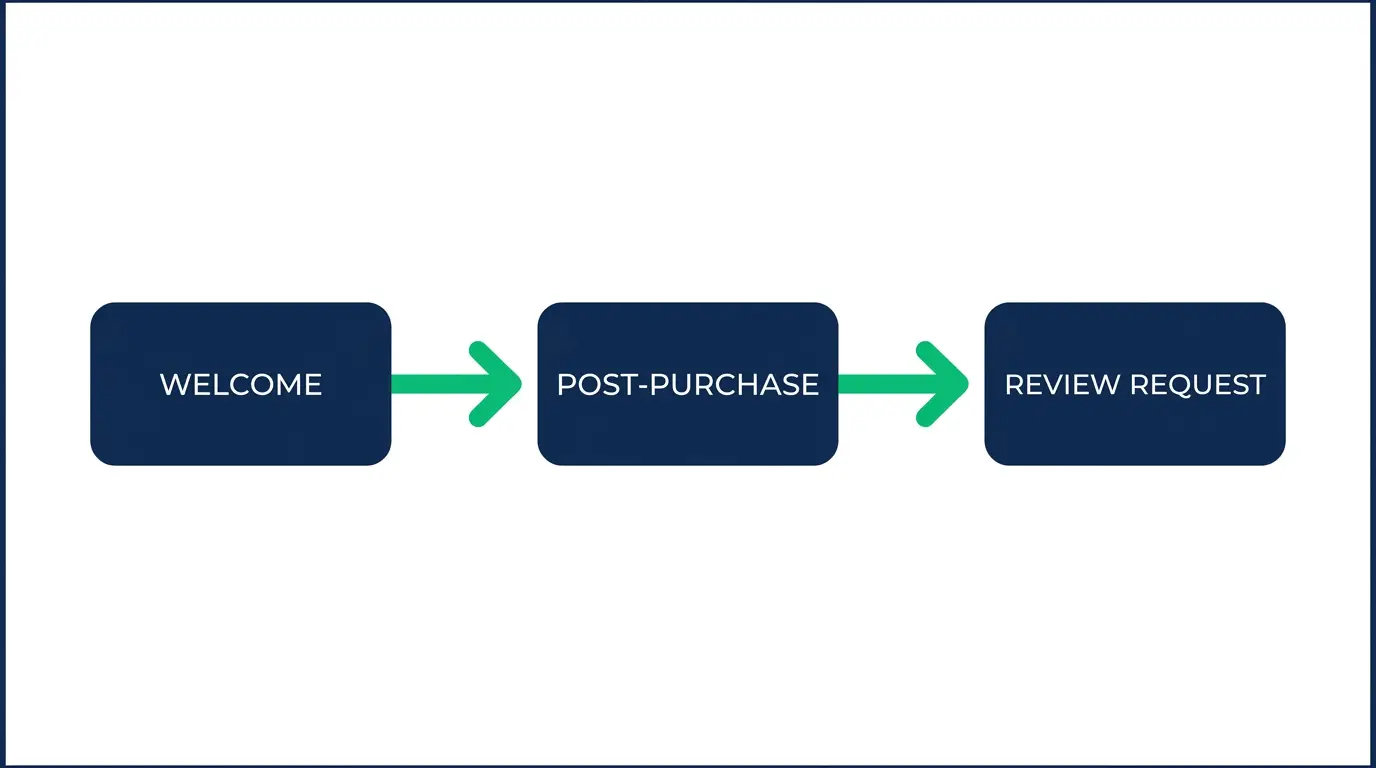
You do not need ten of these. You need three.
The welcome flow. Someone joins your list, and an email goes out within a few minutes. This is your best-performing email you'll ever send, because the person just raised their hand and you're fresh in their mind. Say hello, tell them who you are in two sentences, deliver the coupon you promised, and point them at your best-selling product. That's it. One email is plenty to start. You can add a second and third later.
The post-purchase flow. Someone buys, and you follow up. First a receipt and a thank-you, then a day or two later a "here's how to get the most out of what you bought" note. This one quietly does a lot. It cuts down "where's my order" support messages, it makes people feel taken care of, and it sets up the next flow.
The review request. A week or so after the product would have arrived, ask for a review. Keep it short and make the link stupidly easy to click. Reviews are social proof that sells to the next hundred shoppers, and the only reason most small businesses don't have enough of them is that they never ask.
That's your foundation. Welcome, post-purchase, review. If you set up nothing else this year, these three will earn their keep.

Your first campaign
Flows run in the background. A campaign is a one-time email you send to your whole list, or a chunk of it, on purpose. A sale, a new product, a piece of news, a story.
For your first one, don't overthink it. Pick something you're genuinely doing anyway: a new item that dropped, or a weekend sale, or the story of why you started the business in the first place. Write it the way you'd talk to a regular customer who walked into your shop, because that's who's reading it.
A few things I'd tell you before you hit send:
Write a subject line a real person would open. "August Newsletter" gets ignored. "The candle everyone's been asking about is back" gets opened. The subject line is the whole game for whether the email gets read at all, so spend real time on it.
Keep it short. One idea, one link, one clear button telling people what to do next. Nobody reads a wall of text from a business in their inbox.
Send it to yourself first. Read it on your phone, because that's where most people will see it. If it looks cramped or the button's hard to tap, fix it before it goes out to everyone.
Then send it. Not to a "perfect" segment, not after three more rounds of edits. Send it. Your first campaign will be a little clumsy and that is completely fine. You learn more from one real send than from a month of planning.
Which tool should you actually use
This is where people freeze up, so let me make it simple by matching the tool to who you are.
Mailchimp. The default most people know. Free tier to start, easy enough to figure out, does everything a beginner needs. The downside is the price climbs as your list grows and it can get pushy about upgrades. Fine starting point if you want the most tutorials and the most familiar name.
MailerLite. My usual pick for someone who wants clean and cheap. The interface is friendlier than Mailchimp, the free tier is generous, and it doesn't drown you in features you'll never use. Probably the easiest on-ramp for a non-technical owner who just wants to send good emails without a headache.
Brevo. Worth a look if you also want to text customers or you're watching every dollar, since its pricing is based on emails sent rather than how many contacts you store. Handy when you've got a big list you email occasionally.
Klaviyo. Built specifically for e-commerce. If you're on Shopify or WooCommerce and you're serious about revenue, Klaviyo plugs into your store and knows what people bought, which makes those post-purchase and review flows much smarter. It costs more than a brand-new shop needs on day one. But if selling products online is your business, it's built for exactly you. I broke down that choice in Klaviyo vs Mailchimp if you're stuck between those two.
If you have no idea, start with MailerLite or Mailchimp's free plan, get your welcome flow live, and send one campaign. You can always move later. The tool matters way less than the habit.
What not to over-do
Now the honest part, because most email advice is written by people trying to sell you more email software.
Don't email every day. You are not a daily deals site. For most small businesses, somewhere around two to four times a month is plenty. Enough that they remember you exist, not so much that they start dreading your name in the inbox.
Don't buy fancy automation you can't fill. I've watched owners set up a twelve-email nurture sequence and then have nothing to say in emails four through twelve, so the whole thing reads like filler. Three good emails beat twelve boring ones. Every time.
Don't obsess over open rates the week you start. Watch the trend over a couple of months, not the number on Tuesday. And ignore anyone who tells you there's a magic send time that changes everything. Test it yourself if you're curious, but it's a rounding error compared to just sending consistently.
An email list is a relationship you get to keep. Treat it like you'd treat a regular who walks into your shop every week, and you'll never have to wonder what to send.
If you're curious about the bigger picture of automating the rest of your marketing beyond email, that's a whole separate topic I cover in marketing automation for small business. This post stays on email on purpose, because email is where you start.
FAQ
What is the best email tool for a small business?
There isn't one winner for everyone. For most non-technical owners starting out, MailerLite or Mailchimp's free plan is the easiest place to begin. If you run an online store and care about revenue tied to what people bought, Klaviyo is built for you. Watching costs on a big list? Brevo prices by emails sent rather than contacts stored. Pick one, get a welcome flow live, and move later if you outgrow it.
How often should I email my list?
For most small businesses, roughly two to four times a month works well. You want to stay familiar without becoming the sender people mute. If you have something genuinely useful or interesting to say, send it. If you're emailing just to hit a quota, skip it. Consistency matters more than frequency.
Is email marketing worth it for a small business?
Yes, and it's usually the highest-return channel a small shop has, because you're talking to people who already know you. You own the list, so no algorithm can cut off your reach. The cost to start is close to zero. If you only build one marketing habit this year, this is the one I'd pick.
You do not need a marketing degree to do this. You need a list, three flows, and the willingness to send one clumsy first email. The candle shop with 812 contacts sent her first campaign a week after we talked. It made more in one afternoon than her last month of ads.
If you want to go further, whether that's running this yourself with real skill or becoming the person other businesses pay to do it for them, that's exactly what we teach. Come learn the technical marketing skills that turn a side task into an income. Plenty of developers have made the same jump into this work, which I wrote about in why engineers switch to martech. A lot of the people making good money here started right where you are, staring at a list they'd never used.
Start with one email. You've got this.