Claude Code Pricing: Every Way to Pay, and Which Plan You Actually Need
On this page
The post you're reading was drafted by one of five Claude Code subagents I had running at the same time.
Each one got its own git worktree, its own slice of a five-post cluster, and the same rulebook: a CLAUDE.md file in the repo, a memory folder with about 35 notes Claude has saved about how I like things done, a few skills, and MCP servers for Ahrefs keyword data, Higgsfield image generation, Brevo, and an analytics server we built into codingphase.com itself. I kicked them off and watched five research-heavy drafts start taking shape at once, which still feels a little absurd.
That's the fun part. The other part is that five agents doing research in parallel chew through a usage allowance a lot faster than one person typing questions into a terminal. So when people ask me "how much is Claude Code?", the honest answer starts with another question: how are you going to use it?
Below is every way to pay, what each option buys you in actual usage, and how I'd pick if I were starting over today. All prices below come from Anthropic's pricing page and help center as of September 23, 2026. They change, so check that page before you pay for anything.
The short answer: how much is Claude Code?
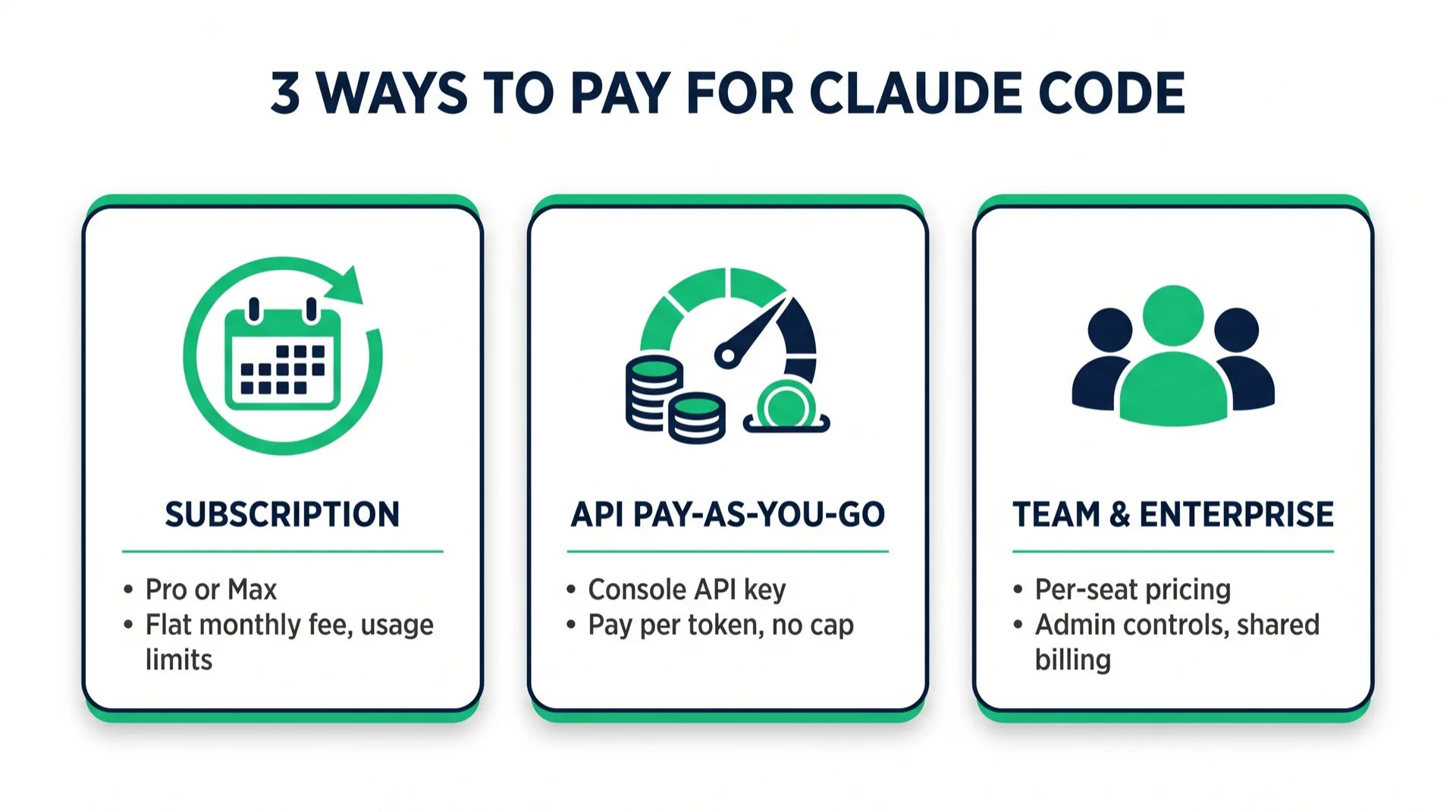
Claude Code itself doesn't have a separate price tag. You get it one of three ways:
- A Claude subscription (Pro or Max) that includes Claude Code, with usage limits.
- Pay-as-you-go API usage through a Claude Console account, billed per token.
- A Team or Enterprise plan for companies, priced per seat.
The free Claude plan does not include Claude Code. The cheapest way in is Pro, at $20 a month billed monthly, or $17 a month if you pay $200 for the year up front.
Here's the whole menu in one place:
| Plan | Price | Claude Code? | Usage you get |
|---|---|---|---|
| Free | $0 | No | Chat only |
| Pro | $20/mo, or $17/mo billed annually ($200/yr) | Yes | At least 5x Free, per 5-hour session |
| Max 5x | $100/mo (monthly billing only) | Yes | 5x Pro, per 5-hour session |
| Max 20x | $200/mo (monthly billing only) | Yes | 20x Pro, per 5-hour session |
| Team, Standard seat | $25/seat/mo, or $20 billed annually | Yes | More than Pro |
| Team, Premium seat | $125/seat/mo, or $100 billed annually | Yes | 5x a Standard seat |
| Enterprise | $20/seat/mo billed annually, plus usage at API rates | Yes | Metered, scales with model and task |
| API (Console) | Per token, see model prices below | Yes | No plan limit, you pay for what you use |
Team plans are for groups of 2 to 150 people. The Max plans are monthly only, so there's no annual discount there.
What "usage" actually means on a subscription
This is the part that confuses everybody, and I get why. Anthropic doesn't sell you a number of messages. There's no fixed count.
Instead, every plan has a limit that resets on a rolling five-hour window, and paid plans stack a weekly limit on top of that. How far a window stretches depends on how long and complex your sessions are, which model you're running, and which features you lean on. A quick question about a regex costs almost nothing. An hour of Claude reading your whole codebase with Opus and extended thinking costs a lot more.
Two details matter more than people realize.
Chat and Claude Code share one pool. If you spend your afternoon brainstorming in the Claude app and then open the terminal, you're drawing from the same allowance. Anthropic's FAQ is explicit about it: web, desktop, mobile, and Claude Code all pull from one place.
Long sessions get expensive quietly. Claude Code sends your full conversation with every request. Prompt caching softens that, but a one-line question in a session you've had open all day still carries the weight of the whole day. Anthropic's own docs call this out, and I'd bet it's behind most of the "I barely did anything and I hit my limit" complaints you see online.
When you do hit the limit on Pro or Max, you can wait it out or upgrade. The option people miss is usage credits: flip them on in Settings > Usage and you keep working past the limit at standard API rates, with a monthly spending cap you choose.

The API route: pay per token, no ceiling
If you'd rather not deal with limits at all, you can run Claude Code on an API key from a Claude Console account and pay for exactly what you use. Here are the per-model prices from Anthropic's pricing docs, per million tokens:
| Model | Input | Output | Cache read |
|---|---|---|---|
| Fable 5.1 | $10 | $50 | $0.25 |
| Opus 5.5 | $4 | $20 | $0.20 |
| Sonnet 5 | $2 | $10 | $0.20 |
| Haiku 4.5 | $1 | $5 | $0.10 |
A few notes that change the math:
- Output costs five times input on every one of these models, and thinking tokens bill as output. A model that reasons at length before answering is doing most of its spending in that column.
- Cache reads are cheap. On Sonnet 5 a cached read is a tenth of the normal input price, and Claude Code caches automatically. That's why long sessions aren't ruinous, just heavier than you'd guess.
- The Batch API is 50% off, but that's for asynchronous jobs you build yourself, not your interactive Claude Code session.
- Fast mode for Opus 5.5 runs up to 2.5x faster at 2x the standard price. Nice when you're in a hurry. Not nice on the invoice.
So what does a real developer spend? Anthropic publishes its own numbers for this in the Claude Code cost docs: across enterprise deployments, the average is around $13 per developer per active day and $150 to $250 per developer per month, and 90% of users stay under $30 per active day.
Read that next to the subscription prices and you can see why I think most individual developers are better off on a plan. If your API bill would land around $150 or more a month, Max 5x at $100 is the better deal, as long as you can live inside its limits.
The gotcha nobody warns you about: if you have an ANTHROPIC_API_KEY environment variable set on your machine, Claude Code uses it instead of your subscription. You'll pay API rates while your Max plan sits there unused. Run /status inside Claude Code to see which account you're actually on. I'd check this the first day, before a surprise shows up on a credit card statement.
Team and Enterprise, in plain terms
If you're buying for a company, the individual plans are the wrong tool. You want central billing and SSO, and you probably don't want employee code sitting under consumer data terms either.
Team is flat per seat, and you can mix seat types. Most people get a Standard seat at $25 a month ($20 billed annually), and your heaviest Claude Code users get a Premium seat at $125 ($100 billed annually), which carries 5x the usage of a Standard seat. For a small agency or startup this is usually where I'd start.
Enterprise works differently. It's $20 per seat per month billed annually, plus usage billed at API rates. You're paying for the seat, then paying the meter. What you get for that is heavier admin tooling: spend limits per user and per org, SCIM, audit logs, custom data retention, role-based permissions. If you're rolling Claude Code out to fifty engineers, that's the version where finance can actually see and cap what's happening.
There's one more route I'll mention and then move on: companies already committed to a cloud provider can reach Claude models through Amazon Bedrock, Google Cloud, or Microsoft Foundry and bill it there. Pricing on those runs through your cloud contract, so I won't quote it.
What my own setup burns through (and why)
I build codingphase.com, a Laravel app with an Inertia and React front end, in Claude Code every day. Features, bug fixes, the admin dashboards, the blog you're on.
The heavy days aren't the days I write the most code. They're the days I fan work out. A normal session is me and one Claude in one worktree fixing a checkout bug. A heavy session is what produced this post: several subagents working in parallel, all loading the same CLAUDE.md, all hitting Ahrefs and web search to verify facts before they wrote a word about pricing. Every one of those agents is its own context window. The cost scales with how many you run and how long they run, roughly the way you'd expect.
Anthropic says this outright for agent teams: token usage is roughly proportional to team size, and teams running in plan mode use about 7x the tokens of a standard session.
Put plainly: your Claude Code bill tracks how many Claudes you run at once, far more than how much code you write.
If you work with one agent at a time, Pro goes further than the internet will tell you. If you like fanning out subagents (I wrote more about how in Claude Code subagents), you're a Max customer whether you like it or not.
How to pick the right plan
Here's how I'd decide.
Pick Pro ($20, or $17 annually) if you're learning or you mostly run one session at a time. Start here even if you think you'll need more. Upgrading is prorated, and a couple of weeks of real work will show you your actual pattern.
Max 5x at $100 is the next step, and the trigger is simple: you hit Pro's limit most days and it's eating real working time. For someone who earns money writing software, one stalled afternoon costs more than the $80 difference. Max 20x at $200 is for people like me, where Claude Code is the main tool all day and parallel agents are normal. If you keep hitting the 5x ceiling, that's your answer.
Pick the API if your usage is spiky (nothing for a week, then a huge weekend project) or you're scripting automation on top of Claude Code and want a per-token paper trail. Just set a workspace spend limit in the Console before you start.
And if anyone besides you is using it on the company's dime, skip all of the above and go Team or Enterprise.
One more honest note on comparison shopping: if you're weighing Claude Code against an editor-based tool, I broke that down separately in Cursor vs Claude Code, and there's a wider roundup in my list of the best AI coding agents.
How to keep Claude Code costs down
Most of these come straight from Anthropic's cost docs, and I use nearly all of them. They help on a subscription (your window lasts longer) and on the API (your bill shrinks).
Clear between tasks. /clear starts a fresh session and costs nothing. Stale context from your last task gets re-sent with every message of the next one. This is the biggest win and it's free.
Default to Sonnet, reach for Opus on purpose. Sonnet handles most coding work fine at half the price of Opus per token. Switch with /model when you hit a genuinely hard architecture problem. For simple subagent jobs, you can set model: haiku in the subagent's config.
Turn the effort down on easy tasks. Thinking tokens bill as output, the expensive column. /effort lets you lower it for routine work. (You can't switch thinking off on Opus 5.5 or the Fable models.)
Keep CLAUDE.md lean. It loads into every session. Anthropic suggests keeping it under 200 lines and moving workflow-specific instructions into skills, which only load when used. Mine sits right around 190, and I feel that ceiling every time I want to add a rule. The memory system helps here too, and I get into that in Claude Code memory.
Prune your MCP servers, too. /context shows what's eating space and /mcp lets you switch off servers you aren't using; where a CLI exists, like gh, it's leaner than an MCP server anyway. And push noisy work (test runs, giant log files) into a subagent, which keeps the mess in its own context and hands back a summary.
Plan before you build. Shift+Tab into plan mode for anything complex. Paying for Claude to explore and propose is cheaper than paying for it to build the wrong thing and then undo it. And write specific prompts. "Add input validation to the login function in auth.ts" is cheap. "Improve this codebase" makes Claude read everything.
Watch it. /usage shows your plan bars and, on paid plans, a breakdown of what's eating your allowance: which skills, subagents, plugins and MCP servers, plus flags for things like long context or cache misses.

Is Claude Code worth it for a learner?
This is where I'll disagree with a lot of the hype.
If you're learning to code, Claude Code can make you faster at the wrong thing. It will happily write a working Laravel controller you don't understand, and you'll feel productive right up until something breaks and you have no idea where to look. I've been teaching since 2016, and the students who get stuck hardest are the ones who can't read the code they shipped.
So for a learner my advice is: Pro, and not a dollar more. Use it to explain code you're reading and to unstick you after you've genuinely tried on your own. Don't buy Max to learn faster. More agent time doesn't teach you anything by itself.
A working developer is a different conversation. If your time is worth $50 an hour, Pro pays for itself the first time it saves you half an hour in a month, and even Max 20x only needs to save you about four hours. For most people who use it daily, it clears that bar easily. For me it's not close.
The honest downside for working devs: limits are real and weekly caps exist, so a crunch week can hit a wall at the worst moment. Usage credits are the escape hatch, but they bill at API rates, so set that monthly cap before you need it.
FAQ
Is Claude Code free?
No. Claude Code isn't included on the free Claude plan. You need a paid plan (Pro, Max, Team, or Enterprise) or a Claude Console account with API credits. The Claude Code software itself is free to install; you pay for the model usage behind it.
Is there a Claude Code student discount?
Not a standing one. Anthropic's help center says it doesn't offer standard discounted pricing on paid plans and that support can't issue one-off coupons. What does exist: some universities buy Anthropic's Education plan, which gives students access through the school, so ask your IT department whether yours has it. The Claude Campus Program also runs student clubs that share resources like API credits, though it's closed for Fall 2026. Otherwise, the cheapest legitimate route is Pro billed annually at $17 a month.
Is the $20 Claude Code plan worth it?
For learners and developers who work one session at a time, yes. It's the plan I'd tell almost anyone to start on. If you hit the limit most days and it's blocking paid work, that's your signal to move to Max 5x.
Why is Claude Code so expensive compared to a chat subscription?
The subscription price is the same one you'd pay for chat. What changes is how fast you spend it. An agent that reads files, runs tests, and loops on its own sends far more tokens per task than a chat, and each request carries the whole conversation. That's why heavy users feel the limits and casual chat users never do.
Can I use my Pro or Max plan and an API key at the same time?
You can have both, but Claude Code will prefer an ANTHROPIC_API_KEY environment variable over your subscription if one is set. Unset it and run /status if you want to be sure you're on the plan. When you run out of plan usage, you can also turn on usage credits instead of switching to a separate API account.
Can I pay for Max annually?
Not right now. Max 5x and Max 20x are monthly subscriptions only. Pro and Team both offer annual billing.
If you take one thing from all this, make it the order of operations: learn the fundamentals, start on Pro, and let your actual usage tell you when to upgrade. The tool gets more valuable the more you understand what it's doing for you.
That understanding is what we build at CodingPhase. Our guided career paths take you from the basics to job-ready, and if you're curious where AI agents fit into a career, how to build an AI agent is a good next read. If you want to keep going with Claude Code specifically, the Claude Code SDK post shows how to script it into your own tools.
Go build something this week, even something small. I'm rooting for you.