ActiveCampaign vs Klaviyo: Which Email Platform Actually Fits Your Business
On this page
A guy emailed me last year, furious at Klaviyo. He ran a small architecture practice. Six clients a year, projects worth forty grand each, sales cycles that ran four months of phone calls and revised proposals. He'd set the whole thing up in Klaviyo because a YouTube video told him Klaviyo was the best email platform, and now he was staring at a dashboard asking him about abandoned carts. He had no carts. He had people who needed a follow-up call in nine days.
Klaviyo wasn't broken. He'd bought a forklift to move a couch.
Both of these platforms send email. Both automate. On a feature checklist they look like twins, and that's exactly how people end up where he was, a year in, wondering why nothing fits.
Let me save you that year.
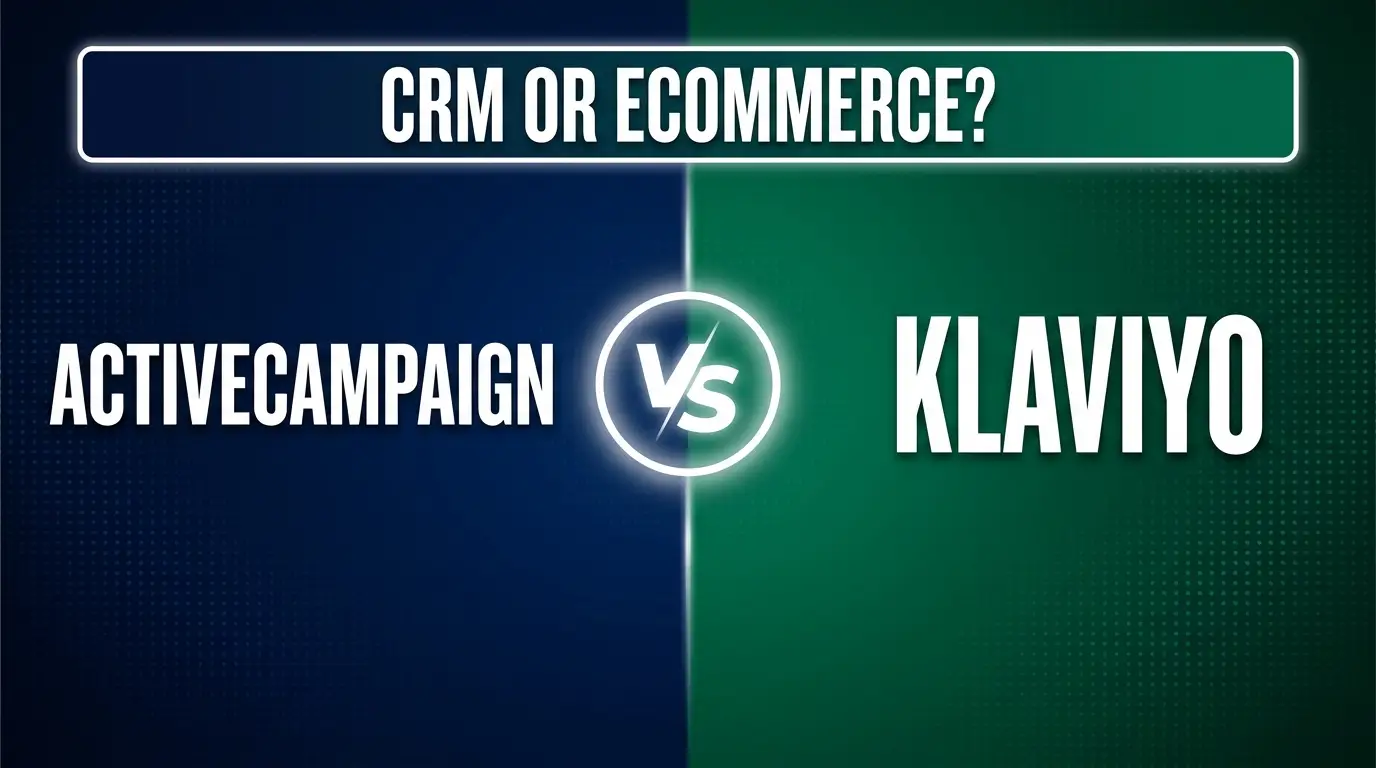
The one-line verdict
If you sell products, pick Klaviyo.
If you nurture leads, clients, or run a service business, pick ActiveCampaign.
Everything below is me showing my work so you can trust it for your specific case.
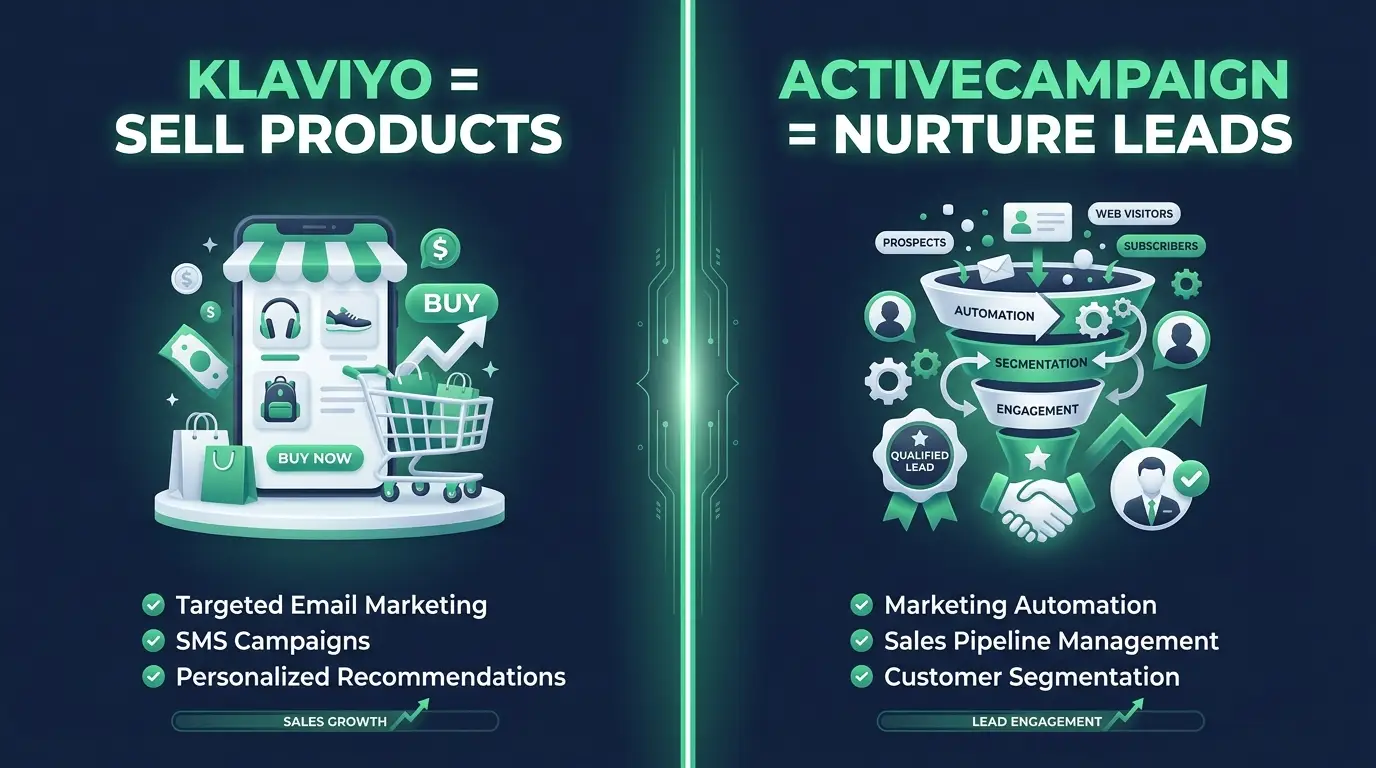
Ecommerce vs CRM: the real divide
These two aren't competing for the same job. They're competing for your attention while doing different jobs, which is a much weirder thing, and it's why every "top email tools" list you've read was useless to you.
Klaviyo is an ecommerce brain. It plugs into Shopify, WooCommerce, or BigCommerce and it knows things about products: what someone browsed, what they abandoned in cart, what they bought last time, how much they've spent lifetime, whether they're about to drift away. Every email can carry that product data. Open the dashboard and the first number you see is revenue, dollars attributed to specific flows. That's the whole personality of the platform. Store behavior in, store revenue out.
ActiveCampaign is a CRM with a serious automation engine bolted on. It cares much less about what product someone viewed and a great deal about where that person sits in your pipeline and what the next right message is. Deals, tasks assigned to actual salespeople, lead scores, long branching nurture sequences. When the thing you sell is a service or a consultation or a relationship rather than a catalog of SKUs, this is the tool that understands you.
So: store or pipeline?
A skincare brand doing 5,000 orders a month is a store. Klaviyo.
The architect with six clients a year is a pipeline. ActiveCampaign. So is the agency, the coach, the B2B software company, the creator with one flagship offer.
If you take one line from this post, take this one: match the tool to what you sell, not to what has the prettiest homepage. No feature list fixes a mismatch there.

Automation builders
Neither of these is a toy. I want to be clear about that, because comparison posts love to pick a loser and there isn't one here. They're both genuinely good, at different things, and you'll feel which one within about a week.
Klaviyo's automations are built around store events. Abandoned cart, abandoned browse, post-purchase upsell, winback, back-in-stock. The pre-built flows are ecommerce playbooks out of the box, and they pull product blocks in on their own. Drop someone into an abandoned-cart flow and Klaviyo already knows which product to show, with a photo and a buy button. For a store, that one behavior is most of the value.
ActiveCampaign's automations are built around logic and people. Its builder is, honestly, one of the best in the business for complex conditional paths. If/then branches, wait-until conditions, goal tracking, lead scoring that shuffles people between segments, and tasks that ping a human at the right moment. If your follow-up looks like a flowchart with fifteen decision points based on what someone clicked or replied to or pointedly ignored, ActiveCampaign handles it without breaking a sweat.
Klaviyo automates transactions. ActiveCampaign automates decisions. Each does the other's job passably and neither does it as well as its home turf.
Segmentation and data
This is where the difference gets loud.
Klaviyo segments on shopping behavior. Placed an order in the last 30 days. Spent over $200 lifetime. Viewed a product but didn't buy. Its predictive analytics take a swing at customer lifetime value and next-order date, which is genuinely useful when you're deciding who needs a discount and who was going to buy at full price anyway. I'd treat those predictions as a strong hint rather than gospel, but they're better than guessing.
ActiveCampaign segments on relationship signals and whatever custom data you feed it. Tags, custom fields, pipeline stage, lead score, page visits. You can build a segment like "opened three emails, visited the pricing page, hasn't booked a call yet" and trigger a nudge. Try expressing that in a tool whose mental model is orders.
If your data is products and orders, Klaviyo reads your mind. If your data is people and where they are in a journey, ActiveCampaign does.
Pricing
Pricing on both platforms shifts, scales with contact count, and gets quoted differently depending on which features you turn on. Treat the shape below as reliable and check current plans on their sites before you commit to anything.
Both charge by how many contacts you have, and both get more expensive as your list grows. Neither is the cheap option past a few thousand contacts.
Klaviyo has a free tier for small lists, then scales on contacts plus whether you're doing email only or email and SMS. Most store owners find it pays for itself, because it's tied directly to revenue you can see. The bill still climbs.
ActiveCampaign sells in tiers, and here's the part that bites people: the features you probably want, the CRM, lead scoring, the deeper automation, live in the higher tiers. The sticker price and the usable price aren't the same number. Budget for a mid tier.
Don't pick on price alone. The subscription is not the expensive part. The expensive part is the year my architect friend spent fighting a forklift.
Deliverability
Both are solid. This shouldn't be your deciding factor, and I'd be suspicious of anyone who tries to make it one.
Klaviyo and ActiveCampaign are established senders with strong infrastructure and good reputations. Mail lands at competitive rates on both. Neither has a deliverability problem that should scare you off.
And deliverability mostly lives in your hands anyway. Authenticate your domain with SPF, DKIM, and DMARC, keep your list clean, stop emailing people who never opted in, warm up gradually. Do that and both platforms treat you well. Skip it and no platform on earth saves you.
Which should you pick
Let me make this decisive, by business model.
Pick Klaviyo if:
- You run an online store on Shopify, WooCommerce, or BigCommerce.
- Your revenue comes from repeat product purchases.
- You want abandoned-cart, browse-abandon, and post-purchase flows working today.
- The number you care about most is revenue per email.
Pick ActiveCampaign if:
- You sell a service, consulting, coaching, courses, or B2B software.
- Your sale takes days or weeks of nurturing, not one click.
- You need a real CRM with deal pipelines and lead scoring.
- Your follow-up logic is complex and conditional.
Still torn? One question. When someone new joins your list, are they closer to buying a product or closer to starting a conversation? Product means Klaviyo. Conversation means ActiveCampaign.
For more matchups, I've broken down Klaviyo vs Mailchimp and Omnisend vs Klaviyo if you're weighing Klaviyo against the rest of the field.

FAQ
Can ActiveCampaign do ecommerce?
Yes. It has ecommerce integrations and it'll run an abandoned-cart flow fine. But it's a CRM that added store features, and for a high-volume store you'll feel the difference every time you build an email around a product. Klaviyo's product-native approach just moves faster there.
Can Klaviyo work for a service business?
It sends email and it automates, so technically sure. You'll miss the deal pipeline, the lead scoring, and the deep conditional logic that a real sales process leans on. You'd be paying for ecommerce muscle you never flex while lacking the CRM you actually need.
Which is easier to learn?
Klaviyo, if you're an ecommerce person, because its templates map to store situations you already understand. ActiveCampaign has a steeper curve, mostly because its builder is more open-ended and more powerful. Power and simplicity trade off. They always do.
Do I need to know how to code to use either?
No. Both are built for marketers, with visual drag-and-drop builders. That said, understanding how email automation, data, and HTML templates actually work under the hood is what separates people who use these tools from people who get paid to run them.
Is it worth switching platforms if I picked wrong?
If you're fighting the tool weekly and losing sales to the mismatch, yes. Migrating a list and rebuilding flows costs you a weekend of annoyance. Staying on the wrong platform is a slow leak that never stops.
Here's the part most comparison posts skip.
Businesses pay specialists to run both of these. Somewhere between $200 and $1,000 a month, or a full salary, to build the automations, wire up the data, design the templates, and keep the machine printing. That someone can be you. The architect I mentioned didn't want to learn any of this. He wanted to hire someone who already had.
Knowing how email systems work across tools, the data, the automation logic, the HTML that renders everywhere, is a real career. It's called email development. Demand is loud and supply is thin. I wrote a full guide on how to become an email developer and a breakdown of the email developer salary if you want the numbers. It's also one of the cleanest ways to launch a one-person agency.
That's exactly what we teach at CodingPhase. Diamond membership is $42/month or $255/year (30% off the $60 and $365 list prices) with a 7-day money-back guarantee, and it gets you every course, the job board, and our email marketing specialist career path. If you want lifetime access and live weekly mentorship, the Tech Accelerator is a $1,500 one-time deal.
Pick the right platform for your business today. Then, if you want, learn to run these tools well enough that businesses pay you for it. I've got you either way.