SEO Content Manager: The Hybrid Role That Pays More Than Either Half

On this page
For years these were two people who mildly disliked each other.
The content person thought the SEO person wanted keyword-stuffed nonsense. The SEO person thought the content person wrote beautiful articles nobody searched for. Both were often right.
The SEO content manager is what happened when companies got tired of refereeing that argument and hired one person to own both sides.

What the job is
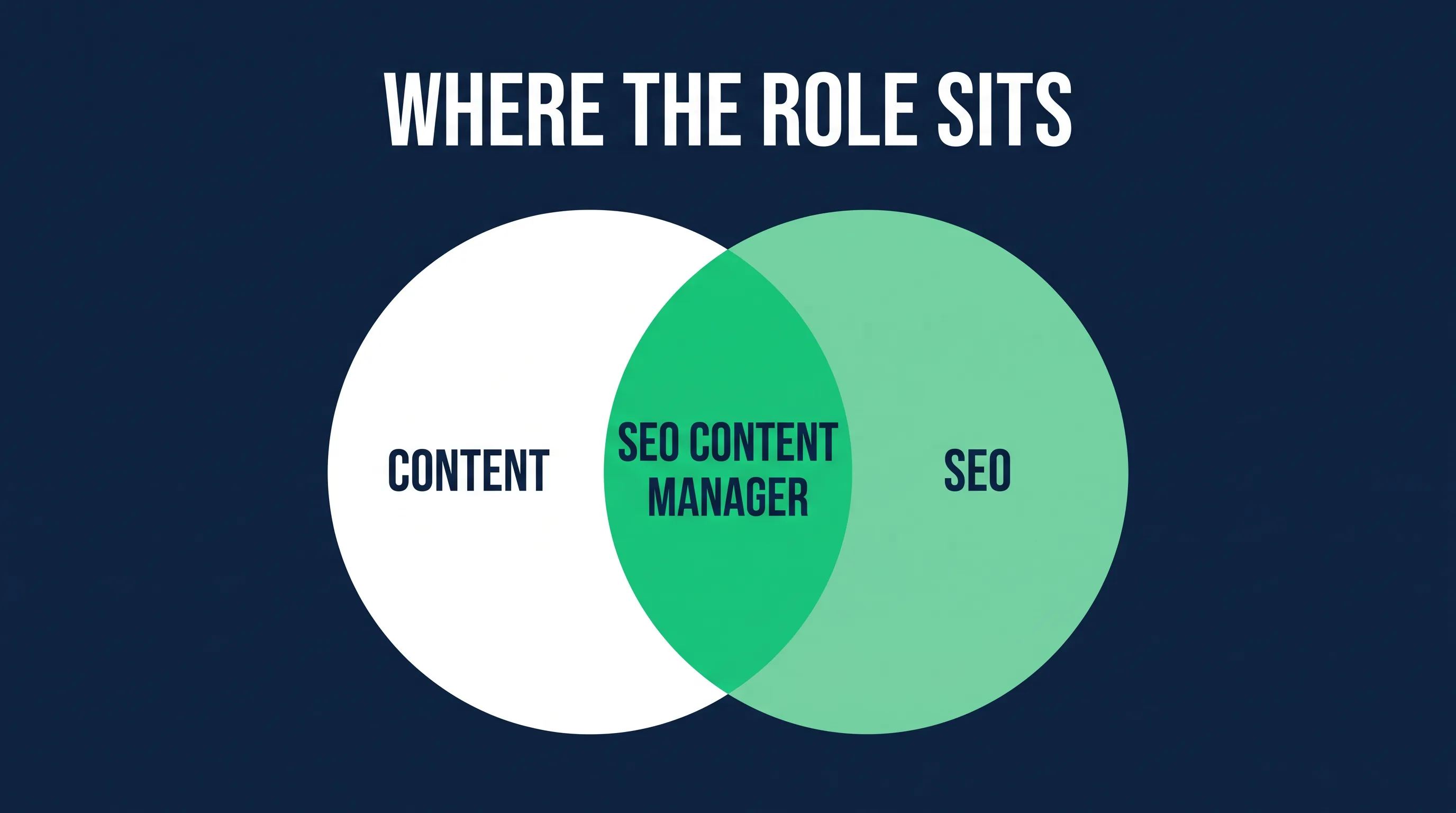
You own the content that has to perform in search. Not all content, and not all SEO. The overlap.
Deciding what gets written. Based on search demand, business value, and what's already ranking. This is where the job either works or doesn't: choosing topics that people search for and that the company can credibly win.
Structuring it. How topics group into clusters, which page targets which intent, and how they link together so the important pages get supported.
Briefing and editing. Writing the brief that tells a writer what the page must cover, then editing for quality and search fit without flattening the voice.
Improving what exists. Usually the highest-return work in the whole role. A page ranking at position eleven that gets rewritten properly can double its traffic in a month, which no new page will do.
Pruning. Deciding what to merge or delete. Most content libraries carry hundreds of pages that dilute the site.
Measuring. Rankings, organic traffic, and ideally what it produced commercially.
How it differs from the neighbors
The titles blur, so here's the practical split.
A content strategist owns what content should exist across the whole organization, including things with nothing to do with search. Broader, less search-specific.
An SEO manager owns organic performance including technical work, site architecture, and links. Broader on search, lighter on editorial quality.
The SEO content manager sits in the middle and goes deeper than either on the specific question of what to publish and how it should read. At a small company, one person does all three.
What it pays
$70k to $100k for most US SEO content managers, with senior roles at $100k to $125k.
That's higher than a general content manager and comparable to an SEO manager, which is the point: the hybrid is worth more than either individual skill, because there are far fewer people who genuinely have both.
The people at the top of that band can all do one extra thing: tie content to revenue rather than to traffic. Traffic is a vanity number in most businesses. Someone who can say which pages produce pipeline gets treated differently in budget conversations.
Why AI made this role more valuable
Reasonable people assumed AI writing tools would eliminate content roles. What actually happened is more specific than that.
Producing words became nearly free, so the value moved to the decisions around them. Which topics are worth covering. Which existing pages to fix instead of writing new ones. What to delete. Whether a draft is actually correct and useful, or plausible-sounding filler that will damage trust.
At the same time, search itself started answering questions directly. That devalues the generic informational article and increases the value of content that's genuinely distinctive, sourced, and structured to be quoted. Being cited by an AI answer is now part of the job, with its own methods, laid out in the AEO guide.
So the role changed rather than shrank. Less "manage a content calendar of twelve posts a month." More "decide what deserves to exist, make it genuinely better than what's there, and make sure machines and people can both use it."
A content manager whose main skill was volume is in trouble. One whose main skill is judgment is worth more than they were three years ago.
How to become one
From content. Learn search properly. Not surface-level keyword tools, but intent, how a SERP reveals what Google thinks a query means, how internal linking works, and how to read Search Console. Then start choosing topics from data rather than from opinion.
From SEO. Learn to judge writing. This is harder than SEO people expect. Read your own briefs as a reader would, edit ruthlessly, and develop a view about what makes something worth finishing. The SEO specialist guide covers the search foundations.
From web content management. An underrated route, because you already know the CMS, the publishing process, and the site structure. Adding search demand analysis to that is a short jump, and it's exactly the ladder in the 26 job titles guide. Our Web Content Manager path covers that same ground with the technical half included.
What to show: take one page that ranks badly, rewrite and restructure it properly, and document what happened over eight weeks. One real before-and-after beats a portfolio of articles.

The honest downsides
You're accountable for results that take a quarter to appear, produced partly by writers you may not manage.
You'll be pressured to publish more when the right answer is usually to publish less and fix what exists. Defending that takes evidence and patience.
And the AI question will follow you into every planning meeting for the next few years. Being able to answer it with a specific position rather than anxiety is basically a job requirement now.
FAQ
What does an SEO content manager do? Owns content that needs to perform in search: deciding what gets written based on search demand and business value, structuring it into topic clusters, briefing and editing, improving existing pages, and measuring results.
How much does an SEO content manager make? Typically $70k to $100k in the US, with senior roles reaching $125k. The hybrid skill set pays more than either content or SEO alone at the same level.
Is this the same as a content strategist? No. The content strategist covers all content across an organization, including governance and workflow. The SEO content manager focuses specifically on content that must earn search visibility.
Will AI replace this job? It's replacing the volume-production part and increasing the value of the judgment part. The role is shifting toward deciding what should exist and making it genuinely good, which is harder to automate than drafting.
Do I need technical SEO skills? Some. Enough to understand indexing, internal linking, and why a page might not be performing. Deep technical work usually sits with a technical SEO specialist.
Do I need to be a strong writer? You need to be a strong editor, which is related but not the same. Knowing why a draft is weak and how to fix it matters more than producing prose yourself.
If you're a writer who has been avoiding search data, or an SEO who has been avoiding editing, this role is the arbitrage sitting between you and a $20k raise.
Pick one badly performing page this month. Work out what the searcher actually wanted, rewrite it to deliver that better than anything currently ranking, then watch it for eight weeks. That single exercise teaches both halves of this job at once.