Content Strategist: What the Job Actually Is (and What It Isn't)

On this page
The top organic result for this job title is a Reddit thread where someone asks what a content strategist is actually responsible for, and the replies do not agree with each other.
That's the honest state of the title. At one company it's a senior writer. At another it's the person who decides what the entire organization publishes, how it's structured, who owns it, and how anyone knows whether it worked.
Those two jobs pay about $40k apart, so the distinction is worth getting right before you aim at it.

The real version of the job
A content strategist decides what content should exist, why, and how it gets maintained. Not writing it. Deciding it.
That covers a few distinct things.
Audience and intent work. Who are we talking to, what are they trying to accomplish, what do they need at each stage. Real research, not personas invented in a meeting.
Content audits. Going through what already exists and deciding what to keep, improve, merge, or delete. Most companies are carrying hundreds of pages that actively hurt them, and someone has to be the person who says so.
Structure and governance. How content is organized, what the taxonomy is, who owns which pages, what the review cycle is, what happens when a page goes stale. This is the least glamorous part and the part that separates strategists from writers.
The plan. What gets produced, in what order, by whom, for which goal.
Measurement. Whether any of it worked, and what to change.
The other version
You write things. Occasionally you make a spreadsheet of things you're going to write. The title says strategist because the company wanted the role to sound senior.
There's nothing wrong with being a writer, and good writers are valuable. But if you took the job expecting to shape what a company publishes and you're producing four blog posts a week to a brief someone else wrote, you're in the writer job with a strategist's title, and you should price yourself accordingly and plan accordingly.
What it pays
$65k to $100k for most US content strategists, with senior strategists at $95k to $125k and content directors past $130k.
The writer-with-a-title version lands at the bottom of that, roughly $55k to $75k. The version that owns structure, governance, and measurement lands at the top.
Two things move you up. Owning a system rather than an output, and being able to tie content to something commercial. A strategist who can say "I killed 300 pages, restructured the remaining 80, and organic conversions went up 40%" is negotiating from a completely different place than one who can describe a content calendar.
The five pillars people ask about
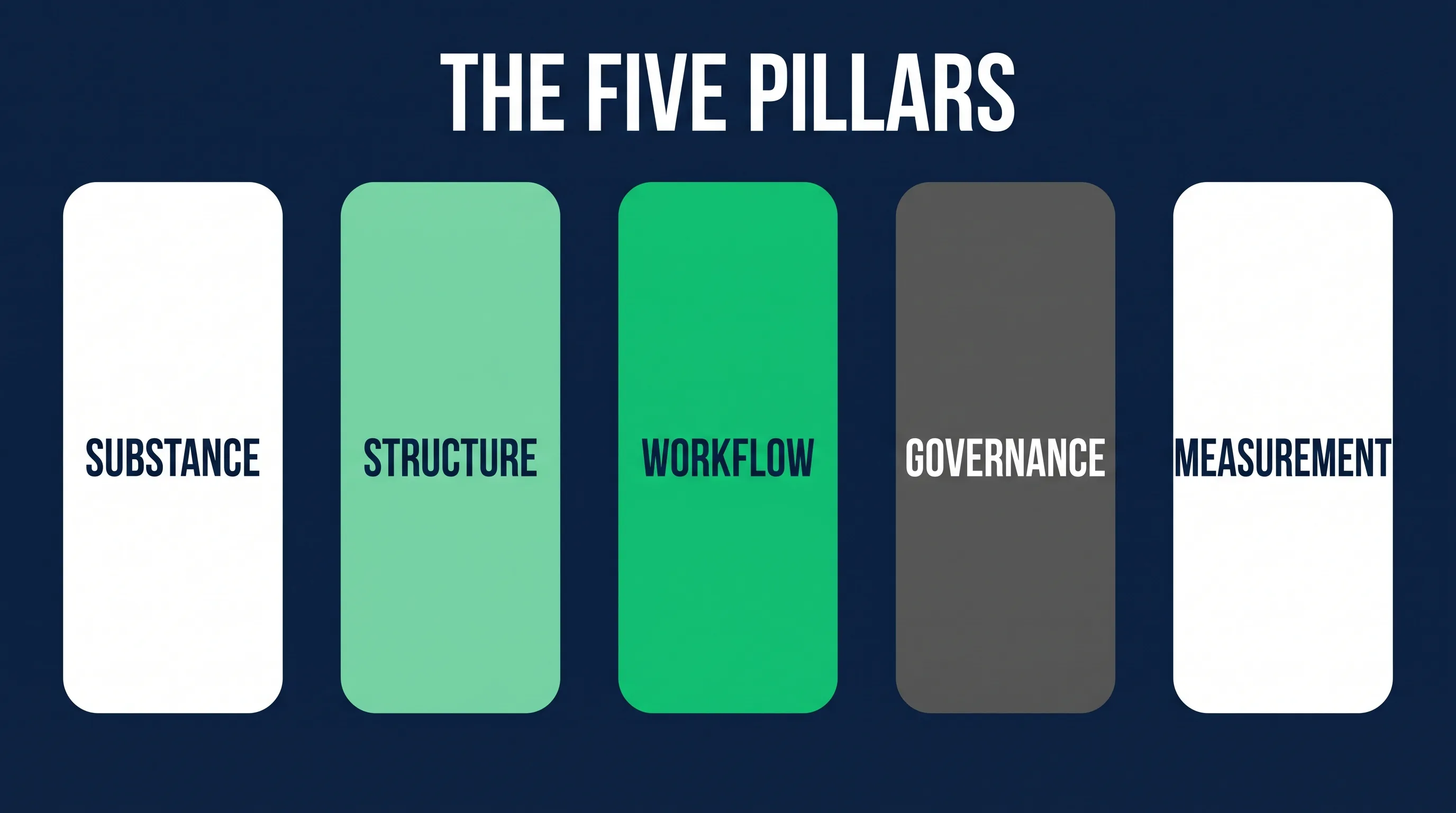
Search this job and you'll see the question about the five pillars of content strategy. Different sources word them differently, but the useful version is:
Substance. What you're saying and to whom. The actual content and whether it's worth anyone's time.
Structure. How it's organized, categorized, and connected. Navigation, taxonomy, internal linking, and how someone finds the thing they need.
Workflow. How content gets made, reviewed, approved, and published. Who does what, and what happens when they leave.
Governance. Who decides. Standards, ownership, review cycles, and what happens to a page nobody has looked at in three years.
Measurement. How you know if any of it is working, in terms the business recognizes.
Most people applying for these jobs can talk about the first one. The gap between a writer and a strategist is almost entirely the middle three.
The skill that's becoming decisive
Content strategy is being reshaped by two things at once, and they push in the same direction.
AI writing tools have made producing content cheap. Volume is no longer a differentiator, and any strategy whose main idea is "publish more" is now worthless.
At the same time, AI search is absorbing informational queries. A page that existed to capture "what is X" traffic is competing with an answer box that never sends a click.
What survives both is judgment about what should exist at all, structural work that makes content findable and useful, and being the source that gets cited rather than the thousandth article on a topic. That's a strategist's job description, honestly. This role is arguably strengthening while writing roles get squeezed, provided you're doing the real version.
The measurement side of that is changing too, which I covered in the AEO guide and from the search side in the SEO specialist guide.
How to get there
From writing. The most common route. Stop taking briefs and start writing them. Volunteer for the content audit nobody wants to do. Propose the structure change rather than complaining about the structure.
From SEO. Very natural, because SEO people already think in terms of what should exist, how it's organized, and whether it worked. SEO content manager is the overlapping title.
From web content management. Also natural, and underrated. Anyone who has run a CMS at scale already understands governance and taxonomy better than most strategists do. That's the ladder described in the 26 job titles guide.
What to show: an audit. A real one, of a real site, with a recommendation about what to cut and why. It is the single most convincing artifact for this role and it takes a weekend.

The honest downsides
Your work is invisible when it goes well. Nobody praises a taxonomy.
You'll be asked to prove the value of things that are hard to attribute, and the proof takes quarters.
And the title's ambiguity works against you in job hunting. You will interview for roles that turn out to be writing jobs, and you'll only find out by asking specific questions: who decides what gets published, who owns the review cycle, and what happened the last time someone proposed deleting pages.
If the answer to all three is "we haven't really done that," it's a writing job. Which might still be fine, at the right salary.
FAQ
What does a content strategist do? Decides what content a company should have, how it should be structured and governed, how it gets produced, and how success is measured. The role is about the system, not the writing.
What is the salary of a content strategist? Typically $65k to $100k in the US, with senior roles at $95k to $125k and directors above $130k. Writing-heavy versions of the title pay $55k to $75k.
Is content strategy a good career? Yes, with a caveat. The strategic version is becoming more valuable as AI makes content production cheap and judgment scarce. The writing-with-a-title version is the most AI-exposed job in marketing. Which one you're in matters enormously.
What are the 5 pillars of content strategy? Substance, structure, workflow, governance, and measurement. Most candidates can only speak to substance, which is why the other four are where you differentiate.
Do you need a degree to be a content strategist? No. Portfolio and demonstrated judgment carry this role. An audit you produced for a real site does more than any credential.
What's the difference between a content strategist and a content manager? The strategist decides what should exist and how it's governed. The manager runs the production of it. At smaller companies they're the same person.
If you want this job, do the thing nobody volunteers for: audit a real site and write down what should be deleted.
Recommending deletion is the clearest signal that you're thinking about content as a system rather than as output, and it's the fastest way I know to stop being read as a writer.