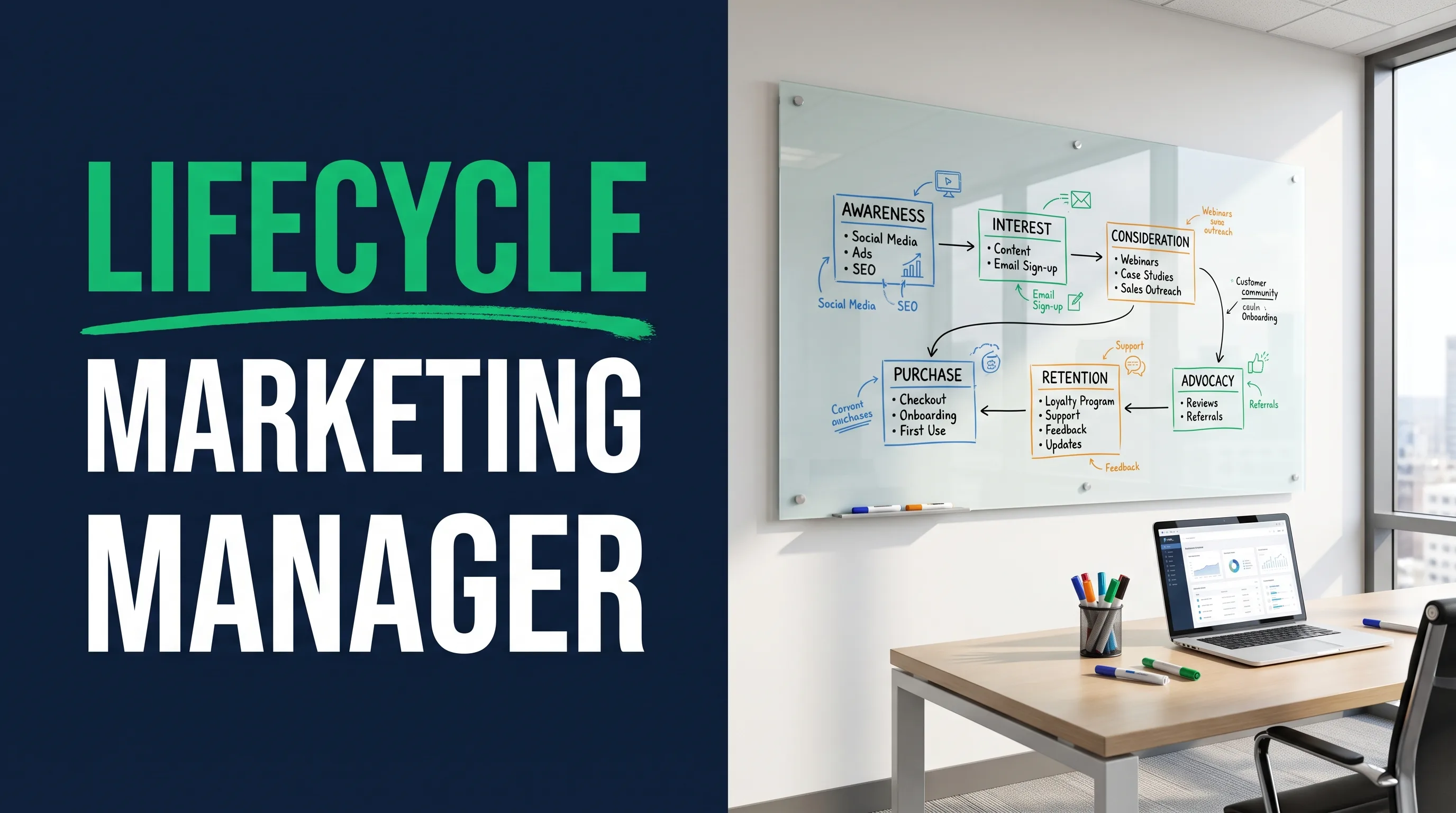
Lifecycle Marketing Manager: The Job Behind Every Retention Number
On this page
Every company eventually does the same arithmetic.
They work out that acquiring a customer costs them $70, that a customer who buys twice is worth four times one who buys once, and that they have been spending everything on the first purchase and nothing on the second.
Then they post a job for a lifecycle marketing manager.

What the job is
You own the customer journey after the first touch. Every message a person receives from the company, across every channel, from the moment they sign up until they either become loyal or disappear.
That's email, SMS, push notifications, in-app messages, and sometimes direct mail. The channel matters less than the sequencing: what should this specific person hear next, and when.
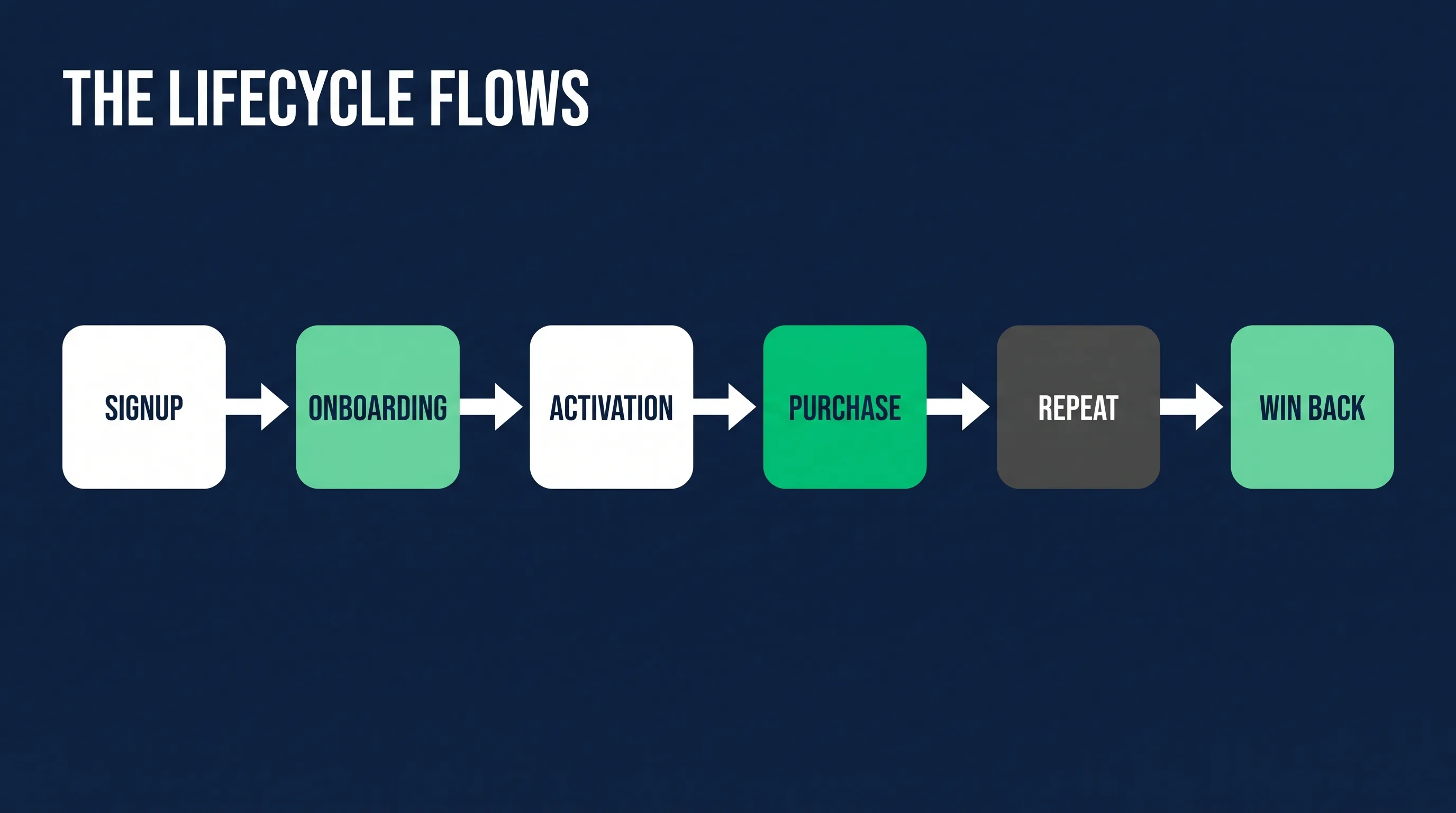
Concretely, you build and own the flows. Onboarding and welcome. Activation, if the product needs someone to do something before they get value. Post-purchase. Replenishment or renewal. Cross-sell. Win-back. Churn prevention for people showing exit signals.
Around all of that sits segmentation, testing, and being able to prove any of it worked.
How it differs from the neighboring titles
These four titles overlap heavily and companies use them almost interchangeably, but there are real tendencies.
Email marketing manager is channel-defined. You own email, and possibly SMS. If the company thinks in channels, that's the title you'll see. Compared in email marketing manager vs specialist.
Lifecycle marketing manager is journey-defined. You own the customer's experience across whatever channels reach them. Common at SaaS and app companies where onboarding and activation matter as much as promotion.
CRM manager is usually the same job with a different regional and industry accent, heavier on data and retail.
Retention marketing manager is outcome-defined. Same work, framed entirely around keeping people.
Read the responsibilities, not the label. The interviews for all four are nearly identical.
What it pays
$85k to $120k for most US lifecycle marketing managers, with senior roles at $120k to $150k and directors of lifecycle or retention above that.
That sits above a general email marketing manager, and the reason is scope: you're accountable for a business outcome across several channels rather than for the performance of one.
Specialist and associate versions of the title run $60k to $85k and are a realistic entry point from an email or CRM role.
The skills that matter
Journey thinking. The ability to hold the whole sequence in your head and notice that a customer in the win-back flow is also in the promotional list and is about to get two contradictory emails on the same morning. Most of the real value in this job is preventing incoherence.
Segmentation and data. Recency, frequency, value, behavior, and lifecycle stage. Comfortable in the data, ideally with SQL, because "which customers should get this" is a query more often than it's an opinion.
Testing discipline. Real tests with holdout groups. Lifecycle is one of the few marketing areas where clean measurement is possible, and doing it properly is what makes your budget defensible.
Technical build ability. You're working in Braze, Iterable, Klaviyo, Customer.io, or HubSpot. Being able to build complex conditional logic yourself, and to hand-fix an email template that breaks, means you ship in a day rather than a sprint. That technical half is exactly what our email marketing path exists to teach, and it's the most common gap in candidates for this role.
Commercial judgment. Knowing when not to send, and when a discount is buying a purchase that would have happened anyway. Lifecycle marketers who discount reflexively destroy margin while reporting great campaign numbers.
How to get there
From email marketing. The most direct route. You already build flows; what you're adding is journey ownership across channels and accountability for retention rather than for campaign performance. The email marketing specialist guide covers that foundation.
From CRM. Practically a lateral move, especially after a couple of years as a CRM specialist. Same skills, different vocabulary.
From product or growth. People from activation-focused growth roles move into lifecycle regularly, especially in SaaS, because the onboarding half of this job is really a product problem wearing a marketing hat.
What gets you hired: one flow you built, with a number attached. "I rebuilt the onboarding sequence and 30-day activation went from 41% to 52%" is worth more than any description of your responsibilities.

The honest downsides
Your results are slow and comparative. Retention improvements show up over quarters, in cohort charts most executives find hard to read. Meanwhile the paid team can point at yesterday's revenue. You will spend real energy on internal education.
You inherit whatever exists, and it's usually a tangle of overlapping flows nobody documented.
And you sit between teams without authority over most of them. Product controls the experience you're messaging about, support hears the complaints, and finance owns the discount policy. Getting things done is a persuasion job as much as a building job.
FAQ
What does a lifecycle marketing manager do? Owns the messaging a customer receives across their whole relationship with a company: onboarding, activation, post-purchase, retention, and win-back, across email, SMS, push and in-app.
How much does a lifecycle marketing manager make? Typically $85k to $120k in the US, with senior roles reaching $150k. Specialist-level versions of the title run $60k to $85k.
Is lifecycle marketing the same as email marketing? Not quite. Email is a channel, lifecycle is a journey across channels. In practice email is where most lifecycle work lands, so the jobs look similar day to day.
What tools should I learn? Braze, Iterable, Klaviyo, or Customer.io depending on industry. Klaviyo for ecommerce, Braze or Iterable for larger consumer apps, HubSpot for B2B. Learn one deeply.
Do I need SQL? Not always to get hired, but it separates the top of the band from the middle. Segmentation is a data problem and self-sufficiency there is worth real money.
Is this a good career? Yes, and structurally it's getting better. As acquisition costs rise, the value of keeping existing customers rises with them, and lifecycle is the function that does that.
The reframe I'd offer if you're weighing this against a flashier marketing role: acquisition spends money to find customers, lifecycle decides how much each one is worth.
Companies figure that out eventually, usually in a quarter when ad costs jump. Being the person who already knows how to run the second half is a durable place to stand.