Email Developer Certifications Ranked by What They Actually Get You
On this page
A hiring manager I know was walking me through a résumé on a call, and he did something I've watched a dozen people do since. His eyes went right past the certifications line. Straight to the portfolio link. Clicked it before he'd read a single job title.
That's the whole industry in one gesture.
Fifteen-plus years in this business, a lot of people helped into their first tech job, and I have never once heard someone say "we picked them because of the badge." Not once.
But I've seen a certificate tip a close call, and that's a different claim. Two candidates, portfolios about even, both interviewed fine. One of them has Klaviyo certified sitting on their résumé and the job posting says, in plain text, "Klaviyo experience preferred." You know how that ends.
So certifications are tiebreakers. Use one as a shortcut around real skill and you've wasted a weekend. Put one on top of real work and a couple of them earn their keep.
The honest truth about certifications in this field
What decides the interview is your portfolio. Real emails you coded and tested across Outlook and Gmail and Apple Mail, with rendering screenshots that prove they held up. If you don't have that yet, go study these email developer portfolio examples before you touch anything on this page. A portfolio with rendering proof beats every certificate on this list combined.
That said, certifications do three real things:
- ATS keyword matching. The posting says "Klaviyo" or "Salesforce Marketing Cloud." Your résumé says the same words, backed by a credential. The applicant tracking system scores you higher and a human being actually opens your application, which is not a small thing when plenty of qualified people get filtered out before anyone looks at their work.
- Structured learning. A decent program marches you through the corners of a platform you'd never wander into on your own, deliverability settings and flow triggers being the two that always bite people. You come out knowing where things live instead of googling mid-interview with your camera on.
- Client trust for freelancers. "Klaviyo certified" on a proposal answers the store owner's "can I trust this stranger" question before they work up the nerve to ask it. Clients can't evaluate your code. They can evaluate a badge from a platform they already pay for every month.
Look at what's missing from that list. Not one of these programs tests whether you can hand-code an HTML table, write an MSO conditional, or fix a dark mode bug. That gap is the whole reason the portfolio still decides.
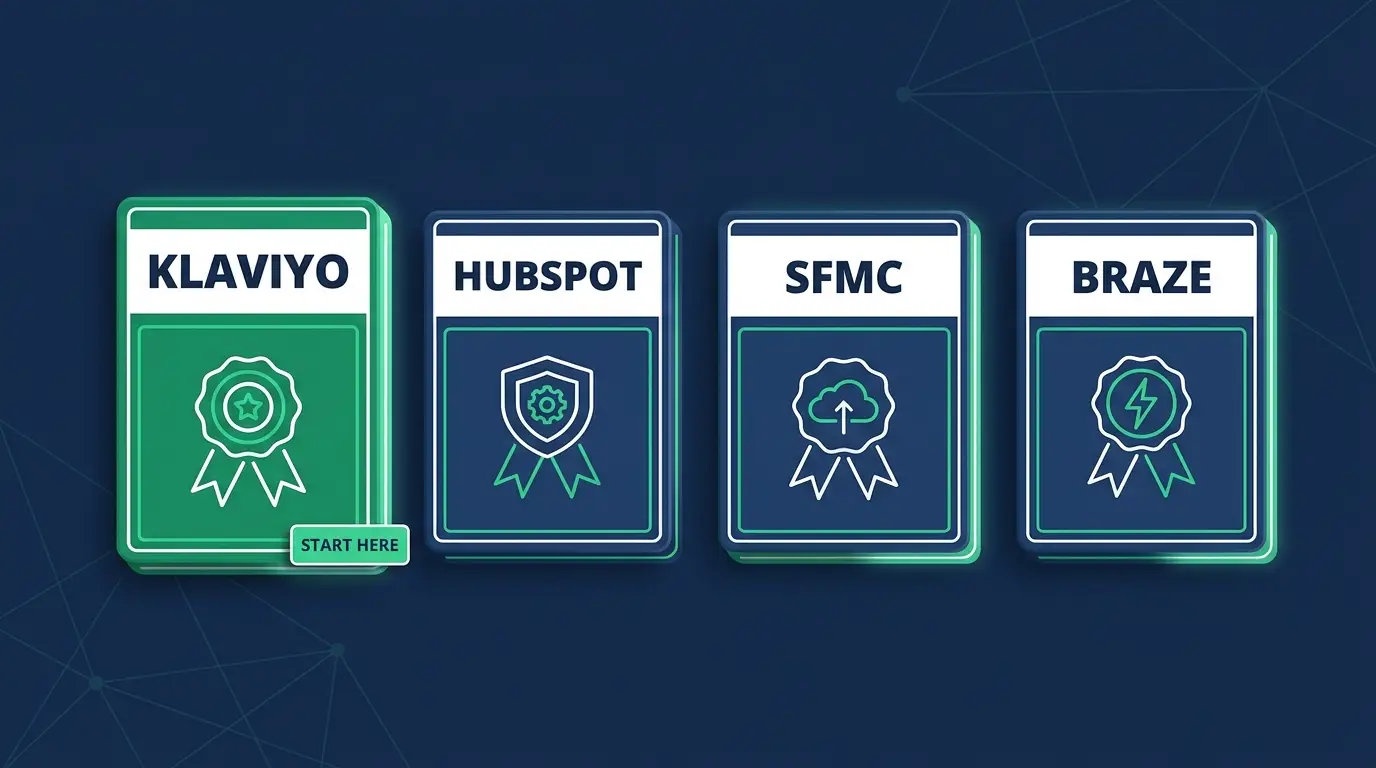
Klaviyo Academy certifications
If you only get one, get this one.
Here's the argument. A student of mine finished Klaviyo Academy on a Sunday, put it on her freelance profile that night, and had a Shopify store owner in her DMs by Thursday asking if she could fix a broken abandoned-cart template. She could. She'd been coding emails for eight months. The badge was just the thing that made a stranger click her name.
Klaviyo runs ecommerce email, and ecommerce is where the biggest pile of email developer work sits right now, both jobs and freelance. Search any board and count the postings that name it. Then remember nearly every Shopify store doing real revenue is on it. Someone who's certified and can actually code a template is rare enough to be annoying to find, which is exactly the position you want to be in.
The downside is real, though. It teaches the platform and nothing about the craft. You'll learn flows and segments and campaigns and you will not write a single line of email HTML. It's platform-specific too, so it counts for less at a shop running something else.
Worth it if you're aiming at ecommerce brands or freelance clients in any form, which for most people reading this means yes. Check the current program page for the lineup, it changes.
HubSpot Email Marketing Certification
Everyone's heard of this one. That's the value, that's the whole value.
The pros. Free, from a brand every recruiter recognizes on sight, and a strong ATS keyword because so many marketing teams run HubSpot. The coursework covers list health, segmentation, testing, the strategy stuff that people who came in from the pure coding side tend to have holes in.
The cons. It's the lightest technical credential here by a distance. It's a marketing certification wearing a lanyard, hiring managers know it, and it impresses less every year.
Get it if you want a recognizable keyword and a strategy refresher. One weekend of your life, and it gets your résumé past a filter. Don't expect it to teach you anything hard. Format and details shift, so check the current program page.
Salesforce Marketing Cloud Email Specialist
Different animal entirely.
The pros. SFMC roles pay at the top of this career's range, and I break down the numbers in the email developer salary guide. Companies on Marketing Cloud are big, the platform is a maze, and certified specialists are scarce. This is the one credential on the page that hiring managers read as a real signal, because you cannot fake your way through the exam without knowing the platform.
The cons. It isn't free and prep takes serious time, weeks not weekends. Outside the Salesforce ecosystem it's worth nothing. A Shopify brand does not care.
Worth it if you're specifically going after enterprise roles at Marketing Cloud companies, or the agencies that serve them. That's your lane? Make this your priority. Not your lane? Skip it, easily. Verify current exam requirements and cost on Salesforce's Trailhead pages, the program moves around a lot.
Braze certifications
Braze sits under a lot of mobile-first lifecycle teams. Apps, subscriptions, fintech. It's been growing fast in enterprise.
The pros. Almost nobody holds Braze credentials, so it separates you from the pile. App companies want people who understand cross-channel messaging, and an email developer who also gets push and in-app is a genuinely uncommon animal.
The cons. The job pool is smaller than Klaviyo's or SFMC's, and it clusters at a specific kind of company. Aiming at ecommerce or freelance? This won't move your needle.
Worth it if you're targeting product-led companies with an app at the center. Check Braze's current certification catalog for what's offered and what it runs you.
Mailchimp Academy
The lightest credential here, and its job is just different. Mailchimp is what small businesses actually use, so if your plan is freelancing for local shops and solo founders, the badge speaks their language. For full-time email developer roles it's worth roughly nothing, because nobody at a brand or agency is screening for it.
Get it if you're building an entry-level freelance client base and want quick credibility with small-business owners. Otherwise put the weekend into your portfolio. Check the current Academy page for what's available.

The order I'd do them in
If you asked me to plan it for you:
- Klaviyo first. Free, in demand, maps to the widest set of real opportunities.
- HubSpot second. Cheap ATS insurance, done in a weekend.
- Then pick your lane. Enterprise Salesforce shop as your target? Go earn the SFMC Email Specialist. Mobile-first lifecycle teams? Braze. Small-business freelancing? Mailchimp.
Do not collect all five. Two aligned with where you're actually applying will beat a trophy shelf every time, and the trophy shelf makes you look like someone who studies instead of someone who ships. While you're stacking credentials, every CodingPhase course comes with a completion certificate too, and the membership's résumé builder puts all of them where ATS scanners actually look.
What certifications can't do for you
Certificate collecting is how people procrastinate on the scary part, so let me be honest about the ceiling.
A certification cannot code a bulletproof email for you while an interviewer watches. It cannot answer the rendering questions coming your way, and I've collected the real ones in my list of email developer interview questions. It cannot hand you the four or five polished portfolio pieces that win the offer, it cannot give you the reps of debugging an email that renders perfectly everywhere except Outlook 2016, and it cannot make a hiring manager stop his eyes on that line of your résumé instead of scrolling past it to your work.
A certification proves you studied a platform. A portfolio proves you can ship. Studying is cheap, shipping is what they pay for.
Earn the badge, put it on the résumé, get back to building.

FAQ
Do email developers need certifications? No. Plenty of working email developers have zero certifications and great portfolios. But the right cert helps you pass ATS filters and tips close hiring decisions, especially early on.
Which email certification should I get first? Klaviyo, for most people. It's free and it matches where the most email work is right now, which is ecommerce.
Is the Salesforce Marketing Cloud certification worth it? Only if you're targeting enterprise companies that run SFMC. In that lane it's the most valuable credential here. Outside it, it's expensive prep for a badge nobody's screening for.
Are free email marketing certifications taken seriously? Within limits, yes. Klaviyo and HubSpot certs still help with ATS matching and client trust. Nobody treats them as proof of deep skill, which is what your portfolio is for.
Do certifications matter more for freelancers or full-time roles? Freelancers get more mileage, because clients can't evaluate code but can recognize a platform badge. For full-time roles, the portfolio and interview matter far more.
If you're at the start of this road, don't let a wall of badges make you feel behind. The path is simpler than the list makes it look. Learn to code emails properly, build proof, then add one or two certifications that match the jobs you're actually applying to. I laid out the full roadmap in how to become an email developer, and if you want the structured version with real projects, the email marketing specialist career path walks you from zero to job-ready.
You don't need every credential. You need the right proof in front of the right person. I'll help you build it.