How to Automate Content Creation With AI (Without Publishing Slop)

On this page
A student sent me a link last month and asked why his blog had stopped getting traffic. Forty posts in six weeks. All written by a single prompt looped through an API, published straight to WordPress, no human between the model and the reader. For about three weeks it looked like magic. Traffic climbing, pages indexing, the dashboard going green.
Then it fell off a cliff.
I read three of the posts. They were fine. That was the problem. Fine, generic, interchangeable, the same four subheadings every other AI blog on that topic already had. Google had seen this movie a thousand times before his site showed up.
That is the trap I want you to avoid. AI content automation is real, and it works, and I use it every week. But most of what gets called automation right now is a machine printing slop at scale, and the internet has gotten very good at ignoring it.
So this is the honest version. What content automation actually means, where AI belongs in your pipeline, where it should never get near, and how to build something that makes you faster without making you worse.
What AI content automation really means
Content automation is using software to handle the repetitive, rules-based parts of producing content so you spend your hours on the parts that need a brain. Research gathering. Formatting. Repurposing one piece into five. Scheduling. The plumbing.
The word doing the work in that sentence is repetitive.
Here is the mistake almost everyone makes. They hear "automate content" and picture a machine that has ideas, forms opinions, and publishes finished work while they sleep. That is not automation. That is abdication, and it produces exactly the kind of writing search engines and readers now filter out on reflex.
Good automation removes friction from work you already know how to do. If you can't tell a good article from a mediocre one, automating gets you a hundred mediocre articles faster than you could have written one. The tool amplifies whatever you point it at. Point it at something you have already gotten right by hand.
The pipeline that does not produce slop
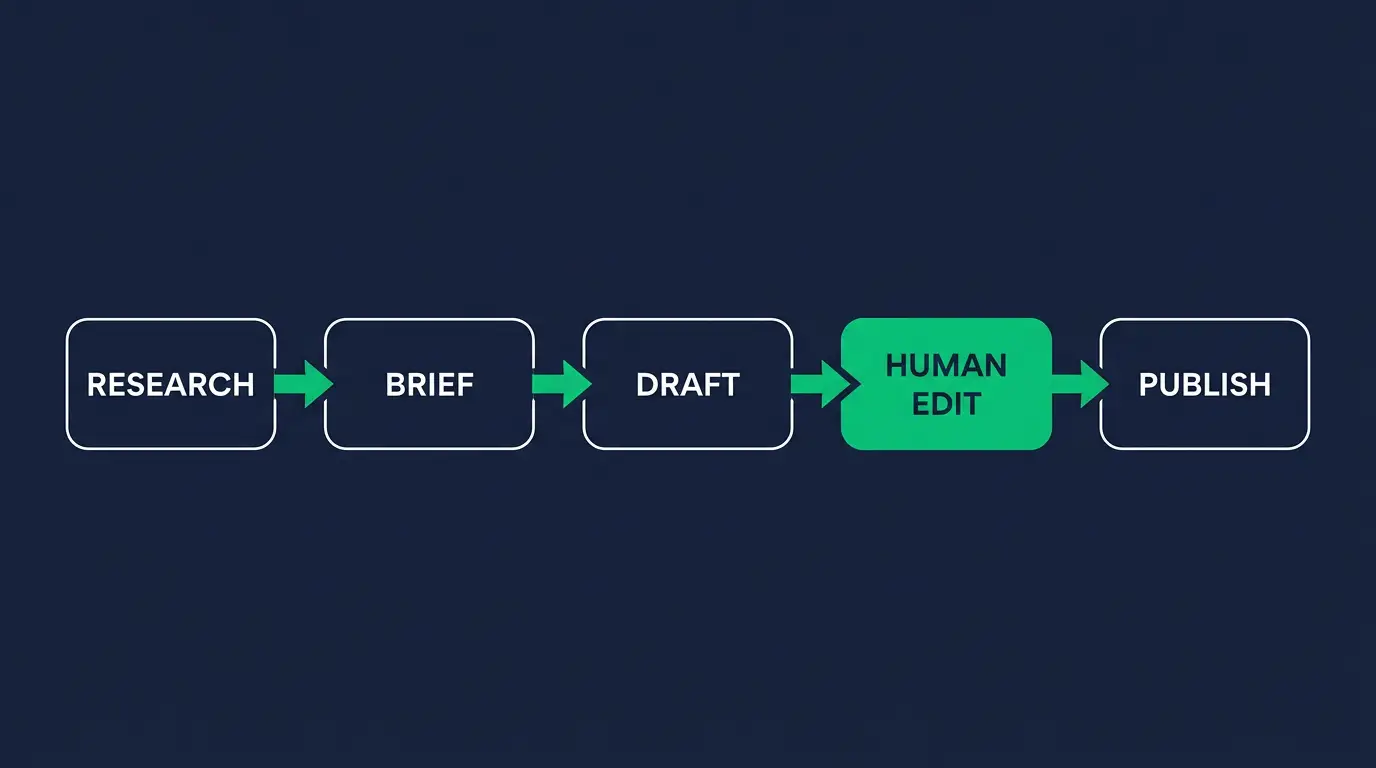
Every piece of content moves through five stages. The skill is knowing which ones a machine can own outright, which ones it can assist, and which ones stay human no matter how good the models get.
Stage one: research. Gathering source material. Pulling the top-ranking pages for a keyword, scraping your own past posts for internal link targets, collecting stats and quotes and competitor angles into one document. This is grunt work and a machine is better at it than you because it never gets bored halfway through. Automate it fully.
Stage two: the brief. Turning that research into a plan. What angle, what sections, what question the reader is actually asking, what you know that the top ten results do not. AI can draft the outline. You decide the angle. The angle is where the whole piece lives or dies, and a model averaging the existing top ten will hand you the same shape everyone else already published.
Stage three: the draft. This is the stage people want to hand over completely, and the one where they get burned. Let AI produce a first draft from your brief if you want a running start. Just understand what a first draft from a model is: a competent, slightly hollow version of the average article on that subject. It has no story, no opinion, no specific detail only you would know. That is your job in the next stage.
Stage four: the human edit. This is the stage that separates content from slop, and it is not optional. You cut the filler. You add the one anecdote the model could never invent. You put your actual opinion in, including the parts that argue against the easy conclusion. You fact-check every claim, because models state wrong things with total confidence. If you skip this stage, you are publishing slop, and no clever prompt earns it back.
Stage five: publish and repurpose. Formatting, scheduling, pushing to the CMS, then slicing the finished piece into a newsletter, a few social posts, maybe a short video script. Pure plumbing. Automate all of it.
Look at where the human sits. Stages one and five are almost fully automated. Stage two is shared. Stage three is optional help. Stage four is you, alone, and it is the stage that decides whether any of this was worth doing.
What to automate and what to never touch
Here is how I sort every content task, same three buckets I use for SEO work.
Safe to automate fully. Mechanical, rule-following, boring:
- Pulling research and source material into one doc
- Transcribing audio and video
- Generating meta titles and descriptions from finished copy
- Resizing and compressing images
- Reformatting a post into newsletter or social versions
- Scheduling and cross-posting
- Broken-link and internal-link checks before publish
Automate with a human check. The machine does the first 80 percent, you approve before anything ships:
- First-draft outlines and section structure
- Rough drafts you will heavily rewrite
- Image alt text
- Summaries and TL;DRs
- Headline variations to choose from
Never hand to a machine. Judgment, taste, truth, and voice:
- The angle and what makes the piece worth reading
- Your actual opinions and the tradeoffs you are honest about
- Fact-checking anything the model asserts
- Personal stories and specific detail
- The final read before publish
That middle bucket is where the money is, and where most people go wrong by shipping the 80 percent as if it were done.
The line I keep coming back to: automation should make good work faster, never make bad work cheaper. The second you use it to lower the bar instead of clearing more of it, you are building a slop factory with a nice dashboard.
A real workflow, start to finish
Let me make it concrete. Here is a blog pipeline you could build this week, the same shape I recommend to students who want leverage without a graveyard of dead posts.
The tools doing the orchestration are workflow platforms. n8n is my pick because it is open source, you can self-host it, and it does not charge you per task once you are running volume. Make and Zapier do the same job with a friendlier interface and a bill that grows with you. For the actual writing and analysis you are calling a model, usually OpenAI's or Claude's API. Your CMS sits at the end, WordPress or Ghost or whatever you publish on.
Now the flow.
A new row lands in a Google Sheet: target keyword, angle, a couple of notes from you. That trigger kicks off the workflow.
n8n fetches the top-ranking pages for that keyword and pulls them into a research document. It searches your own site for related posts so you have internal links ready. It drops all of it into one brief.
The model takes the brief and your angle and writes a first draft. The draft lands in a Google Doc, not on your site. Nothing publishes yet.
You get a Slack message: draft ready. You open the doc and you do the real work. Cut, rewrite, add your story, check the facts, make it sound like a person who has actually done the thing. This is the twenty minutes that the whole pipeline exists to protect.
When you mark it approved, the automation takes over again. It formats the post, generates the meta description, pushes it to your CMS as a draft, and spins up three social posts and a newsletter blurb from the final text.
Count the human touches. Two. The angle at the start, the edit before it ships. Everything else the machine handles, and the quality never drops because the one stage that determines quality is still yours. If you want more workflow ideas to steal, I have a whole post on n8n workflow examples built the same way.

The tradeoffs nobody puts in the tutorial
Every honest guide has this section, so here is mine.
Google is watching, and its stance is specific. The company does not penalize content for being AI-assisted. It penalizes content made at scale to game search with no regard for the reader. That is the exact description of the forty-posts-in-six-weeks approach. Helpful content written with AI help is fine. A firehose of generic pages built to farm rankings is what the "scaled content abuse" policy exists to bury. The difference is entirely in stage four.
Brand voice does not survive automation on its own. Models write in a smooth, averaged, slightly corporate register that reads the same across every site running the same tools. If you never rewrite for voice, every post you publish sounds like every competitor who bought the same subscription. Your voice is the one thing a machine cannot copy, so it is the one thing worth spending your time on.
Fact-checking is now your full-time job on the back end. Models fabricate. Names, dates, statistics, quotes, study results, all stated with the confidence of a textbook and sometimes completely invented. If you automate drafting and skip verification, you will eventually publish something false with your name on it. Budget for the checking. It does not go away because the writing got faster.

Quality guardrails to bake in
A few rules I would wire into any content pipeline before I trusted it:
Keep a human approval step that cannot be skipped. The workflow should physically not be able to publish without someone clicking approve. Make the easy path the safe one.
Never let a draft publish itself. Ship everything to a draft state in the CMS, never live. A one-character bug in a loop can post fifty pages in a minute, and you want the brakes on by default.
Run a plagiarism and AI-detection pass, not to game a score, but to catch a draft that leaned too hard on one source or came out sounding like a robot. Treat a high AI score as a signal to rewrite for voice, then move on.
Kill the tells by hand. The rule-of-three lists, the "in today's fast-paced world" openers, the em dashes everywhere, the tidy little summary at the end that says nothing. Readers clock these now, and so does Google. Read the draft out loud. If it sounds like a press release, it is not done.
FAQ
Is AI content automation against Google's guidelines?
No. Using AI to help produce genuinely useful content is allowed. What Google acts on is content produced at scale mainly to manipulate rankings, with no real value for the person reading it. The tool is not the problem. Publishing unedited slop by the hundred is.
Can I fully automate a blog with no human involved?
You can, technically, and the results are almost always bad. The human edit is the stage that decides whether a post is worth reading. Remove it and you are back to the forty-posts-that-tanked story. Automate the plumbing around the writing, not the judgment inside it.
Which tool should I start with?
If you want the cheapest path at volume and do not mind a learning curve, n8n. If you want to move fast with a gentler interface, Make or Zapier. Pair whichever you pick with a model API for the writing and your existing CMS at the end. Start with one workflow, get it good, then add more.
Will AI-written content rank?
Edited, genuinely useful content that happens to have AI in its pipeline can rank fine. Generic content mass-produced to fill a calendar tends to get filtered out fast. The ranking has almost nothing to do with which tool wrote the first draft and almost everything to do with what you did after.
How much time does this actually save?
Real numbers depend on how much you rewrite, but the research and repurposing stages are where most of the hours hide, and those are the safe ones to automate. The drafting time you save often gets reinvested into editing and fact-checking, which is exactly where it should go.
If you take one thing from this, take the pipeline. Automate the research and the plumbing, share the brief with the machine, and guard the edit with your life. That is the whole difference between leverage and a slop factory.
I teach this stuff properly inside CodingPhase, from the automation platforms to the APIs underneath them, so you can build these workflows instead of renting someone else's. If you want to go deeper, start with our automation tutorials or read how to start an AI automation agency if you are thinking about doing this for clients. Build the machine that makes your good work faster. Leave the slop to everyone who skipped the edit.