AI Agent vs Chatbot vs Assistant: What's Actually Different
On this page
I was on a call last week where someone kept calling their FAQ bot an "AI agent." You know the thing. It lives in the bottom-right corner of a website, it answers "what are your hours" and "how do I reset my password," and if you ask it anything off-script it says "let me connect you to a human."
That's a chatbot. A good one, maybe. But an agent it is not, and the gap between those two words is the whole reason people are confused right now.
So let me clear it up. Three words get thrown around like they're interchangeable: chatbot, assistant, agent. They're stacked on top of each other, each one doing more than the last. Once you see the ladder, you can't unsee it, and you'll catch the mislabeling everywhere.
The one-line version of each
Here are the definitions I'd put on a whiteboard, short enough to actually remember.
A chatbot is software that responds to messages, usually following a script or answering questions from a fixed set of knowledge.
An AI assistant is software that helps you do a task when you ask it to, and can pull from tools or data to give a better answer, but still waits for you to drive.
An AI agent is software that takes a goal and works toward it on its own, deciding the steps, using tools, and looping until the job is done.
Read those three again. The thing that grows across them is autonomy. A chatbot reacts. An assistant helps. An agent acts.
One task, three very different results
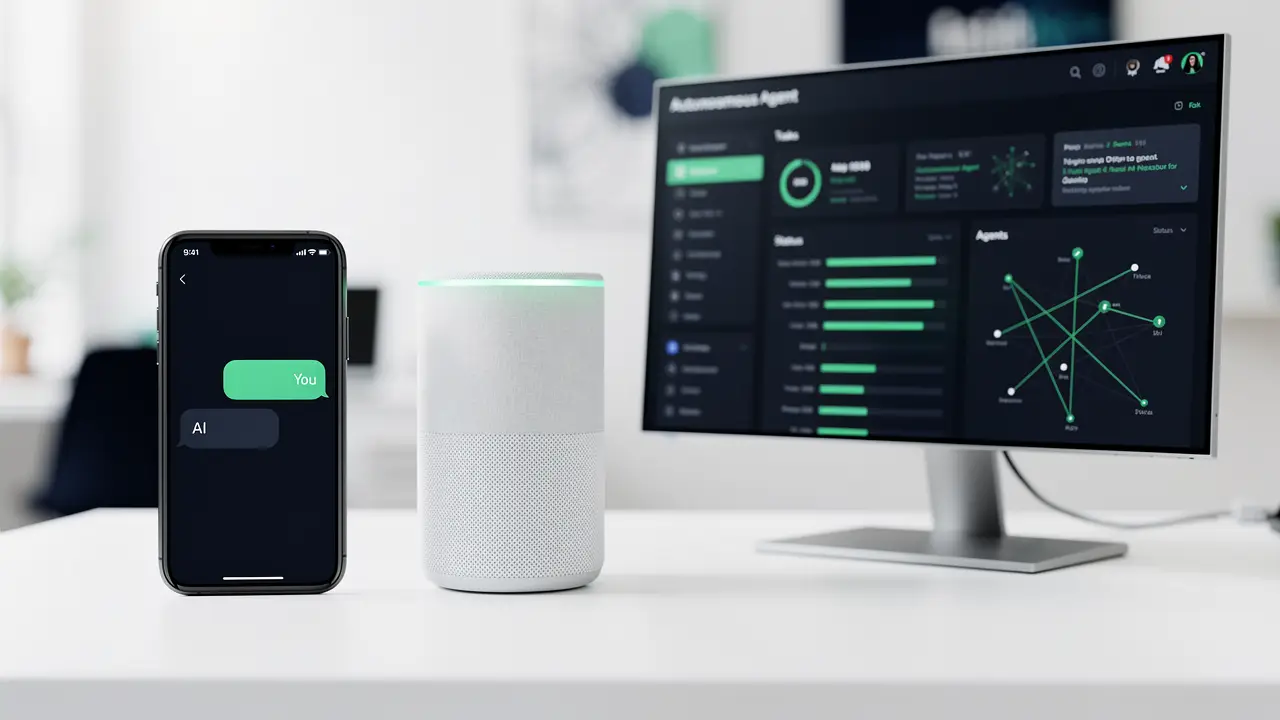
Definitions are slippery, so let's run the same request through all three. The task: "book me a flight to Miami next Friday."
The chatbot hears "flight" and "Miami" and does what it was built to do. It matches your message to a script. Maybe it replies with a link to the booking page, or asks "would you like to search flights?" and hands you a form. It doesn't know when Friday is. It doesn't know your budget. It pattern-matched your words to a canned response, and that response is where its job ends.
The assistant goes further. Ask a good assistant to book you a flight and it can actually search. It looks up next Friday's date, pulls live flight options, and comes back with "here are three flights to Miami on August 1st, ranging from $180 to $340, which one do you want?" It used tools. It reasoned about your request. But notice what it did at the end: it stopped and asked you. It got you to the doorstep and handed you the keys. You still click the buy button.
The agent is the one that scares people and excites people in equal measure. You say "book me a flight to Miami next Friday," and it decides the plan by itself. Check the calendar for conflicts. Search flights. Apply what it already knows about you, aisle seat, no red-eyes, under $300. Pick the best option. Fill in the passenger details. Complete the checkout. Then tell you "done, you're on the 9am out of JFK, confirmation is in your email." It didn't come back to ask which flight. It made the call and finished the job.
Same eight words from you. Three completely different amounts of work handed off.
Now, would you actually let an agent spend your money without a confirmation? Probably not yet, and that hesitation is healthy. Most real agents today pause before the truly irreversible step. But the architecture, the thing that makes it an agent, is that it could run the whole chain without you.
Where the real line sits
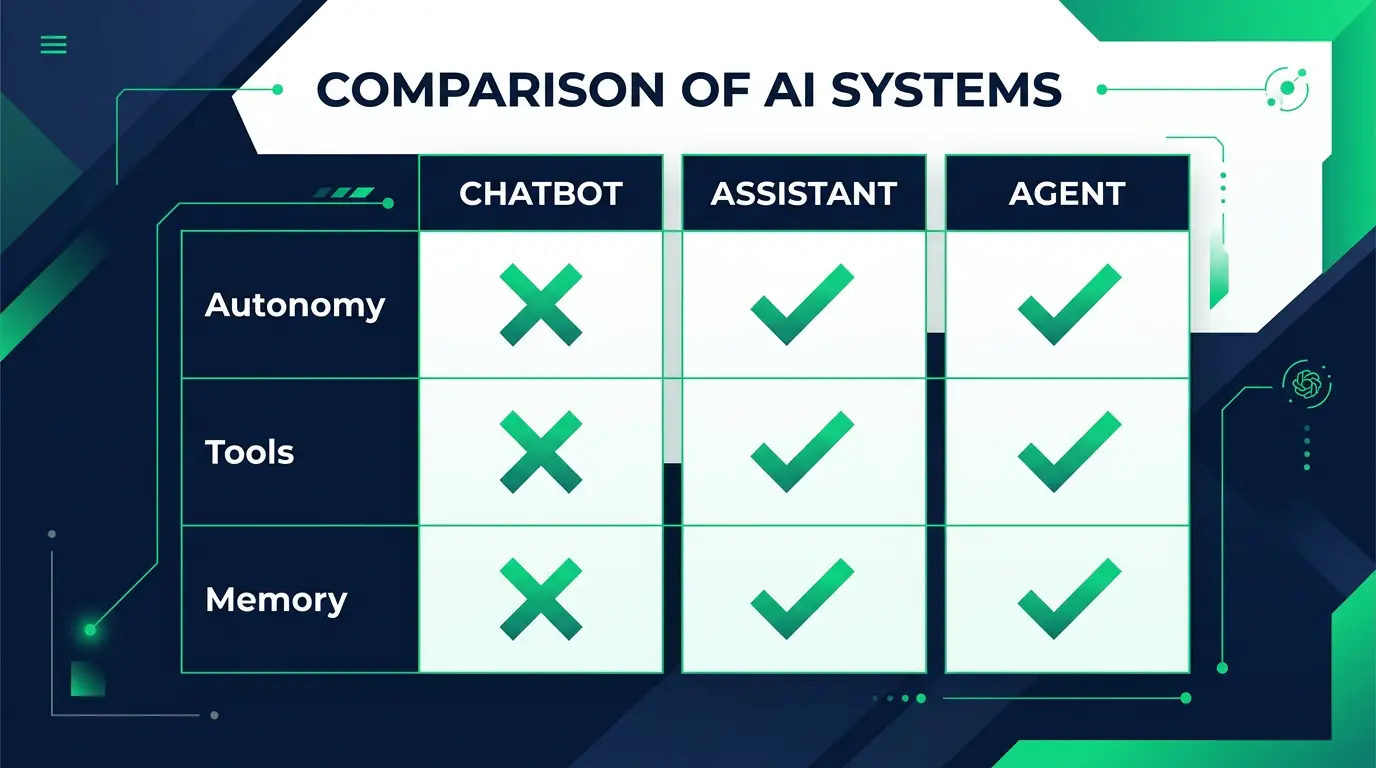
If you want a sharper test than "vibes," four things separate these categories. Run any AI product through them and you'll know what you're actually looking at.
Autonomy. How much happens without you in the loop? A chatbot needs a message to do anything. An assistant needs a request per task. An agent needs a goal, then it runs.
Tools. Can it reach outside the conversation? A basic chatbot can't. It just talks. An assistant can call a search, a calendar, a database. An agent chains several tools together across many steps to get somewhere.
Memory. Does it remember? A scripted chatbot forgets you the second the chat closes. An assistant might remember the current session, sometimes your preferences. An agent usually needs real memory, because a job that takes twenty steps has to recall what happened on step three.
Goals. This is the big one. A chatbot handles turns. An assistant handles tasks. An agent handles goals, and it breaks a goal into its own tasks. That self-directed planning is the line. When software decides its own next step, you've crossed from assistant into agent.
Here's the reframe I want you to keep. What separates these three is how much rope you hand the model, not how smart it is. Same underlying AI, different length of leash.

Why the words keep getting mangled
Marketing. That's most of it, honestly.
"Agent" is the hot word in 2026, so everything is suddenly an "agent." The FAQ bot from the top of this post got a new landing page and a rebrand, and now it's "AI agent" even though nothing under the hood changed. Nobody wants to sell a "chatbot" anymore because the word sounds like 2019.
There's a real technical reason for the fog too. The same large language model can power all three. Wrap it in a script and it's a chatbot. Give it tools and a chat window and it's an assistant. Put it in a loop with a goal and the ability to act, and it's an agent. The brain is identical. What changed is the cage you built around it. So when a founder says "we use GPT, so it's an agent," they're pointing at the engine and calling it a car.
And to be fair, the categories genuinely bleed into each other. A really capable assistant that remembers your preferences and takes a few actions on its own is drifting toward agent territory. There's no bright fence. It's a spectrum of how much the software decides for itself, and the labels are just rough regions on that spectrum.
That's the honest version most breathless LinkedIn posts skip.
So when would you build each one?
If you're learning to build this stuff, matching the tool to the job matters more than chasing the fanciest label.
Build a chatbot when the questions are predictable and the stakes of a wrong answer are low. Store hours, order status, tier-one support, a lead-capture form with a friendly face. Cheap, fast, hard to break. You do not need an agent to tell someone your return policy.
Build an assistant when a human should stay in charge but you want to remove the grunt work. A coding helper that suggests the function but you approve it. A writing tool that drafts and you edit. A support copilot that pulls the customer's history so the rep answers faster. The human is the pilot, the AI is the very good co-pilot.
Build an agent when the task is multi-step, somewhat repetitive, and you trust the system enough to let it run. Researching a topic across a dozen pages and writing you a summary. Monitoring a system and fixing small issues. Processing a stack of invoices end to end. Agents earn their keep on work that's too long and fiddly to babysit, and where a mistake is recoverable.
The trap is reaching for an agent because it sounds impressive when a chatbot would've done the job for a fraction of the cost and none of the risk. Complexity is not a flex. Fit is.
FAQ
Is a chatbot an AI agent? Usually no. A traditional chatbot follows a script or answers from a fixed knowledge base and waits for your next message. An agent sets its own steps and takes actions toward a goal. A chatbot can be part of an agent, the talking layer, but the agent is the part that plans and acts. If it can't do anything except reply, it's a chatbot.
What's the difference between an AI agent and an AI assistant? Autonomy, mostly. An assistant helps with a task and then stops to let you decide or approve. An agent takes a goal and works through the steps by itself until it's finished, using tools along the way. Assistant waits for your next instruction. Agent doesn't need one, it already has the goal.
Is ChatGPT an agent? It depends which mode you're using. Plain ChatGPT answering a question in the chat box is behaving like an assistant. It responds to what you ask and waits for your next turn. But when you turn on features that let it browse the web, run code, or use tools to complete a multi-step task on its own, it starts acting like an agent. Same product, different amount of leash, which is the whole point of this article.
Which one should a beginner learn to build first? Start with a chatbot, then an assistant, then an agent, in that order. Each one is the last one plus a new capability. You can't build a reliable agent until you understand tool calling and memory, and you learn those on smaller projects first.
Once the three words click, a lot of the AI hype gets easier to read. You'll hear "agent" in a demo and quietly ask yourself, is this thing actually deciding its own steps, or is it a chatbot in a nicer jacket? That question alone will save you money and disappointment.
If you want to go from spotting the difference to building it, that's the fun part, and it's very learnable. We walk through it in plain steps inside CodingPhase, from your first scripted bot to a working agent that uses tools. Start with how to build an AI agent, see what people are shipping in these AI agent examples, and if you want to see how the tools connect without heavy code, what is n8n is a good next read. Curious where "agentic AI" fits into all this? That's covered in AI agents vs agentic AI. When you're ready to actually build, start learning here.