How to Become a Web Developer in 2026 (Step by Step)
On this page
A student messaged me last month with a screenshot. It was a plain webpage he'd built, white background, a headline in a font he picked, a button that actually did something when he clicked it. Ugly, honestly. But he wrote underneath it: "I made this. It's on the internet. Anyone can see it."
I know that feeling. The first time you type something and it shows up in a browser, real, live, yours, a switch flips. You stop being a person who uses websites and start being a person who makes them.
That's the whole job, scaled up. And you can get there in 2026 without a degree, without a bootcamp loan, without permission from anyone. So here's the actual path.

What a web developer actually does all day
Forget the movie version with the hoodie and the green terminal. Most days you're taking a design or an idea and turning it into pages people can click through. You write the structure, make it look right, wire up the buttons and forms, and fix the thing that broke when someone opened it on their phone.
Some days it's building something new. A lot of days it's the boring, valuable stuff: a checkout that won't submit, a layout that collapses on mobile, a page that loads too slow and is losing the company sales. Companies pay web developers because a broken or slow site costs them money, and a good one makes them money. You're not "coding" in the abstract. You're keeping the thing that prints revenue online and working.
That framing matters, because it changes what you learn and why. You're not memorizing syntax to pass a quiz. You're learning to build the thing a business needs.
Front-end, back-end, full-stack (told honestly)
There are three doors, and people overthink which one to walk through.
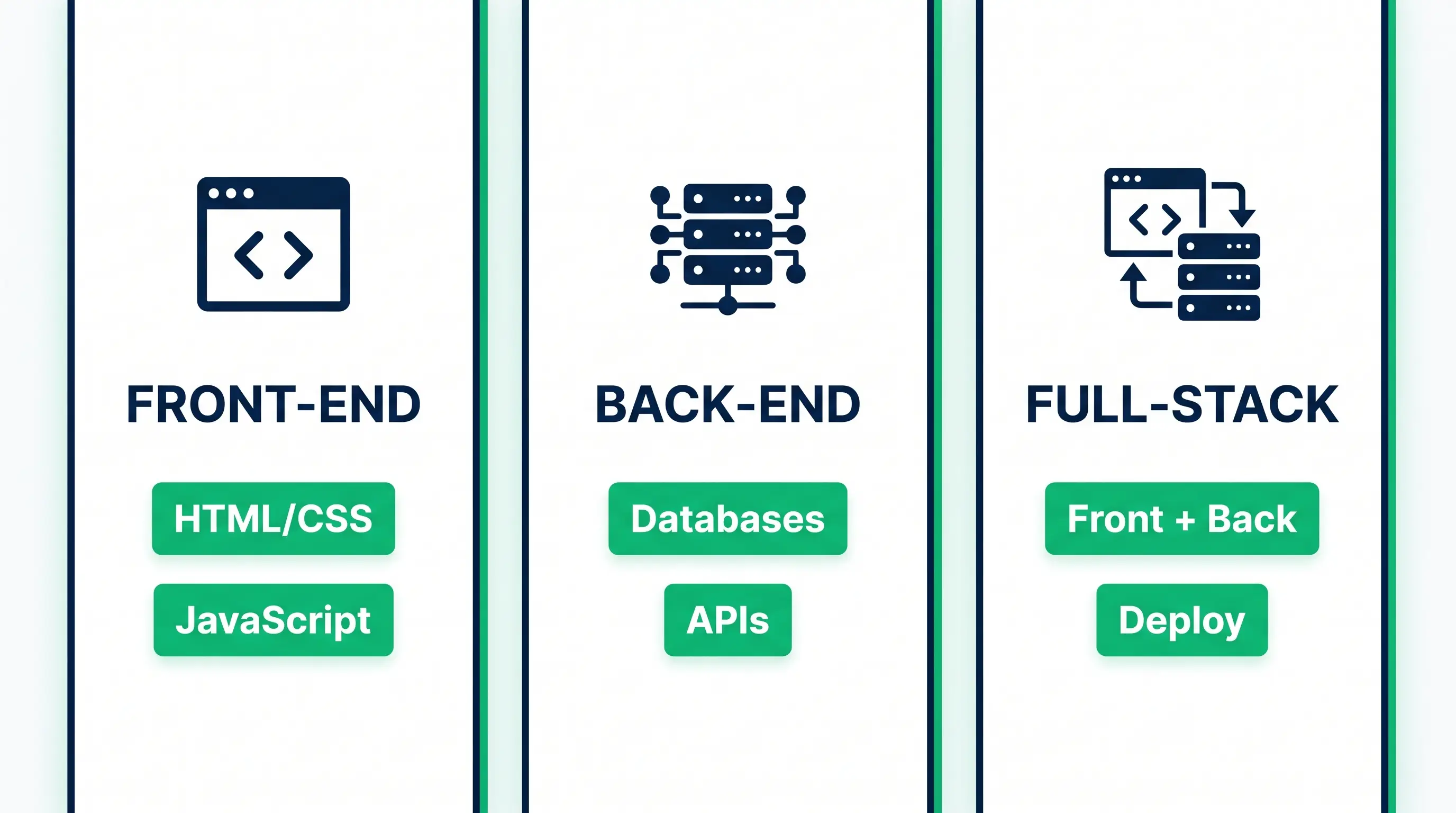
Front-end is everything the user sees and touches. The layout, the colors, the animations, the form that shakes when you type a bad password. If you like seeing your work immediately and you care how things look and feel, start here. It's also the most beginner-friendly door because your changes show up on screen instantly, which keeps you going when you'd otherwise quit.
Back-end is the part you don't see. The server, the database, the logic that decides what happens when you hit "buy." When you log in and the site remembers you, that's the back-end. It's less visual, more about data and rules and making sure things are secure and fast. People who like puzzles and systems tend to land here.
Full-stack means you do both. Most jobs at small and mid-size companies want this, because they'd rather hire one person who can build a whole feature than two who each do half. Here's the honest part nobody says out loud: you don't pick full-stack on day one. You start on one side, usually front-end, get comfortable, then learn the other. Full-stack is where you end up, not where you begin.
If you want the longer breakdown with real day-in-the-life differences, I wrote a whole piece on front-end vs back-end. Read it if you're stuck on the choice. But don't let the choice stall you. The first three skills are the same no matter which door you walk through.
The stack to actually learn, in order
This is where most people go wrong. They open a roadmap that looks like a subway map, panic, and buy a course on some framework they have no business touching yet. Learn these in this order and don't skip. If you want a course to follow, most of the cheap and free coding courses I recommend teach them in roughly this sequence.
1. HTML. The skeleton. It's what puts text, images, buttons, and forms on a page. It's not really "coding" and it's not supposed to be hard. You can be dangerous with it in a weekend. Don't linger here forever, but don't skip it either, because everything sits on top of it.
2. CSS. The styling. Colors, spacing, fonts, and the thing everyone struggles with, layout. Getting boxes to sit where you want them is where beginners hit their first real wall. Push through it. When CSS clicks, you can make a page look genuinely good, and that's the skill that makes your portfolio not look like a class assignment.
3. JavaScript. This is the one that turns a page from a poster into a machine. Menus that open, forms that check themselves, content that loads without a refresh. JavaScript is where you become an actual developer instead of someone who styles pages. It's also where it gets hard, and where a lot of people quit. Don't. This is the hump, and the paycheck lives on the other side of it.
4. A framework, and React is the safe bet. Once you can write real JavaScript, learn React. It's what a huge share of companies build with, which means it's what a huge share of job postings ask for. Learn it after JavaScript, never instead of it. People who jump straight to React without knowing JavaScript build things they can't debug, and it shows in an interview within about five minutes.
5. Then pick your back-end path. If you're going full-stack, you add a server language and a database. Node.js is the natural next step because it's JavaScript on the server, so you're not learning a whole new language from scratch. Python is another friendly path and opens doors beyond web. PHP with Laravel is the third, and it's behind a huge share of existing sites; the PHP developer career path covers it start to finish. Pair either with a database like PostgreSQL, and learn how to send and receive data through an API. That's the moment you can build a whole app by yourself.
You don't need all five to get hired. Plenty of people land a front-end job at step four. The back-end is what widens your options and your salary later.
The roadmap, start to hireable
This is the sequence I'd hand my younger self.
Start by building tiny things with HTML and CSS. Not tutorials you watch, things you make. Rebuild a page you like. Clone a login screen. Make it look right, then make it look right on a phone.
Add JavaScript and make those pages do something. A working calculator. A to-do list that saves. A form that tells you when you typed your email wrong. Small, finished, real.
Learn React and rebuild one of your projects with it, so you feel the difference between doing it the hard way and the framework way. That contrast is where React finally makes sense.
If you're going full-stack, add a back-end and connect it to a database, then build one app that stores real data and lets a user log in. One good full app teaches you more than ten half-finished ones.
The whole time, put everything on the internet. A live link beats a description every single time. If you want a more structured version of this with someone checking your work, our front-end developer path walks the same road in order, and the career paths lay it out beginner to job-ready.
One reframe to keep in your pocket: the goal isn't to finish learning. Nobody finishes. The goal is to build the smallest real thing you can, then a slightly bigger one, forever. Employable happens somewhere in the middle, quieter than you expect.
Projects that actually get you hired
Your portfolio is your résumé. A hiring manager will click your projects before they read a word about you, so this is where your energy goes.
Three or four real projects beat twenty tutorial clones. And a tutorial clone is easy to spot: it's the exact to-do app from the exact course everyone took. Build things that look like they solve a problem. A booking page for a fake barbershop. A dashboard that pulls real weather data from an API. A small store with a working cart. Something with a login and data that persists is worth more than five static pages, because it proves you can build the parts a company actually needs.
Make them live, make them work on a phone, and put the code on GitHub so people can see how you think. Then write two honest sentences about what each one does and what was hard. That's it. That portfolio, with four solid projects, has gotten people hired with zero degree and zero prior experience. I've watched it happen more times than I can count.
First job or freelance: which door
Two ways in, and they suit different people.
A first job gives you a salary, health insurance, and something worth more than both when you're starting out: senior developers who review your code and teach you what tutorials can't. You'll grow faster with people around you. The tradeoff is that getting the first one is the hardest part of the whole journey, because everyone wants experience and you're trying to get your first. You break in with a portfolio that makes the "no experience" line irrelevant.
Freelance means you find your own clients and build their sites, often starting with small businesses that need a simple site and don't care about your résumé. You can start earning sooner, sometimes while you're still learning, and a local business paying you $800 for a website is real experience and a real testimonial. The tradeoff is you're running a business, chasing clients, and handling money, on top of the actual coding. No one's reviewing your work, so you have to be honest with yourself about quality.
Plenty of people do both. Freelance a few small sites to build proof and income, use that to land the first salaried job. There's no rule that says pick one forever.

The honest salary talk
Real numbers, no hype. In the US, a junior web developer generally starts somewhere in the $55,000 to $75,000 range, and it swings hard with location and whether you can do full-stack. Mid-level developers with a few years and real projects behind them commonly land in the $85,000 to $120,000 range. Senior and specialized roles go well past that.
Freelance is a different shape. Early on you might charge a few hundred dollars for a small site and feel underpaid. Once you have a body of work and can build real applications, day rates and project fees climb fast, and some freelancers out-earn salaried developers. It's less stable and more up to you.
Two honest caveats. Entry-level is competitive right now, and a weak portfolio won't cut through it. And the developers earning the top numbers are the ones who kept learning after the first job instead of coasting. The floor is good. The ceiling is up to you.
FAQ
Can I become a web developer without a degree? Yes, and a lot of working developers don't have one. Employers hiring for web roles care whether you can build the thing. A portfolio of real, live projects answers that question better than a diploma. A degree doesn't hurt, but it's not the gate people think it is.
How long does it take to become a web developer? It depends on your hours and how you learn, so anyone promising an exact number is selling you something. What's true: people who build real projects consistently get hireable faster than people who watch tutorials passively for twice as long. Focused practice beats clocked time.
Which should I learn first, front-end or back-end? Front-end, for most people. Your work shows up on screen instantly, which keeps you motivated through the early grind, and the first three skills (HTML, CSS, JavaScript) are the foundation for both paths anyway. You can pivot to back-end or full-stack once the basics are solid.
Is web development still worth it in 2026 with AI around? Yes, with a shift. AI writes code now, which means the developers who win are the ones who understand what the code does, can debug it, and can build the whole system, not just paste snippets. AI is a power tool. It rewards people who actually know how to build, and it exposes the ones who don't.
Do I need to be good at math? No. Web development is mostly logic and problem-solving, not calculus. If you can follow a recipe and figure out why the dish came out wrong, you have the brain for this.
You don't need to feel ready. Nobody does at the start. The student with the ugly white webpage wasn't ready either, he just made the thing and put it online, and that one act changed how he saw himself.
Pick the first door. Write your first line of HTML today, not next month. If you want the whole path laid out in order with people who'll actually check your work and answer your questions, that's exactly what we built CodingPhase for. Come build something real, and message me when it's live. I still love seeing the first one.
If you're weighing this against other tech roles, these help too: how to become a software developer and how to learn to code when you want the ground-floor version.