How to Learn Coding From Absolute Zero (2026)
On this page
A student messaged me last month, half embarrassed. He'd been "learning to code" for seven months. Watched hundreds of hours of tutorials. Bought three courses. Could follow along with any instructor perfectly.
Then I asked him to build a to-do list from a blank file. Nothing fancy. Add a task, check it off, delete it.
He froze.
Not because he was dumb. He'd been busy the whole time, felt productive the whole time, and had almost nothing of his own to show for it. He'd been stuck in the trap that swallows more beginners than difficulty ever does.
So when people ask me how to learn coding, I don't start with a language or a course. I start here, with the thing that quietly eats most of a beginner's first year. If you're at the very beginning, I want to keep you out of it from day one.

Why most beginners quit (and it isn't the hard part)
People assume the thing that beats beginners is brutal syntax or scary math. It's rarely that.
What actually beats them is a slow, quiet feeling that they're not making progress. They open a course, finish a module, feel good, open the next one. Weeks pass. The dopamine of "completing" a lesson keeps them going, but nothing is sticking, because watching someone else solve a problem is a completely different skill from solving it yourself.
This has a name. Tutorial hell. The place where you can follow any instructor and build nothing alone.
The reason it's so sticky is that it feels like the responsible thing to do. More lessons, more prep, more theory before you "earn" the right to build something real. So you keep consuming, waiting to feel ready.
You never feel ready. That's the secret nobody tells you at the start. The readiness comes from building badly first, being confused, and pushing through the confusion. There's no course that skips that part.
First, pick a language (and stop agonizing over it)
Every beginner wants the answer to the same question before anything else. Which language should I learn first?
Here's the honest version: the specific language matters far less than the internet makes it sound. Beginners spend weeks reading "Python vs JavaScript vs Java" comparison posts, and every one of those weeks is a week not spent writing code. The comparison is a very comfortable form of procrastination.
Pick based on what you want to build.
Want to make websites and web apps? Learn JavaScript. It runs in every browser, it's the language of the web, and you'll see results on screen fast, which matters enormously when you're new and need the motivation.
Drawn to data, scripting, automation, or AI? Learn Python. The syntax reads almost like English, and it forgives a lot while you're still forming habits.
Not sure yet? Then just pick JavaScript and move on. Getting good at your first language teaches you how programming actually thinks. Loops, conditionals, functions, and data all carry over. Your second language takes a fraction of the time because the concepts transfer. The first one is where you learn to think like a programmer, and any of the mainstream ones will teach you that.
The people arguing about which language is "best" in forums are mostly people who already know how to code. For you, right now, the best language is the one you'll actually stick with long enough to build something.
The best way to learn coding: build first, learn as you go
Here's the shift that pulled my student out of the swamp, and it's the single most important idea in this whole post.
Stop trying to learn everything before you build. Build first, and learn the pieces you need as you hit them.
The loop looks like this. Pick something tiny you want to make. Try to build it. Get stuck. Look up the specific thing you're stuck on. Apply it. Get stuck again. Repeat.
That's it. That's how real developers work, by the way. Nobody has the whole language memorized. They have a strong mental model and a browser tab open to look up the rest.
When you learn a concept because you need it right now to make your thing work, it sticks in a way no tutorial can match. You felt the problem. You found the tool. You used it. That's a memory with a hook in it, not a fact you'll forget by Thursday.
So what do you build when you know almost nothing? Start absurdly small.
A page that says hello and changes color when you click a button. A script that renames a folder full of files. A calculator. A to-do list. The classic beginner to-do list is a rite of passage for a reason: it forces you to handle input, store data, update what's on screen, and delete things. That's a huge chunk of what apps do, hiding inside a boring little project.
Finish the small thing. Then make it slightly harder. Add a feature you don't know how to build yet, and figure it out. Each project should scare you a little. That fear is the learning.
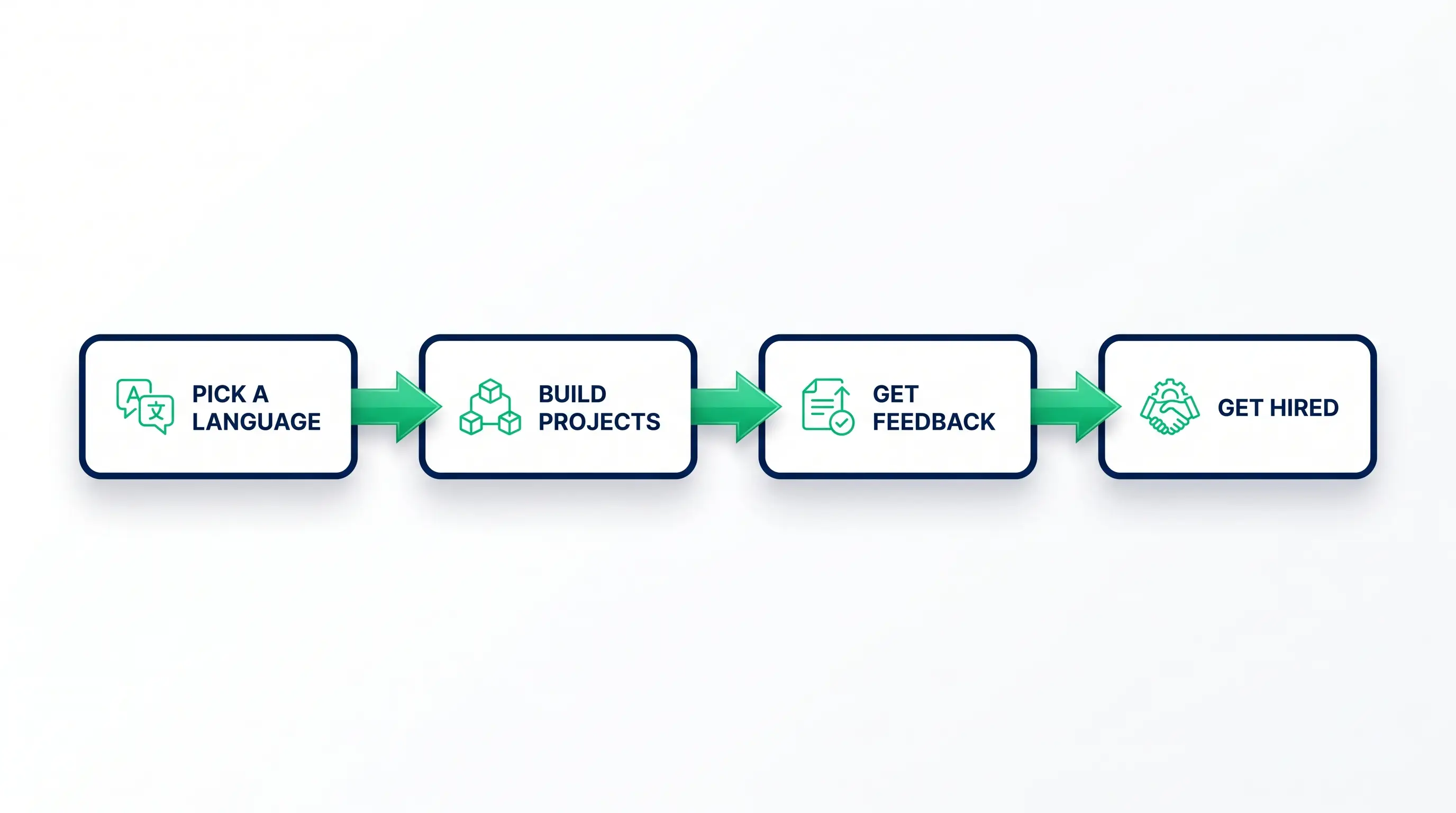
Getting feedback, because you can't grade your own blind spots
Building alone gets you surprisingly far. It also lets bad habits harden without you noticing.
You'll write code that works but is a tangled mess. You won't know it's a mess, because it runs and you're proud of it, and there's no instructor peering over your shoulder saying "this'll bite you in six months." That gap is where feedback earns its keep.
A few ways to get it, roughly in order of how much they help:
Read code better than yours. Find small open-source projects or other people's solutions to problems you just solved. Comparing your approach to a cleaner one teaches you fast. You'll feel the difference before you can explain it.
Get a human to look at your work. A community, or a mentor who's a few steps ahead of you. Someone who can look at what you built and say "this part is solid, this part will cause you pain later, here's why." That one sentence can save you a month of forming a bad habit.
Rebuild things. Take a project you finished two months ago and build it again from scratch. You'll be a little horrified at the old version. That horror is proof you improved, and rewriting it cements how much.
This is the piece self-taught learners skip most, and it's why so many plateau. You can only get so far grading your own work when you don't yet know what good looks like.
A realistic road to job-ready
Let me be straight with you, because a lot of the internet won't be.
You will see ads promising you a six-figure job in a fixed number of weeks. Ignore the countdown. How fast you get hired depends on how many hours you put in, how consistent you are, and how good your projects end up being. Someone grinding four focused hours a day gets there a lot sooner than someone doing twenty distracted minutes when they feel like it. A fixed number of weeks stamped on an ad is a sales tactic, nothing more.
What the path actually looks like, in order:
You get comfortable with one language and the fundamentals. You build a handful of small projects, then a couple of bigger ones you actually care about. You learn the tools around the code, which for web means things like Git, the command line, and how to put a site online. You build one or two portfolio projects that solve a real problem and look finished, not like a tutorial clone. Then you apply, relentlessly, while you keep building.
The portfolio is what gets you the interview. Not certificates, not the number of courses you finished. A hiring manager wants to see something you built that works, ideally something with a little ambition to it. Three polished projects that show you can ship beat a stack of completion badges every time.
And you don't need a degree for this. Plenty of working developers came in through self-teaching, bootcamps, or career paths that had nothing to do with computer science. I've written more about that in how to get into tech without a degree and the fuller picture in how to become a software developer. The field cares about whether you can do the work.

Mistakes that quietly waste months
I've watched enough beginners to see the same few potholes claim people over and over.
Collecting courses instead of finishing one. Five half-done courses teach you less than one course you actually completed while building alongside it. Jumping to a new course when things get hard is just tutorial hell wearing a productive costume.
Tweaking your setup forever. Some people spend a week making their editor look perfect and choosing the ideal theme and font. Your tools don't write code for you. A plain setup and a lot of practice beats a gorgeous setup and none.
Copying without understanding. Pasting code that works, then moving on without knowing why it works, feels like progress and isn't. When you copy something, sit with it until you could explain it to a friend. If you can't, you haven't learned it yet.
Comparing your chapter one to someone's chapter ten. You'll see people online building incredible things and feel like you're hopeless. They were where you are once. Every single one of them wrote garbage code for months. You're just seeing the highlight reel.
Waiting to feel ready before building something real. The readiness never arrives on its own. You manufacture it by building things slightly beyond your skill, on purpose, over and over.
Where a structured path beats random free videos
You can absolutely learn to code for free. The whole internet is a classroom if you have the discipline to assemble the curriculum yourself.
The catch is the assembly. Free content is scattered and often out of order, so a huge amount of a self-taught beginner's energy goes into figuring out what to learn next instead of actually learning. You watch a video that assumes things you haven't learned, get lost, and blame yourself.
That's the gap a structured path fills. A guided sequence takes you from your first line of code to job-ready without you having to guess the order, and it puts building at the center instead of endless watching.
That's the whole idea behind CodingPhase. Guided career paths that walk you from beginner to job-ready, projects baked into the learning so you're never just consuming, plus a community you can get feedback from and a resume builder for when you're ready to apply. Membership runs $42 a month, or $255 for the year if you want the cheaper route, and it opens up 90+ courses instead of one narrow subject. If money's tight, I've also put together an honest look at the best affordable coding courses and even free coding bootcamps, because the right path is the one you'll actually stick with.
Whatever you choose, the principle holds. Structure beats scattered, and building beats watching.
FAQ
What programming language should I learn first? Pick based on what you want to make. JavaScript if you want to build websites and web apps, Python if you're drawn to data, automation, or AI. If you genuinely don't know, choose JavaScript and start. The first language teaches you how to think like a programmer, and those fundamentals carry over to whatever you learn next, so the specific choice matters far less than committing to it.
Can I learn to code for free? Yes. There's enough free material online to take you a long way. The hard part isn't finding content, it's sequencing it, staying consistent, and knowing what to learn next when everything is scattered across a thousand sources. A structured path costs money mainly because it removes that guesswork and keeps you building instead of hunting.
How long does it take to learn coding? Long enough that anyone promising an exact number of weeks is selling something. It depends on your hours, your consistency, and how much you build versus watch. Someone putting in focused daily practice and shipping real projects gets to job-ready far sooner than someone dabbling. Expect months of steady effort, not days, and expect the timeline to bend around how much you actually build.
What's the best way to learn coding? Build something small, get stuck, look up the exact thing that stopped you, then build something slightly harder. Watching tutorials feels like learning and mostly isn't, because following along and starting from a blank file are two different skills. Structure helps with knowing what order to learn things in, but the building is the part that moves you.
Do I need a degree to get a coding job? No. Many working developers are self-taught or came through bootcamps and non-traditional routes. What gets you hired is a portfolio of real projects that prove you can do the work, not a diploma. A degree can help in some companies, but it's far from required, and plenty of people break in without one.
Everyone who can code today was once exactly where you are, staring at a blank file with no idea what to type. The only real difference between the people who make it and the people who quit is that the ones who make it kept building through the part where they felt lost.
So build the tiny thing. Get it wrong. Look up what you need. Build the next slightly harder thing. That loop, repeated for months, turns absolute beginners into developers.
When you're ready for a path that keeps you building instead of drowning in tabs, come start with us at CodingPhase. We'll take you from your first line of code to job-ready, and you won't have to figure out the order alone.