How to Become a Software Developer (No Degree Required)

On this page
A guy in our community posted his offer letter last month. Junior backend developer, $78k, a company he'd been too intimidated to apply to six months earlier. In the same message he mentioned he'd dropped out of college in 2019 and spent the years since driving for a delivery app. No CS degree. No bootcamp certificate on the wall. Just a year of nights spent building things that mostly broke before they worked.
I bring him up because his first message to us, back when he started, was a question I've now read a few hundred times: "Can I actually do this without a degree, or am I fooling myself?"
You can. I'm going to walk you through exactly how, and I'm not going to pretend it's a weekend project.
What a software developer actually does all day
Most people picture a hooded figure typing green text at 3am. Real developer work is slower and a lot more human than that.
You spend a surprising amount of your day reading. Reading other people's code, reading error messages, reading documentation for a tool you've never used. You write code in bursts, then spend longer figuring out why it doesn't do what you expected. Bugs are the job, not an interruption to it.
A normal day might look like this. You pick up a ticket that says "users can't reset their password on mobile." You reproduce it. You dig through the code until you find the broken piece. You fix it, write a test so it stays fixed, and open a pull request for a teammate to review. Then you do it again with the next ticket.
There's also talking. Standups, planning meetings, someone Slacking to ask why the checkout page is slow. The developers who grow fastest are usually the ones who can explain a technical problem to a non-technical person without making them feel dumb.
Software developer, software engineer, programmer, coder. People argue about the labels. For getting hired, treat them as the same job. The title on the posting matters less than whether you can build the thing they need built.

The skills that actually matter
Here's where people waste months. They collect languages like trophies. A little Python, some Java, a Ruby tutorial, three JavaScript courses half-finished. Breadth feels like progress. It isn't. Pick one language, pick one of the best coding courses for beginners on a budget, and finish it.
You need one language you know well. Deep enough that you can build a real thing in it without a tutorial holding your hand. Python and JavaScript are the two I'd point a beginner toward, because the job market for both is enormous and the learning material is everywhere. Pick one. Stay there until you're dangerous.
Then there's the stuff underneath the language, the part that transfers to every job you'll ever have:
How programs are structured. Variables, loops, functions, and objects are the grammar. You don't memorize them, you use them until they're boring.
Data structures and algorithms, the practical amount. You don't need to reinvent a red-black tree. You do need to know when a list is the wrong choice and a hash map is the right one, because interviewers ask and because it makes your code faster.
Git and version control. This trips up self-taught people constantly. Every real team uses Git, and showing up not knowing how to make a commit or open a pull request marks you as green immediately. Learn it early on your own projects.
The command line, databases, and how the web works. How a request travels from a browser to a server and back. What SQL is for. Enough of the terminal that you're not scared of it.
Debugging. Not a topic you study, a muscle you build. Reading a stack trace, forming a guess, testing the guess. This one skill separates people who finish projects from people who abandon them.
Notice what's missing. A degree isn't on the list. Neither is math beyond basic logic for most web and app roles. The industry hires on proof you can build, and a diploma is a weak proxy for that when a portfolio can show the real thing.
The roadmap, step by step
I'll give you the order I'd follow if I were starting over today with no degree and a full-time job eating my hours.
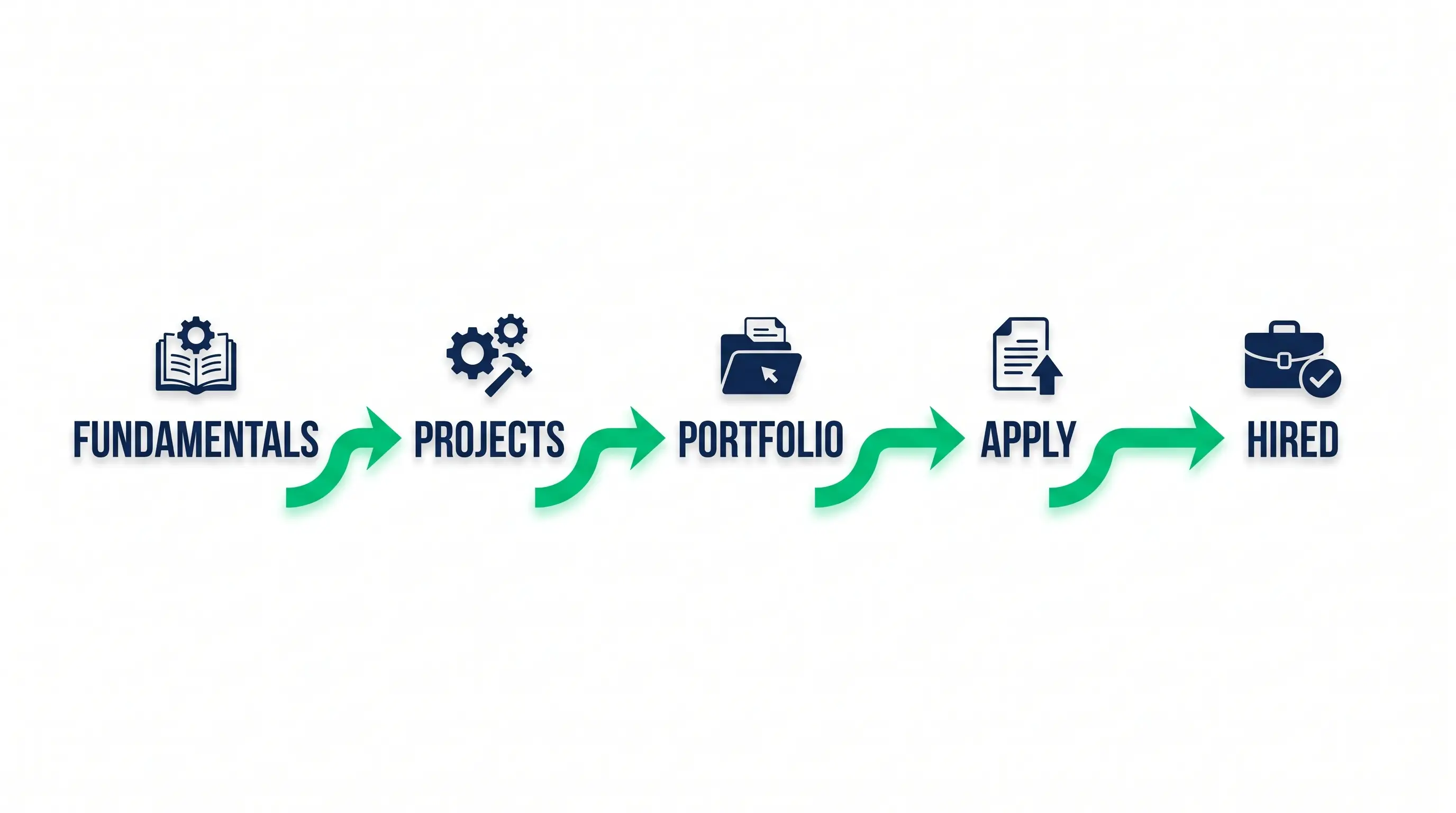
1. Learn the fundamentals in one language. Spend your first stretch getting genuinely comfortable, not certified. Variables, control flow, functions, working with data. Type every example yourself. Copy-pasting teaches your clipboard, not your brain.
2. Build tiny things immediately. Don't wait until you "know enough." A calculator. A to-do list that saves to a file. A script that renames all the photos in a folder. Small wins keep you in the chair, and the chair is where the learning happens.
3. Learn the tools of the trade. Git, the command line, how to read documentation, how to Google an error properly. Boring, unskippable.
4. Pick a lane and go deeper. Front-end, back-end, or full-stack for web. Mobile if you want to build apps. Data if numbers pull you. You can switch later, but a beginner spread across everything learns nothing well. If web is where you're headed, our guide on how to become a web developer breaks that path down further.
5. Build real projects that solve a real problem. This is the whole game, and it gets its own section below.
6. Prepare for interviews while you build. Practice explaining your code out loud. Do a handful of coding challenges so the format doesn't shock you. Learn to talk through your thinking, because interviewers care more about how you reason than whether you nail the answer.
7. Apply before you feel ready. You will not feel ready. Nobody does. Apply anyway, at volume, and let the rejections teach you what to shore up.
If you're still deciding whether to teach yourself or pay for structure, I wrote a longer piece on how to learn to code that gets into the tradeoffs, and one comparing the best online coding bootcamps if the intensive route tempts you.
Building a portfolio that gets you hired
Your portfolio is the degree. That's not a motivational line, it's how hiring actually works for self-taught developers. A manager can't verify what you know from a resume bullet, but they can open your GitHub and read your code in four minutes.
Three or four real projects beat twenty tutorial clones. A recruiter has seen the same weather app and Netflix homepage a thousand times, and a to-do list from a course tells them nothing except that you can follow instructions.
So build things that look like the job:
Something with a real backend. An app that stores data, has user accounts, and does something useful. This proves you understand how the pieces connect, which is most of the job.
Something that solves a problem you actually have. The best portfolio project I ever saw was a scheduling tool a guy built for his wife's hair salon because their paper booking system kept double-booking. It wasn't fancy. It was real, he could talk about every decision in it, and it got him the interview.
Something a little uncomfortable. A project that forced you to learn a tool you didn't know going in. It shows you can teach yourself, which is the trait every team wants in a junior.
Put the code on GitHub. Write a plain-English README that explains what each project does and why you made the choices you did. Deploy at least one so a hiring manager can click a link and use it, not just read about it. A live thing they can touch beats a screenshot every time.
How to get hired without a degree
The honest part. No degree makes the first job harder, not impossible. You'll get filtered out of some big companies with rigid HR requirements. Fine. Those aren't the only companies hiring, and plenty of the best ones stopped requiring degrees years ago.
Here's what moves the needle.
Aim your early applications at startups and small-to-midsize companies. They hire on ability and they move fast, and a founder who needs the feature shipped this quarter cares about whether you can ship it, not where you studied. Big-name corporations with automated resume filters are the hardest door for a self-taught developer, so don't spend your first month knocking only there.
Get your GitHub and your projects in front of humans. Referrals skip the resume filter entirely, and the way you get referrals is by not being a stranger. Help people in developer communities. Answer questions once you're able. Contribute a small fix to an open-source project you use. Show up consistently in a few places and people start to know your name.
Treat the job search like its own project. Applying to five perfect-fit roles a week and following up beats spraying two hundred applications into the void. Tailor the first few lines to the company. Mention the thing you built that's relevant to what they do.
Expect the first yes to take a while and a pile of nos to come first. The developers who make it aren't the smartest ones, they're the ones who kept applying after the tenth rejection. If you want the wider view on breaking in, we cover it in how to get into tech without a degree.

What you'll actually get paid
Let me give you real numbers, with the caveat that pay swings hard by city, company, and specialty.
In the US, a junior software developer typically lands somewhere in the $60k to $85k range to start. Mid-level, once you've got two or three years and shipped real things, commonly runs $90k to $130k. Senior developers frequently clear $130k and go well past $160k at strong companies, and that's before you get into the specialized or big-tech numbers that make headlines.
A few honest caveats. Those figures skew toward US roles and higher-cost cities. Remote work has softened the geography, but a developer in a small market still usually earns less than one in San Francisco. And the first job pays the least by design. The jump from junior to mid-level is often the biggest raise of your career, and it tends to come within a couple of years of shipping real work.
The degree question fades here too. Once you've held one developer job and have production experience, almost nobody asks about your education again. The first door is the heavy one.
Where a structured path helps
You can absolutely learn all of this from free tutorials scattered across the internet. Some people do. Most people who try it that way quit, and it's usually not because they weren't smart enough. Free content has no order, no accountability, and no one to ask when you've been stuck on the same error for three days.
That's the gap CodingPhase was built to close. It's a membership, not a bootcamp, so you're not gambling ten grand on a program you might hate. Diamond runs $42 a month, or $255 a year for the cheaper route, and that gets you 90-plus courses, guided career paths that take you from beginner to job-ready in order, a résumé builder made to pass the automated screeners, a job board, and a community of people going through the same thing you are.
The structure is the point. You're not guessing what to learn next or wondering if a random YouTube playlist is teaching you bad habits. You follow a path someone already mapped, you build real projects along the way, and you have people to ask when you're stuck. You can browse the career paths here or just start learning and see if the way it's taught clicks for you.
FAQ
Can I become a software developer without a degree? Yes. Plenty of working developers are self-taught, and a growing number of companies dropped the degree requirement years ago. You'll need to prove your ability with real projects instead of a diploma, and the first job is harder to land, but the ceiling on your career is set by your skill, not your education.
How long does it take to become a software developer? For most people learning seriously alongside a job, roughly six months to a year to reach a hireable junior level, and longer if you can only spare a few hours a week. Consistency matters more than intensity. An hour every day beats a ten-hour Saturday you burn out on and skip the next three weekends.
What should I learn first? One language, learned well. Python or JavaScript are the safest first picks because of the job market and the sheer amount of learning material. Get comfortable with the fundamentals in that one language before you touch a second. Chasing multiple languages early is the most common way beginners stall out.
Am I too old to become a developer? No. People switch into development in their 30s, 40s, and 50s and get hired. Teams care whether you can do the work, and career-changers often bring communication skills and work maturity that a 21-year-old doesn't have yet. Your age is not the thing standing between you and this job.
That guy with the $78k offer wasn't special. He wasn't a math genius or a natural. He was stubborn, he built things that were slightly too hard for him, and he kept going after the college dropout voice in his head told him he didn't belong. That's the whole formula, and it's available to you right now.
Start with one language and one small project this week. If you want the path laid out so you're not guessing, that's exactly what we built CodingPhase to give you. We've got you.