The Best Online Coding Bootcamps in 2026 (Honest Picks)

On this page
A guy messaged me last year. He'd just finished a well-known online bootcamp, $15,000 on a loan, and he wanted me to look at his portfolio before he started applying.
The portfolio was fine. Three projects, clean enough, the kind of thing a junior should have.
Here's what got me. Every single thing he built, I could point to a free or cheap course that taught the same stack. Same React. Same Node. Same deploy-to-Vercel final project. He'd paid the price of a used car for a curriculum you can basically find scattered across the internet for a couple hundred bucks.
I didn't tell him that. What would be the point? He'd already paid.
But you haven't. So let me actually be useful before you sign anything.

The thing nobody selling you a bootcamp will say out loud
Bootcamps are not magic. They're a curriculum, a schedule, and some accountability, sold at a markup because they package all three together and put a jobs promise on the box.
Some of that markup is worth it. The schedule and accountability are real value if you're the kind of person who buys courses and never opens them. Paying money you can't easily walk away from is, for a lot of people, the only thing that makes them actually show up.
The curriculum, though? That part is close to a commodity now. Web development in 2026 is taught roughly the same way everywhere because the industry mostly agreed on the tools. Nobody has a secret stack.
And the jobs promise is where you have to read carefully, because that's where the industry gets slippery.
How to actually choose one
Forget the rankings for a second. Here's what I'd weigh, in the order I'd weigh it.
Cost, and what happens if it doesn't work out. Most reputable online bootcamps land somewhere in the $10,000 to $20,000 range, and the ones advertising "deferred tuition" or an income share agreement aren't free, they're just charging you later, sometimes more. Read the financing like it's a car loan, because that's the size of it. I wrote a whole breakdown of what coding bootcamps actually cost if you want the ugly math.
Job placement numbers, and who's counting them. This is the big one. A bootcamp will tell you "85% of graduates hired." Hired doing what? Counted how? Within what window? A lot of these stats quietly include people who took any job, or who got hired by the bootcamp itself as a mentor, or who self-reported and never got verified. The honest schools publish an audited outcomes report you can actually read. The rest give you a number with no footnote. If a school won't show you the methodology, treat the number as marketing. I dug into which programs have real job placement versus which just say they do.
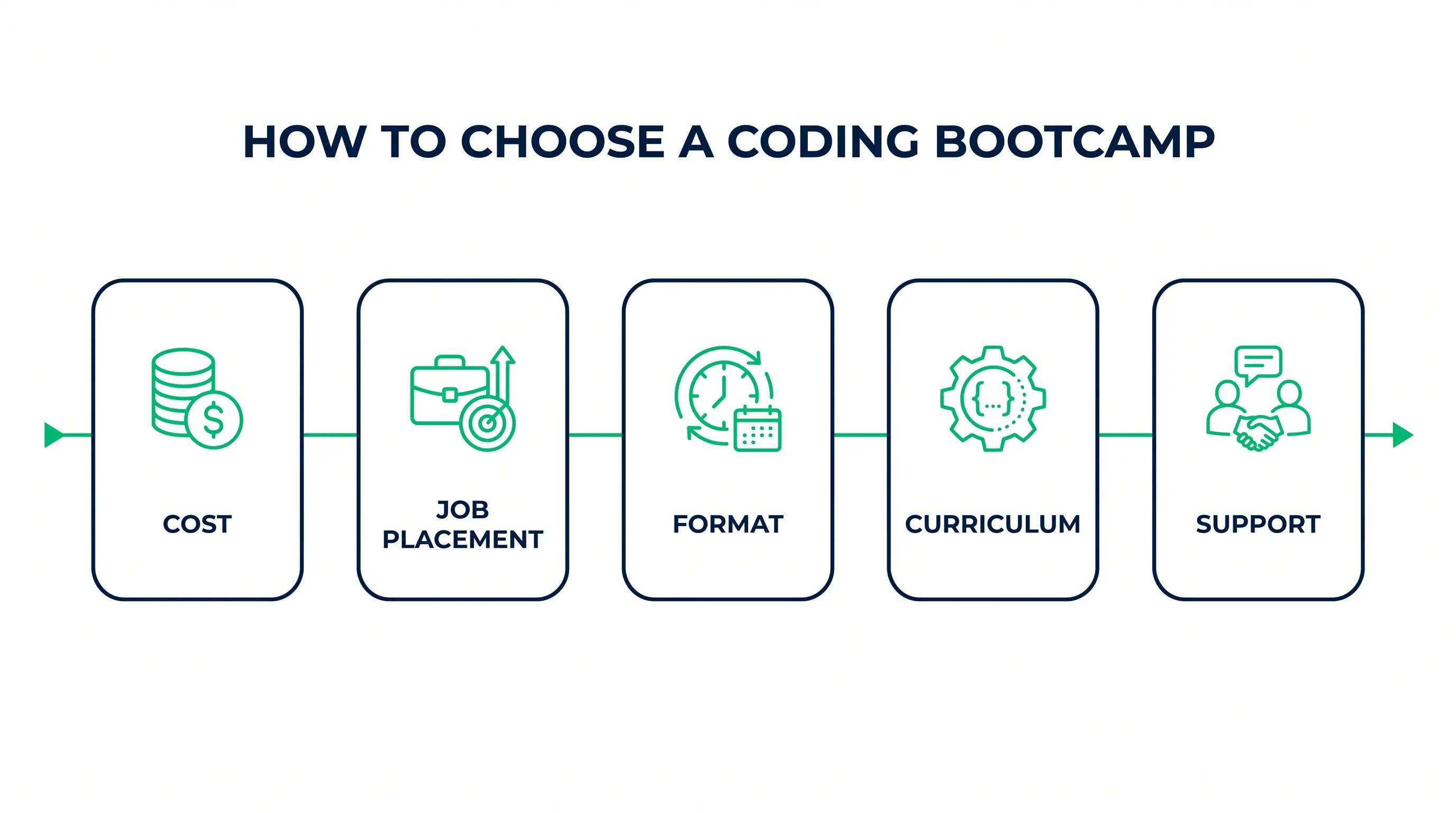
Format, and whether it fits your actual life. Full-time immersive means quitting your job for a few months and going all in. Part-time means keeping your income and grinding nights and weekends. Neither is better. The failure mode is picking full-time when you have rent due in eight weeks and no runway, then panicking halfway through. Be honest about your money and your schedule before the vibe of "total immersion" sells you something you can't sustain.
Curriculum, but only the parts that matter. Everybody teaches the same languages. What actually varies is depth on data structures, whether they make you build things from scratch or fill in blanks, and whether the final projects are real or a paint-by-numbers clone everyone in the cohort submits. Ask to see a syllabus. Ask what the last project looked like for the last cohort.
Support after you finish. Career coaching, resume help, interview prep, an alumni network that actually answers. This is often where the expensive programs earn their price, and where the cheap ones leave you alone at the hardest part. Getting to job-ready is one problem. Getting hired is a different one, and it's the one people underestimate.
The honest picks
I'm not going to give you a numbered leaderboard with fake precision. Reputations shift, cohorts vary, and the same school can be great one year and thin the next after a layoff or an acquisition. What I can do is tell you the categories that are worth your attention and who each one suits.
The premium immersive programs. You know the names in this tier. The ones with a strong brand, a real alumni network at good companies, and a price tag to match. If you have the savings to not work for a few months, you learn well under pressure, and the audited outcomes actually hold up, these can be worth it. The network alone sometimes justifies the cost. Just go in knowing the brand is part of what you're paying for, and brands coast on old reputations longer than they deserve to.
Good for: career switchers with runway and savings, who want structure and a network and can stomach the price.
The university-affiliated bootcamps. A lot of universities slap their name on a bootcamp that a third-party company actually runs behind the scenes. The degree-school logo makes it feel safe. Sometimes the teaching is genuinely solid. Sometimes you're paying a premium for a brand that outsourced the whole thing and barely checks on it. If you're looking at one of these, find out who's actually running the classroom, not whose name is on the certificate.
Good for: people who want the reassurance of a known institution, as long as you verify who's really teaching.
The income-share / "pay when you're hired" programs. These sound like the school has skin in the game. Sometimes true. But the terms can get expensive if you do land a good job, and some of these outfits have a weaker curriculum propped up by aggressive marketing about how they only win when you win. Read the contract like a lawyer. Calculate the total you'd pay on a real salary, not the scary-sounding percentage.
Good for: people with zero upfront cash who've read the agreement carefully and done the total-cost math.
The self-paced online platforms. Cheaper, more flexible, no cohort breathing down your neck. The tradeoff is obvious. Nobody's making you show up, so a lot of people drift. But if you're self-motivated, this is where the value-per-dollar gets absurd compared to a $15k immersive. This is the category I care most about, and it's where CodingPhase lives, so I'll come back to it.
Good for: self-starters, people on a budget, anyone who's tried expensive things before and knows accountability has to come from inside.
One honest note across all of them. Outcomes vary wildly by person, not just by school. The most motivated person at a mediocre bootcamp beats the passenger at a famous one, every time. The school matters less than most marketing pretends, and you matter more.
The real problem is the price
Let's stay on the money, because it's the part that quietly wrecks people.
Fifteen to twenty grand is not "an investment in yourself" if it comes from a high-interest loan and the job on the other side isn't guaranteed. It's a bet. Sometimes a good bet. But a bet, and the house doesn't always pay.
I've talked to people still carrying bootcamp debt two years later, working a job that a much cheaper path could've gotten them to. Not because the bootcamp was a scam. Because they bought the most expensive version of a thing that has cheap versions that work.
Here's the reframe I want you to keep: the price of a bootcamp buys speed and structure, not the code itself. Code is cheap now. So the only question that matters is whether the premium buys you enough speed and enough structure to be worth the debt. For some people, yes. For a lot of people, no, and nobody told them there was a door marked "cheaper."
There's a door marked cheaper. Two of them, actually, and I've written up the affordable courses worth your time separately. But let me tell you about ours, honestly.
Where CodingPhase fits (and where it doesn't)
I'll say the honest thing first. CodingPhase is not a bootcamp. No cohort start date, no instructor grading your homework at 9pm, no career coach on a Zoom call with you. If those specific things are what you need to move, a bootcamp might genuinely be your answer, and I'd rather you know that than buy the wrong thing from me.
What CodingPhase is: a membership. Diamond runs $42 a month or $255 a year, which is less than most people spend on coffee, and a rounding error next to a $15,000 program. For that you get more than 90 courses, guided career paths that take you from total beginner to job-ready, an 80,000-plus member community when you're stuck at 1am, a resume builder that gets you past the ATS filters, and a job board. If you want everything for life plus live weekly mentorship, the Tech Accelerator is a one-time $1,500, which is still a fraction of what the immersive programs charge for a few months.
I'm not going to claim we're the cheapest month-to-month option out there, because we're not, and you'd catch me if I did. Plenty of single subscriptions cost more than that. What we win on is the annual price working out to about $21 a month, and on breadth. One membership covers the whole roadmap plus the career tooling that usually costs extra everywhere else.
The tradeoff is real and I'll name it. Self-paced means you have to bring the discipline. Nobody's going to call you if you disappear for three weeks. If you already know you won't show up without someone standing over you, spend the money on the accountability. If you can drive yourself, though, paying $15k for a curriculum you could get here for the price of a couple dinners is the thing I'd stop you from doing.

FAQ
Are online coding bootcamps worth it in 2026? For some people, yes. If you need the structure, the deadline pressure, and hands-on career support, and you've verified the school's outcomes are real, a bootcamp can pay off. For self-motivated people on a budget, the expensive version is often overkill, and a self-paced path gets you to the same place for far less. I broke this down further in are coding bootcamps worth it.
How much does a coding bootcamp cost? Most reputable online bootcamps run $10,000 to $20,000. Income-share and deferred-tuition options don't remove that cost, they move it later, and sometimes add to it. Budget for the total you'd actually pay, not the headline number.
Do coding bootcamps actually get you a job? Some graduates get hired, but published placement rates are often generous with what counts as "hired" and how long they waited. Look for an audited outcomes report with a clear methodology. If a school won't show you how it counts, assume the number is marketing.
What's the cheapest way to learn to code and still get hired? A self-paced membership or a solid set of affordable courses, paired with real projects and genuine discipline. You give up the built-in accountability of a cohort, so it only works if you'll actually show up. The savings versus a full bootcamp are enormous. If you want to see how a membership stacks up against a single platform, I compared CodingPhase and Codecademy.
Is a self-paced program as good as a bootcamp? The curriculum is usually comparable, since everyone teaches similar tools. The difference is accountability and support, not content. Motivated self-learners often do better in a flexible program because they're not paying for structure they don't need.
Whatever you choose, choose it with your eyes open. Read the outcomes report. Do the loan math. Be honest with yourself about whether you'll show up without someone making you.
And if the price of a bootcamp is the only thing standing between you and starting, don't let it stop you. You can start learning on CodingPhase today for less than dinner out, work through a real career path at your own pace, and put the $15,000 back in your pocket. The job on the other side doesn't care how much you paid to get ready for it. It cares whether you can do the work.