Are Coding Bootcamps Worth It? An Honest 2026 Answer
On this page
A guy messaged me last month with a screenshot of his cart. A well-known bootcamp, tuition sitting at just under $15,000, his finger basically hovering over the "pay" button. He had one question. "Be honest with me. Is this worth it, or am I about to make a huge mistake?"
I didn't answer for a few hours because the honest answer isn't a yes or a no.
I've watched a bootcamp completely change someone's life. Warehouse job to a $75k developer role in under a year, the whole dream. I've also watched people put fifteen grand on a credit card, finish the program, and end up exactly where they started, except now they're in debt and quietly convinced they're "not a coder." Same programs, sometimes. Different people.
So let me give you the version I gave him, without the marketing gloss.
The short honest answer
A coding bootcamp is worth it if you're the kind of person who was going to grind through the material anyway and you just want structure and a cohort to keep you honest. For that person, paying for pressure and a schedule is a reasonable trade.
It's a bad deal if you're buying the price tag as a substitute for the work. Fifteen thousand dollars does not install skills in your head. Nobody's does. The tuition buys you a curriculum, some instructor hours, and a career-services team. Whether that turns into a job depends almost entirely on what you do at 9pm when the live session is over and nobody's watching.
That's the whole thing, really. Bootcamps sell outcomes but deliver a container. The outcome is still on you.

Who a bootcamp is actually worth it for
There's a specific person who gets their money's worth, and I want to describe them clearly so you can check yourself against it.
You already tried learning on your own and hit a wall. Not because you couldn't do it. You kept drifting. No deadline, life got busy, the tabs stayed open and nothing got finished. A bootcamp fixes that specific problem. The schedule is the product. You're paying someone to make you show up.
You also learn better with people around. Some folks genuinely need a Slack channel full of confused classmates and a TA they can ping. If sitting alone with documentation makes you want to quit, the cohort is worth real money to you.
And you have the runway. This matters more than anyone admits. Full-time bootcamps are usually a few months where you cannot work, or can barely work. If you have savings, a partner covering rent, or a job you can pause, that's survivable. If you're going to be panicking about rent in week three, the stress will wreck the learning, and the sticker price was never the real cost anyway.
If that's you, honestly, a good bootcamp can be one of the better bets you'll make. I won't pretend otherwise.
Who should not do it
Now the other side, because I've watched this one go wrong too many times.
If money is tight and $15k means a loan you'll feel for years, slow down. A bootcamp is not a guaranteed job, and the debt is very much guaranteed. Going into high-interest debt for a maybe is how people end up worse off than when they started.
If you've never written a line of code and you're not sure you even like it, don't let a bootcamp be your test. Find out if you enjoy this for cheap first. Plenty of people discover three weeks in that they actually hate staring at bugs for eight hours, and there are far less expensive ways to learn that about yourself.
And if you're expecting to be carried, it won't happen. The bootcamps with the best reputations are brutal precisely because they push you hard. If you want someone to make it easy, no program on earth is priced for that.
The real cost versus the real outcome
Let's talk actual numbers, because the brochures love to blur them.
Full-time immersive bootcamps mostly run somewhere between $10,000 and $20,000. Some are cheaper, a few are more. On top of tuition there's the part nobody puts on the pricing page: the months of income you give up while you study full-time. For a lot of people that lost salary is bigger than the tuition itself. I broke this down further in what a coding bootcamp actually costs, because the sticker price is genuinely the small number.
Now the outcome side. When a bootcamp works, the return is real. Landing a $70k or $80k developer job after spending $15k is a fantastic trade, and it happens. That's not a myth. The problem is the word "when." The people it worked for are loud and visible in the testimonials. The people it didn't work for mostly go quiet and move on, so you never hear from them, and your sense of the odds gets warped.
So the ROI isn't fixed. It's a range that depends on you, the program, and the job market the month you graduate. Treat any promise more precise than that as marketing.
The job placement rate problem
Here's the part that made me want to write this at all.
Bootcamps advertise job placement rates. You'll see "94% of graduates hired" plastered across the homepage. Sounds incredible. Then you read the fine print, and the number starts dissolving.
Sometimes that 94% only counts graduates who "completed the program and were actively job searching," which quietly drops everyone who got discouraged and stopped looking. Sometimes it counts a role that has nothing to do with what you trained for. Sometimes it counts people the bootcamp hired back as teaching assistants, which is a real thing that happens. And the reporting is often self-published, with no outside auditor checking the math.
I'm not saying every bootcamp lies. Some publish genuinely honest, third-party-verified outcomes, and those are the ones worth trusting. What I'm saying is that a placement number, on its own, tells you almost nothing until you know exactly how they counted. Before you pay anyone, ask three blunt questions. What counts as "placed"? Who's excluded from the denominator? Who verified this? If they get cagey, you have your answer. I dug into which programs are actually straight about this in my rundown of the best online coding bootcamps.
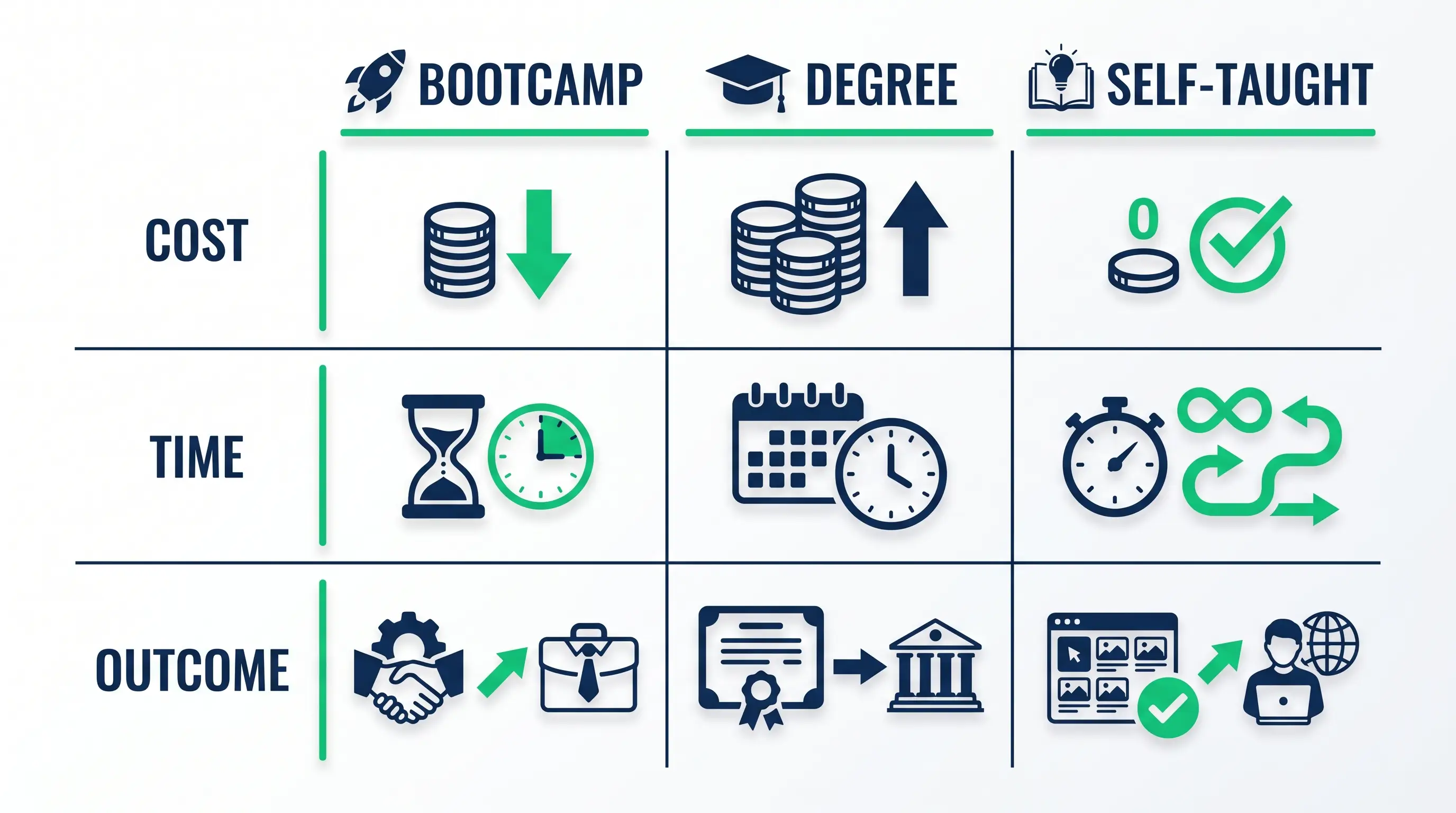
Bootcamp versus degree versus self-taught
People frame this as bootcamp or nothing. There are really three roads, and they suit different lives.
A computer science degree is the slow, expensive, thorough one. Four years, often far more than any bootcamp in total cost, and you come out with deep fundamentals plus a credential that opens doors bootcamp grads sometimes have to knock harder on. If you're 18 with time and financial aid, it's a legitimate path. For a 32-year-old career changer with a mortgage, it usually isn't.
A bootcamp is the fast, focused, moderately expensive middle. Months instead of years, job-ready skills instead of theory, and a real support structure. The trade is depth and the occasional employer who still raises an eyebrow at a non-degree resume.
Self-taught is the cheapest and the hardest to finish. Total freedom, almost no cost, and nobody holding you accountable when you'd rather watch Netflix. The people who pull it off save a fortune. Plenty of others quit in month two. If you want to see how far this road actually goes, I wrote a whole piece on getting into tech without a degree.
Here's the reframe I keep coming back to. What you're actually paying a bootcamp for isn't the code. The code is free and it's everywhere. You're paying for structure and accountability. So the real question is how much that structure is worth to you, and whether there's a way to get most of it without the five-figure bill.

The affordable middle path
This is where I'm going to be upfront that I run a learning platform, so take it with that in mind. But it exists for exactly the person in this post, so I'd be doing you a disservice not to mention it.
Most people who ask me about bootcamps don't actually want a bootcamp. They want the outcome a bootcamp promises without betting their savings on it. They want structure, a path that goes from zero to job-ready, real projects, and other humans to learn alongside. They just can't stomach the idea that if it doesn't work out, they're down fifteen grand.
That's the gap CodingPhase is built for. It's a membership, not a bootcamp. Diamond runs $42 a month, or $255 for the whole year, which lands around $21 a month if you pay annually. Compare that to $10k to $20k up front and the math speaks for itself. Inside you get 90-plus courses, guided career paths that take a total beginner to job-ready, an 80,000-member community so you're not grinding alone, a resume builder tuned to get past the automated screeners, and a job board. It's self-paced, so nobody's forcing you to quit your job to learn.
The honest tradeoff, because there's always one: a membership won't chase you down the way a full-time cohort with daily live sessions will. If you're someone who genuinely cannot self-start no matter what, the built-in pressure of an in-person bootcamp might be worth paying more for, and I'll say that plainly. But if you've got even a little self-discipline and you'd rather not gamble a year's savings to find out whether you like coding, starting cheap and self-paced is the lower-risk move by a mile. If cost is your main worry, I put together a list of the best affordable coding courses that's worth a look too.
FAQ
Are coding bootcamps worth it in 2026? For the right person, yes. If you have some savings, you learn well with structure and a cohort, and you're ready to work hard, a reputable bootcamp can pay for itself fast. If money's tight or you're not even sure you like coding yet, it's a risky way to find out, and cheaper options will teach you the same skills.
Do employers respect coding bootcamps? Many do, especially for junior roles, and plenty of developers you'd never guess came out of bootcamps. That said, some companies still prefer a degree, and a bootcamp certificate alone won't get you hired. What actually lands the job is a portfolio of projects that proves you can build things.
Can I get the same skills without paying for a bootcamp? Yes. The curriculum a bootcamp teaches isn't secret. The information is available cheaply or free. What a bootcamp adds is structure, accountability, and support, and you can get a solid version of all three from a membership platform for a tiny fraction of the cost.
How much does a coding bootcamp cost? Full-time immersive programs mostly run $10,000 to $20,000, plus the income you lose while studying. Part-time and online options can be cheaper. Membership learning sits far below all of it, usually tens of dollars a month rather than thousands up front.
What's the catch with bootcamp job placement rates? The catch is how they count. A high placement rate can quietly exclude people who stopped searching, count unrelated jobs, or include grads the bootcamp hired itself, and much of it is self-reported with no outside audit. Always ask who's counted, who's excluded, and who verified the number.
So back to the guy with his finger over the "pay" button. I didn't tell him to buy it and I didn't tell him to run. I told him to figure out which person he was first. Then spend accordingly.
If you're pretty sure you'll do the work and you just want a structured, low-risk place to start without betting your savings on a maybe, come see what's inside a membership and try it before you ever consider a five-figure tuition bill. Learn the skill first. Decide how much structure you actually need second. You've got more room to figure this out than the sales pages want you to believe, and I'd rather see you start than see you stuck weighing it forever.