Free Coding Bootcamps That Are Actually Worth It (2026)
On this page
A guy messaged me last month, kind of embarrassed about it. He'd spent four months trying to learn to code for free. freeCodeCamp for a week. Then a YouTube playlist somebody swore by. Then a Udemy course he got on sale, then back to a different YouTube channel because the first one moved too fast. He had 30 tabs open and a Notion doc full of half-finished notes and no idea what he was actually building toward.
He wasn't lazy. He'd put in real hours. He just had no map. And somewhere around month four he decided he "wasn't a coding person" and stopped.
I've heard some version of that story more times than I can count. So let me tell you the thing I told him. The free resources are not the problem. Most of them are genuinely excellent, better than what people paid thousands of dollars for a decade ago. The problem is that "free" quietly hands you a second job you didn't know you signed up for, and that job is the reason most people quit.
Let me walk you through the good stuff first, honestly, and then the catch.

First, "free coding bootcamp" isn't really a thing
Let's clear this up, because the search term is a little bit of a lie.
A bootcamp, the real kind, is a structured program with a curriculum, deadlines, instructors, a cohort of other students, and usually some kind of career support at the end. Almost none of that is free. The famous "free until you get a job" income-share bootcamps mostly collapsed or turned into something else, and the ones still standing take a big cut of your first salary. That's not free. That's a loan with extra steps.
What actually exists for free is a pile of world-class courses and platforms. Not bootcamps. Courses. The difference matters, because a course gives you the material and walks away. A bootcamp gives you the material and then stands over your shoulder making sure you don't wander off. When you go free, you're getting the first thing and doing the second thing yourself.
So when I say "free coding bootcamp," what I really mean is: can you assemble something bootcamp-shaped out of free parts. You can. Plenty of people have. Here's what you're working with.
The free options that are genuinely worth your time
freeCodeCamp
This is the one everybody names first, and for good reason. It's a nonprofit, it's completely free with no upsell, and the curriculum is enormous. You write code right there in the browser, work through interactive lessons, and build actual projects to earn certifications. Responsive web design, JavaScript, front-end libraries, data structures, the whole path is laid out for you.
If I had to point a broke beginner at exactly one thing, this would be it. The structure is the closest a free resource gets to a real curriculum.
The catch here is subtle. The lessons are so bite-sized that you can pass them without really absorbing anything. People fill in the blanks, watch the checkmark go green, and six lessons later can't write the same code from a blank file. Passing isn't the same as knowing. You have to close the tutorial and rebuild things from scratch, which nothing forces you to do.
The Odin Project
If freeCodeCamp sometimes feels like it holds your hand too tightly, The Odin Project is the opposite, and that's its whole strength. It's a full-stack curriculum, free, that deliberately throws you into the deep end. It doesn't hand you every line. It tells you to go read the documentation, figure out the thing, and come back. That's on purpose, because that's what the actual job feels like.
People who finish Odin tend to come out genuinely capable. They can sit down with a problem they've never seen and grind through it, which is the real skill.
But that same "go figure it out" design is exactly where people bail. There's no dopamine hit every 90 seconds. Some sections feel like slamming your head against a wall for two days before something clicks. If you're not ready for that, you'll read it as "I'm failing" instead of "this is the work." It isn't failing. It's the work. Nobody tells beginners that clearly enough.
Harvard's CS50
CS50 is Harvard's intro computer science course, and you can take the entire thing online, free, taught by a professor who is genuinely one of the best lecturers alive. This is the one that teaches you how computers actually think. Memory, data structures, a little C before you ever touch the friendlier languages. It goes deeper than most bootcamps that charge five figures.
Here's my honest take. CS50 is not the fastest road to a first job, and if your only goal is "employed as a web developer as soon as possible," it can feel like a detour. But the people who do it stop being scared of hard concepts. That fearlessness pays off for years. I'd say do it alongside something more job-focused, not instead of it.
MDN Web Docs
MDN isn't a course, and I want to include it precisely because it isn't. It's the reference. When you actually build things, you will live inside MDN's documentation for HTML, CSS, and JavaScript. It's accurate, it's maintained by people who know what they're talking about, and learning to read it well is a skill in itself.
The catch is just that it's a reference, not a path. You can't "start at the beginning" of MDN. It's the dictionary, not the novel. Treat it as the thing you keep open in a tab, not the thing you learn from cover to cover.
YouTube
And then there's YouTube, which is a monster. Some of the best teaching on the internet is sitting on YouTube for free, full multi-hour project builds, entire courses, a person walking you through exactly the bug you're stuck on at 1 a.m.
But YouTube is also where good intentions go to die. It's built to keep you watching, not to make you competent, and those two goals pull in different directions. You can watch a person build a beautiful app for six hours, feel like you learned a ton, and then discover you can't build anything yourself because you were watching, not doing. Tutorial hell is real, and YouTube is its capital city. Use it to unstick yourself, not as your main curriculum, and pause the video to write your own code constantly.
The catch nobody puts on the landing page
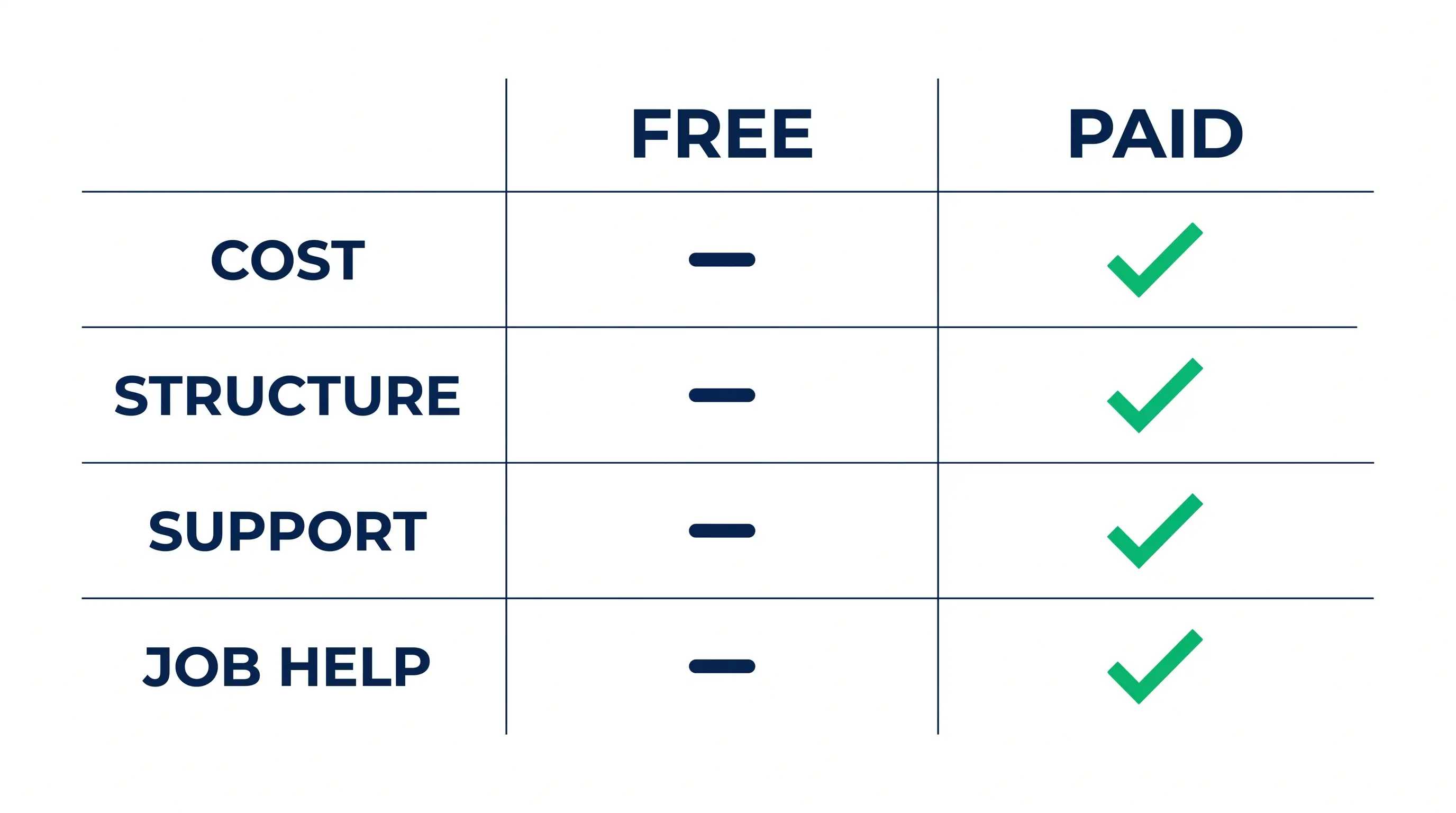
Notice the pattern in everything above. Every free option is strong on material and quiet on everything else.
That "everything else" is what actually gets people to the finish line, and free tends to skip all of it.
There's no map. You have to decide the order yourself, which resource comes first, when you're ready for the next thing, what to skip. Beginners are the worst-positioned people on earth to make those calls, because you don't know what you don't know yet.
There's no accountability. Nobody notices when you stop. The course doesn't email you asking where you went. Your streak breaks and the universe is silent about it, and silence is really easy to quit into.
There's nobody to ask. You hit a bug that isn't in any tutorial, you paste an error into Google, you get 40 tabs of people arguing, and two hours later you're more confused than when you started. A person who's done this before could've answered it in ninety seconds. On the free path, that person doesn't exist for you.
And there's no job help at the end. You finish, you're actually decent now, and then you find out that being able to code and being able to get hired are two different skills. No portfolio review, no resume that survives an ATS scanner, no interview practice, no one who's placed people before telling you your GitHub looks empty.
None of that means free is bad. I want to be really clear here. If you're disciplined, if you can build your own structure and sit in the discomfort of not knowing and keep going anyway, free will absolutely get you there. People do it every year. The internet made that genuinely possible and it's a beautiful thing.
But be honest with yourself about whether that's you. Most people aren't wired to be their own teacher, own manager, own accountability partner, and own career coach all at once, for free, in their spare time, after work. That's a lot of jobs for one tired person.
When it's worth paying a little for the parts free can't give you
Here's the reframe I want you to keep: free gives you the information, and information was never the expensive part. The expensive part was always the structure around it.
So the real question isn't free versus paid. It's whether you're the kind of person who can supply your own structure, or whether you'll get further paying a small amount for someone to supply it for you.
That's the honest gap CodingPhase is built to fill, and I'll tell you exactly where it fits so you can decide. It isn't a bootcamp and it doesn't cost bootcamp money. It's a membership: 49 dollars a month, or 250 for a year if you want the cheaper route. For that you get 90-plus courses arranged into guided career paths, so the order is decided for you instead of you guessing. A community of people learning the same thing, so when you're stuck at 1 a.m. there's somebody to ask. A resume builder made to pass the ATS filters that quietly reject most applicants. And a job board for when you're actually ready.
Basically, it's the four things free skips, for less than most people spend on takeout in a month. That's the whole pitch. If you're disciplined enough to go free, genuinely, go free and save your money. If you've already tried free and stalled out like the guy who messaged me, the structure is probably what you were missing, not talent.
If you want to think through the money side more, I wrote a straight breakdown of what coding bootcamps actually cost and a rundown of the most affordable coding courses worth paying for. And if you just want to know how to sequence the learning itself, start with how to learn to code.

FAQ
Are there actually free coding bootcamps?
Not really, at least not the way people picture. True bootcamps with instructors, cohorts, and career support cost money, or they take a slice of your future salary through an income-share agreement, which isn't free either. What's genuinely free is a set of excellent courses and platforms like freeCodeCamp, The Odin Project, and CS50. You can build something bootcamp-shaped out of them, but you're the one supplying the structure.
Can you get a coding job with only free resources?
Yes, people do it every year. It's harder, and it filters hard for self-discipline, because you get no accountability and no job help along the way. If you can build your own routine and push through being stuck without someone to ask, free can absolutely get you hired. If that's a struggle, a little structure changes the odds a lot.
freeCodeCamp or The Odin Project, which should I start with?
Start with freeCodeCamp if you want more hand-holding and quick wins early on, since the momentum helps when you're brand new. Move to The Odin Project when you're ready to be pushed toward figuring things out on your own, which is closer to the actual job. A lot of people do both, and that's a completely reasonable plan.
Is CS50 worth it if I just want a web dev job fast?
It's worth it, but maybe not first and not alone. CS50 makes you unafraid of hard concepts, which pays off for years, but it isn't the shortest path to a paycheck. Run it next to something more job-focused rather than treating it as your only track.
Why do so many people quit learning to code for free?
Almost always structure, not ability. Free hands you the material and none of the scaffolding, so you become your own teacher, manager, and coach all at once. That's a lot to carry alone after a workday, and most people run out of steam long before they run out of talent. If that's been you, read whether coding bootcamps are worth it before you decide free failed you.
If you've tried the free route and it didn't stick, I don't think that says anything about whether you can code. It usually just means you needed a map and somebody in your corner, which is a normal thing to need and a cheap thing to fix. Poke around the guided paths, see if the structure is the piece you were missing, and if free is working for you, keep going. Either way, you're closer than you think.