Web Content Manager Job Description (With the Subtext Included)
On this page
Job descriptions for this role are written by committees, which is why they read like a list of everything anyone in the building could imagine a website needing.
Here's a clean version if you're hiring, and underneath it, the honest translation for anyone deciding whether this job is worth applying for.

The job description
Role: Web Content Manager Also posted as: Website Manager, Web Content Specialist, Digital Content Manager, Web Administrator, CMS Specialist Reports to: Marketing Director, Head of Digital, or Communications Director Typical range: $70,000 to $95,000
Summary. Own the day-to-day management of the organization's website: publishing and maintaining content, managing the CMS, coordinating requests from across the business, and keeping the site accurate, accessible, findable, and on brand.
Responsibilities:
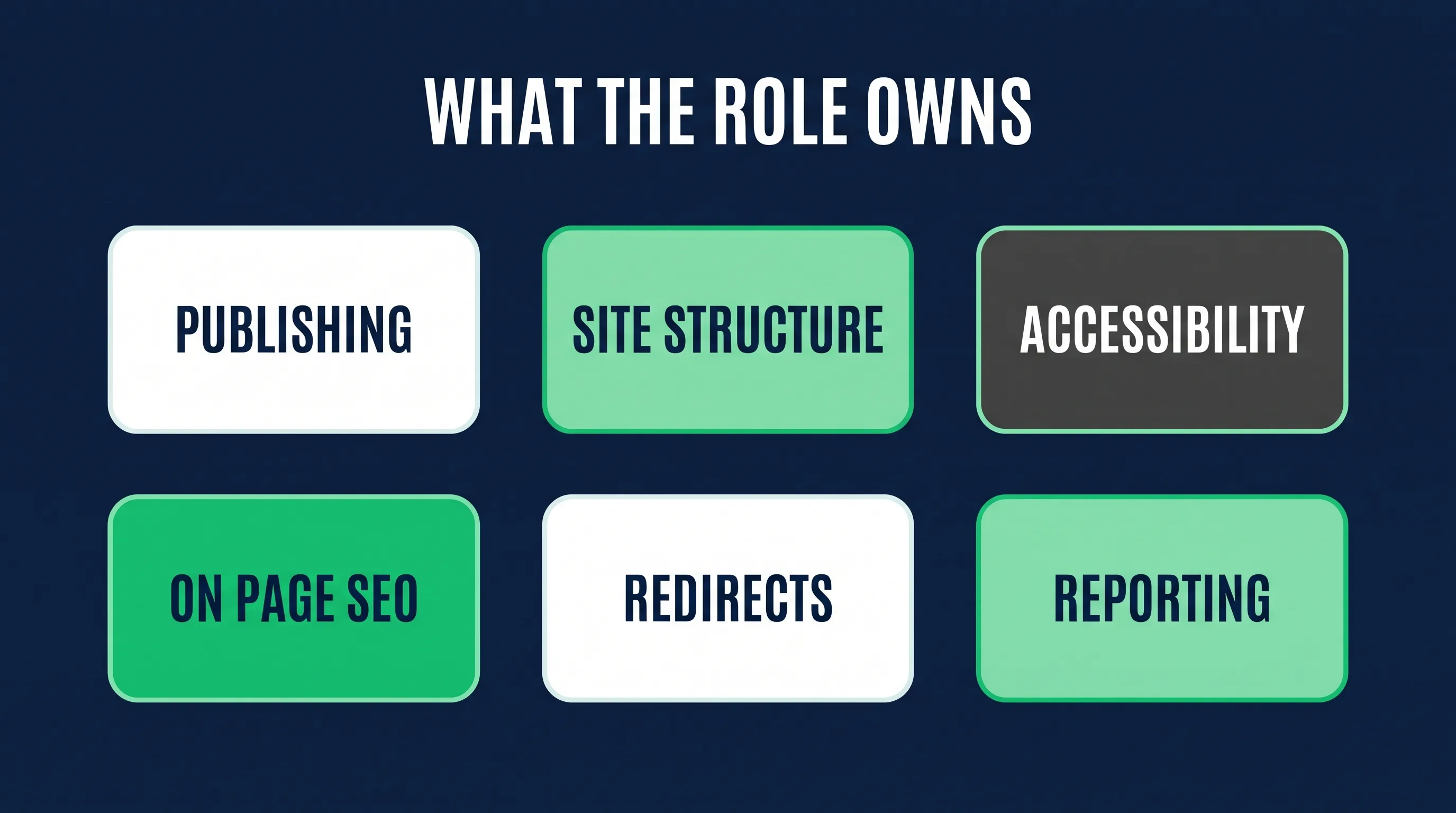
- Publish, update, and retire content across the website using the CMS
- Own site structure, navigation, and taxonomy as the site grows
- Coordinate content requests from marketing, product, legal, and other departments
- Maintain content standards, including tone, formatting, imagery, and metadata
- Ensure accessibility compliance across published content
- Apply on-page SEO fundamentals: titles, meta descriptions, heading structure, internal linking
- Manage redirects and monitor for broken links and orphaned pages
- Work with developers or agencies on templates, components, and fixes
- Report on site performance using analytics and Search Console
- Maintain the publishing calendar and approval workflow
Requirements:
- Two or more years managing a website through a CMS
- Working knowledge of HTML and CSS
- Understanding of on-page SEO and web accessibility standards
- Comfortable with analytics tools
- Strong organization and attention to detail
Nice to have:
- Experience with the organization's specific CMS
- Basic image editing
- Experience with a site migration or redesign
What those lines actually mean
"Coordinate content requests from across the business." This is the real job. You are a queue with a person attached, and success depends on process rather than speed. Ask in the interview how requests currently arrive. If the answer is "email and Slack and sometimes people just stop by," that's what you'd be fixing first.
"Own site structure and taxonomy." Usually means the site has grown into a mess and nobody has authority to reorganize it. Excellent opportunity if you're given that authority, thankless if you aren't. Ask who signs off on structural change.
"Working knowledge of HTML and CSS." They mean it, and most applicants overstate it. If you can genuinely edit a template and fix a broken layout, you're in a different tier of candidate. It's also the clearest lever on pay in this whole job family, which is the argument in the salary guide.
"Ensure accessibility compliance." At a university, hospital, or government agency this is a legal requirement with real consequences, not a nice-to-have. Learn WCAG basics before interviewing at any of them; it's rare among applicants and moves you up the list fast.
"Work with developers or agencies." Translation: you'll wait. How long depends on whether the developers are in-house or a retainer that runs out mid-month. Ask how site changes get prioritized.
"Strong organization and attention to detail." Every posting says this. It's real here, because the failure mode of this job is a wrong price or an out-of-date policy sitting live for three weeks.
Warning signs in a posting
Nine responsibilities that span design, development, copywriting, social, and email. That's four jobs. Fine at the right salary and a genuinely fast education, but negotiate as though the title said specialist.
No CMS named. Companies that know their platform say so. Vagueness sometimes means it's a custom system nobody documented.
"Webmaster" in the title. Not disqualifying, but it tends to signal an organization that hasn't updated how it thinks about the web in a while. Context in web administrator vs webmaster.
A band under $55k for a manager title. That's coordinator pay.
Heavy mention of "quick turnaround" with no mention of process. You'll be reactive all day.
Questions worth asking in the interview
"How many people can publish to the site today?" Reveals the governance situation immediately.
"What's the process when legal needs a change?" Tells you how much of your week is approvals.
"When was the last content audit?" If the answer is never, expect several hundred stale pages.
"Who owns the templates?" Determines whether you can make things happen or only request them.
"What's the biggest complaint about the site internally?" Their answer is your first project.

If you're hiring
Ask for an audit, not a portfolio. Give candidates a page of your live site and ask what they'd change and why. Fifteen minutes of that conversation tells you more than any résumé, because it surfaces whether they think about structure and accessibility or only about publishing.
And decide honestly whether you want a publisher or an improver. Both are valid hires and they're different people. A publisher keeps the queue moving. An improver will want to restructure things, which is valuable only if you're prepared to let them.
For the full picture of how this title relates to the two dozen others companies use for the same work, the 26 job titles guide maps them, and the salary guide covers the bands.
FAQ
What does a web content manager do? Manages an organization's website content day to day: publishing and updating pages, maintaining structure and standards, coordinating requests, handling on-page SEO and accessibility, and reporting on performance.
What qualifications does a web content manager need? Typically two years of CMS experience, basic HTML and CSS, on-page SEO knowledge, and accessibility awareness. Degrees are required more often in government and higher education than in private industry.
What is the salary range for this role? $70k to $95k for manager titles in the US, with specialist and coordinator roles lower and digital experience roles reaching $115k.
What should a web content manager job description include that most miss? Who owns site structure, how requests are prioritized, and what the accessibility obligations actually are. Those three determine what the job is really like.
Is this the same as a web administrator? Practically, yes, at most organizations. How to become a web administrator covers the same role under the older label.
Is the role remote friendly? Often, since the work is browser-based. Public sector employers are the most likely to require on-site presence anyway.
If you're applying, read the responsibilities twice and count the jobs. If there are three, you now know what you're negotiating for.
And if you can edit a template, lead with it. That one line moves more applications forward than any amount of describing yourself as detail-oriented.