How to Retire Early With a Tech Job (The FIRE Math Nobody Shows You)

On this page
A while back one of my students, a guy who went from warehouse shifts to a $95k developer job in under two years, sent me a message that stopped me cold.
He didn't ask about React. He didn't ask about interviews.
He asked: "Joe, now that I make real money... when can I stop?"
That question is the whole game. Everybody teaches you how to get the tech job. Almost nobody teaches you what the job is actually for. And I'll tell you what it's for: buying your freedom back. That's it. The laptop, the standups, the salary, all of it is a vehicle. The destination is the day work becomes optional.
That's what the FIRE movement is about, and tech workers are sitting on the single best FIRE vehicle available without a trust fund. Most of them have no idea.
What FIRE actually means (in one paragraph)
FIRE stands for Financial Independence, Retire Early. The core idea: instead of working until 65 and hoping Social Security shows up, you save an aggressive chunk of your income, invest it in low-cost index funds, and quit mandatory work decades early, living off your investments. The math rests on one number: your FIRE number, which is roughly 25 times your annual spending. Spend $50,000 a year? You need about $1.25 million invested. That 25x comes from the 4% rule: research going back to the Trinity Study found that withdrawing about 4% of a diversified portfolio per year has historically survived 30+ year retirements.
If you spend $4,000 a month, your number is $1.2M. If you spend $3,000, it's $900k. Notice what that means:
Your FIRE number is set by your spending, not your salary.
Read that again, because it's the part everyone gets backwards. A developer spending $40k a year with a $130k salary is racing toward freedom. A developer spending $110k a year on the same salary is just a well-dressed hamster.
You can skip the spreadsheet and get your exact numbers in about 30 seconds with our free FIRE calculator. It handles the regular version plus Coast FIRE and Barista FIRE, which I'll explain below. Come back when you have your number. It changes how you read the rest of this.

Why a tech job is the best FIRE vehicle on the planet
I've said for years that learning to code is the cheapest legal way to change your income bracket. FIRE is why that matters. Here's what tech gives you that almost no other career does:
- A high income without a decade of credentials. Doctors out-earn developers, sure, but they start at 30 with $300k of school debt. You can be earning six figures in tech in your twenties, or two years after a career change, with certifications and a portfolio instead of a mortgage-sized degree.
- Income that scales without more hours. Raises, job hops, freelance work, contract gigs. In most jobs a 40% raise takes a promotion cycle of five years. In tech it can take one well-timed job switch.
- Remote work breaks the geography trap. A remote salary spent in a cheap city or country is a savings-rate cheat code. Same income, half the cost of living, double the gap you can invest.
- Your skills compound like your portfolio does. Every year of experience raises your market rate, which raises your savings rate, which pulls your retirement date closer.
The honest downside: tech salaries make lifestyle inflation feel affordable. The $700 car payment, the $3,200 apartment, the DoorDash habit. Tech doesn't just hand you the best FIRE vehicle; it also hands you the nicest-looking ways to crash it.
The only table you actually need
Forget complicated projections for a second. Your savings rate, the percentage of take-home pay you invest, almost single-handedly decides your working years remaining. Assuming roughly 5% real returns and the 4% rule, starting from zero:
| Savings rate | Years until work is optional |
|---|---|
| 10% | ~51 years |
| 25% | ~32 years |
| 40% | ~22 years |
| 50% | ~17 years |
| 65% | ~10.5 years |
| 75% | ~7 years |
Sit with that table for a minute. A normal American savings rate keeps you working for half a century. A 50% savings rate, which is genuinely achievable on a mid-level tech salary, makes work optional in about 17 years. Start at 25, done before 45.
This is the reframe I want you to steal: every dollar you don't spend is buying back days of your life. Not "saving for retirement." Buying days. At a $60k-a-year spending level, every $164 you put away covers one more day of retirement spending.
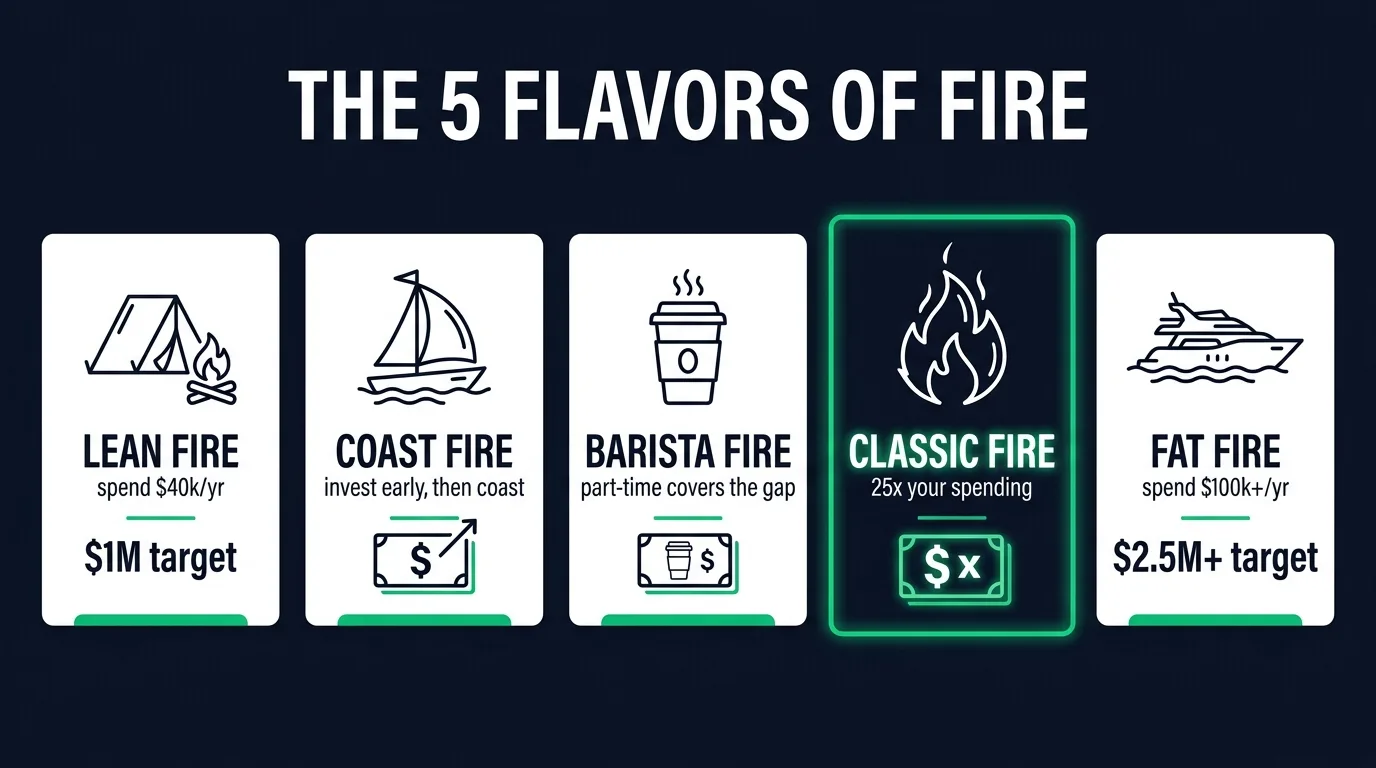
The four flavors of FIRE (pick your difficulty setting)
FIRE isn't all-or-nothing, and the variants matter, especially for tech workers who mostly like their work and just hate being trapped in it.
- Classic FIRE is the full version: 25x your spending invested, work fully optional. The benchmark everything else is measured against.
- Coast FIRE is the underrated one for people in their twenties and thirties. You front-load investing hard for a few years until your current portfolio will compound to your FIRE number by traditional retirement age on its own, with zero new contributions. After that you only need to earn enough to cover your bills. A 27-year-old with about $120k invested and $50k annual spending has often already hit Coast FIRE for age 65. The pressure release is enormous: take the interesting job over the lucrative one, go part-time, start something.
- Barista FIRE means your portfolio covers most of your spending and easy part-time work covers the rest (the name comes from people working at Starbucks partly for the health insurance). For a developer, "barista" work might be 10 hours a week of freelance code at $85 an hour, which beats steaming milk.
- Lean FIRE and Fat FIRE are the same math at different spending levels: Lean is retiring on a slim budget (roughly $40k a year or less, so around a $1M portfolio), Fat is retiring on $100k+ a year (a $2.5M+ portfolio). Same formula, different lifestyle.
The FIRE calculator has dedicated modes for Coast and Barista, so you can see all three targets side by side with your real numbers instead of guessing which flavor fits your situation.
The actual plan, step by step
Nothing here is exotic. FIRE on a tech salary is boring on purpose. The plan is five moves, repeated for a decade or two.
1. Get your income into tech range, then keep pushing it. If you're not in tech yet, this is the highest-leverage move on this list; the jump from $45k to $95k does more than any budgeting trick ever will. If you're already in, remember the market pays for skills, not loyalty: job switchers consistently out-earn job stayers. Learning in demand, higher-paying skills is the raise you give yourself. That part is exactly what I build career paths for.
2. Freeze your lifestyle at "comfortable," not "impressive." The gap between your income and your spending is the whole engine. You don't need rice-and-beans asceticism; you need to stop letting every raise disappear into a nicer everything. Bank the raises. Live like you did before them.
3. Invest the gap automatically into boring index funds. Max the 401(k) match (that's an instant 50 to 100% return), then fill tax-advantaged accounts, then a regular brokerage buying broad market index funds. Automatic transfer on payday, every payday. No stock picking, no crypto lottery tickets, no waiting for the dip. The people who hit FIRE are almost universally the boring ones.
4. Check your number, not the news. Run your numbers once, set the plan, then review maybe quarterly. The market will crash at some point during your journey. That's not a flaw in the plan; it's a feature you're buying shares through.
5. Pick your exit ramp early. Decide whether you're driving toward Classic, Coast, or Barista, because they imply different intensity. Coast FIRE by 35 is a very different (and much gentler) plan than full retirement by 40.
The honest part: what FIRE actually costs
I'd be lying to you if I sold this as free money and sunshine, and lying to you isn't what I do here.
- The 4% rule is a strong guideline, not a law of physics. It's based on historical US market data. Plenty of serious people argue 3.5% is safer for a 50-year retirement. That's the difference between 25x and ~28x your spending. Plan with margin.
- Healthcare in the US is the real boss fight. Retire at 40 and you have 25 years before Medicare. ACA marketplace plans, Barista FIRE with benefits, or a bigger cushion: pick one, but plan for it, because it can add $10k+ a year to your spending number.
- Extreme frugality has a body count. I've watched people white-knuckle a 70% savings rate into burnout, damaged relationships, and a joyless decade. If your plan requires hating your life for fifteen years, it's a bad plan. A 40 to 50% rate you can hold beats a 70% rate you abandon in year three.
- Sequence risk is real. A market crash in your first years of retirement hurts far more than one in year twenty. Flexible spending, a cash buffer, or part-time income in the early years is the standard defense.
- "Retire" is the wrong word anyway. Almost every FIRE person I know still works. They just work on what they want. The realistic goal isn't a beach chair at 42; it's never having to say yes out of fear again.
And the obvious disclaimer: I teach code, not securities law. This is education, not personalized financial advice. Big money decisions deserve a fee-only fiduciary advisor.

FAQ
How much money do I need to retire early?
Roughly 25 times your annual spending, based on the 4% rule. If you spend $50,000 a year, that's about $1.25 million invested. Use a lower withdrawal rate like 3.5% (about 28x spending) if you want extra safety for a retirement that could last 50 years. Our FIRE calculator computes it from your real numbers.
Can I retire early on a normal developer salary?
Yes, and you don't need FAANG money. A $100k salary with $50k annual spending is a ~50% savings rate, which historically means work becomes optional in roughly 17 years starting from zero. The savings rate matters far more than the salary itself.
What is Coast FIRE and why do tech workers love it?
Coast FIRE means you've invested enough early that compound growth alone will carry your portfolio to your FIRE number by traditional retirement age, with no further contributions. It's popular in tech because a few high-earning years in your twenties can buy you decades of career flexibility afterward.
Is the 4% rule still safe in 2026?
It remains the standard starting point, backed by decades of historical data, but it was built on 30-year retirements. For 40 to 50 year early retirements, many planners suggest 3.25 to 3.75% withdrawal rates, flexible spending in down years, or a part-time income buffer. Treat 4% as the benchmark, not a guarantee.
Should I pay off my house before investing for FIRE?
Mathematically, investing usually wins when your mortgage rate is below expected market returns, but a paid-off house lowers your annual spending, which lowers your FIRE number by 25x that amount. There are strong FIRE cases on both sides; most people land on "invest first, but never carry high-interest debt."
Does FIRE mean I have to stop working forever?
No. Most people who reach financial independence keep working on their own terms: passion projects, part-time consulting, teaching, or building a business. FIRE removes the obligation to work, not the option.
Here's what I want you to actually do with this.
Tonight, take ten minutes. Figure out what you spent last year, run it through the FIRE calculator, and look at the date it gives you. Not to panic about it. Just to know it. Because the day I calculated mine was the day my salary stopped being a scoreboard and started being a tool.
And if the honest answer is "my income isn't big enough to make this math work yet," that's not a wall, that's the first step of the plan. Growing your income through tech skills is the exact thing I've helped thousands of people do inside CodingPhase: 90+ courses, guided career paths from beginner to job-ready, and a community of people running the same play. The membership is $42 a month or $255 a year, which is a rounding error against your first raise.
Your job funds the plan. Your skills grow the job. The calculator shows you the finish line.
Go find out where yours is.