Coursera vs Udemy: Which One Is Worth Your Money in 2026?
On this page
A question shows up in our community about once a week, and it usually reads something like this: "I've got fifty bucks and a free weekend. Coursera or Udemy?"
I like that question because the person asking is about to spend real money, and a lot of what ranks for Coursera vs Udemy is a few years old and written to earn an affiliate commission on both.
My bias, up front: I run CodingPhase, which sells a membership that competes with both of these platforms. I've also been teaching online since 2016, and a lot of our members arrive with a Coursera certificate or a half-watched Udemy library already in hand. I'm going to tell you where each one is the right call, including the cases where you shouldn't buy from us.
One thing changed this year that most comparisons haven't caught up with. Coursera and Udemy completed a merger on May 11, 2026, so they are one company now. Coursera's own announcement says nothing changes for learners yet: the two sites run separately, with separate accounts, and a Coursera Plus membership does not unlock Udemy courses. The choice is still a real one.
Coursera vs Udemy in one paragraph
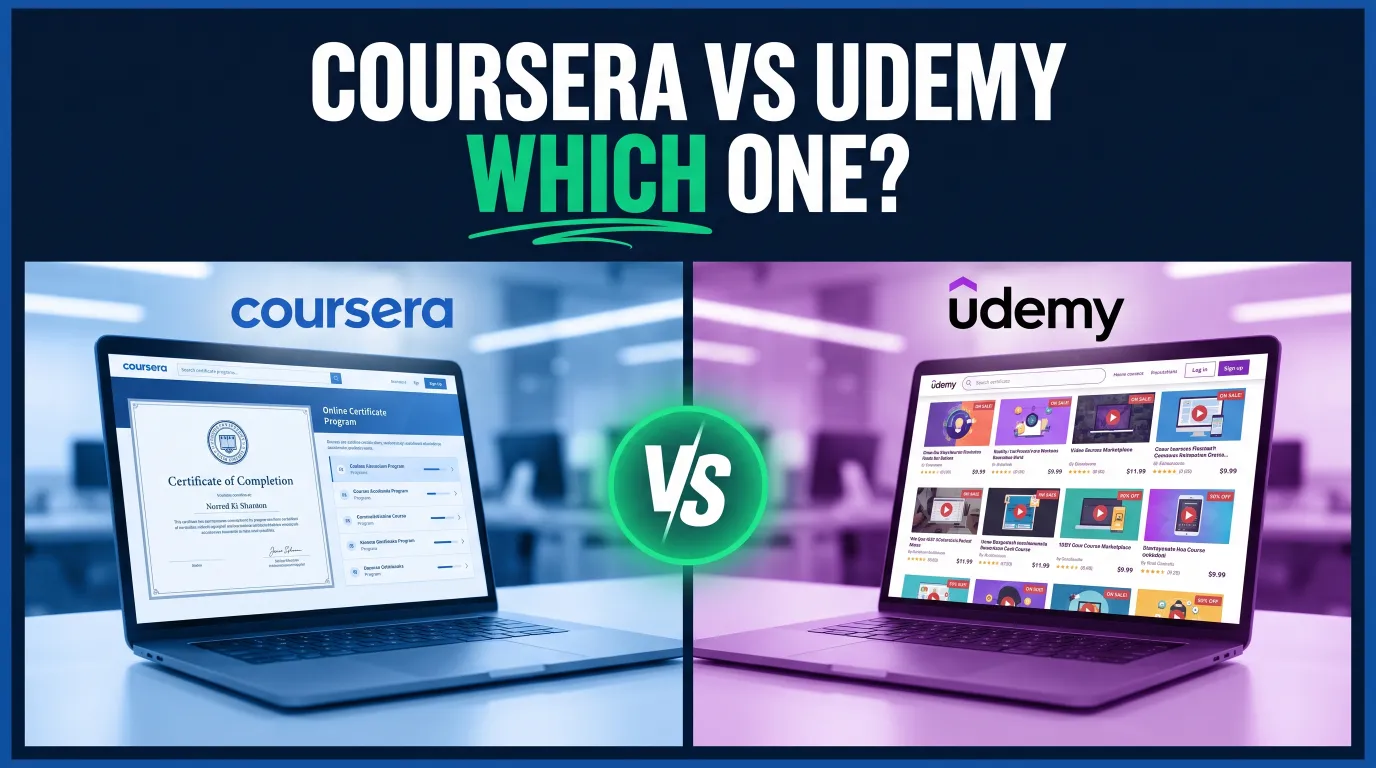
Coursera sells structured programs from universities and big companies, mostly by subscription, and its certificates carry names like Google and Stanford. Udemy is an open marketplace where independent instructors sell individual courses you keep for life, usually at a steep discount. Pick Coursera for the credential. Pick Udemy for a specific skill, fast and cheap.
| Coursera | Udemy | |
|---|---|---|
| Who teaches | Universities and companies (Google, IBM, Meta, Stanford) | Independent instructors, anyone can publish |
| How you pay | Monthly subscription per program, or Coursera Plus | One-time purchase per course, or Personal Plan |
| All-access plan | Coursera Plus: $59/month or $399/year, 10,000+ courses | Personal Plan: from $13/month billed annually, 28,000+ courses |
| Access length | While subscribed (180 days on one-time course purchases) | Lifetime on purchased courses |
| Certificate | Co-branded with the university or company | Udemy certificate of completion, not accredited |
| Refunds | 7 days on one-time purchases, 14 days on annual Plus | 30 days on courses, none on subscriptions |
Prices are what each platform's own pages showed in mid-September 2026, in US dollars. Both run promotions constantly, so check before you pay.
Udemy vs Coursera pricing: what you'll actually pay
Udemy is cheaper for one skill: a single course, bought on sale, that you own for life. Coursera costs more per month, but one Coursera Plus subscription covers multiple full certificate programs. The break-even depends on how many months you take to finish.
Udemy. The pricing page lists individual courses at $19.99 to $199.99 as a one-time purchase, across a catalog of 250,000+ courses. Almost nobody pays the top of that range. Udemy runs sales so often that if the course you want is showing full price today, put it on your wishlist and wait a week or so. You keep a purchased course for life, so you can come back to that SQL course two years later when a job finally asks for it.
There's also a subscription, the Personal Plan. Udemy advertises it as "starting at $13.00 per month" for a curated 28,000+ of its top-rated courses. That $13 figure is the annual plan divided by twelve. Paying month to month costs noticeably more, and the exact number varies by country, so look at the checkout page before you assume. The week I checked, the annual plan was 30% off for the first year.
Coursera. Here you mostly rent. Professional Certificates and Specializations are monthly subscriptions to that one program. Coursera's help center puts Professional Certificates at $49 a month and up, and Specializations have historically ranged from about $39 to $89, with the real number only appearing when you click enroll. The subscription ends when you earn the certificate, so finishing faster is literally cheaper. Google's IT Support certificate is pitched at three months at ten hours a week. Take six and you've paid double.
Coursera Plus is the all-you-can-eat option: $59 a month or $399 a year for 10,000+ courses, including most of the big-name certificates (degrees and some programs are excluded). Two or more certificate programs in a year and Plus at $399 wins. One certificate and some discipline, and the single subscription is usually less.
About "free." Coursera used to let you audit most courses at no cost. Since 2025 most offer a preview of the first module instead, and a smaller set remain fully free without a certificate (Class Central counted a bit over 470 this year). Udemy's free courses don't come with a certificate either. Coursera still lists financial aid on many programs, worth applying for if money is tight.
Who teaches, and how consistent the quality is
Coursera's floor is higher and Udemy's ceiling is higher. Coursera courses come from vetted partners, so almost nothing is bad, though some of it is slow and academic. Udemy lets anyone publish, which produces both the best practical coding courses online and a lot of filler.
Coursera's partner list includes Google, IBM, Meta, Microsoft, Stanford and Duke, and a program goes through one of those institutions before it reaches you. The tradeoff is pace. University material tends to be lecture-heavy, and peer-graded assignments can leave you waiting on strangers.
Udemy is a marketplace. An instructor records a course, publishes it, and the ratings sort it out. The good ones are excellent and get updated every year by working developers. The bad ones are six hours of someone reading documentation aloud. You do the vetting yourself: check the last-updated date, read the three-star reviews (they're the honest ones), and watch the free preview lectures before buying anything.
One thing our members say a lot about Udemy: the library becomes a graveyard. Courses bought for the price of a sandwich, with good intentions, never opened. A $12 course you never open is more expensive than a $49 one you finish.

Which certificate do employers care about more?
Coursera's, and it isn't especially close. A Coursera certificate carries the name of Google, IBM or a university on it. A Udemy certificate carries Udemy's name, and Udemy says plainly that it isn't an accredited institution. Neither one replaces a portfolio when you're applying for technical work.
Udemy's help center puts it this way: certificates "cannot be used for formal accreditation." Only paid courses issue one. It proves you finished the videos, which is fine for a line on LinkedIn and pretty weak as a hiring signal.
Coursera's Professional Certificates are a different animal. Google's IT Support page says graduates can apply directly to Google and a consortium of over 150 US employers. That's Google's claim, and being allowed to apply isn't being hired, but it's a name a recruiter has seen before. For HR-screened roles like IT support or data analytics, that recognition has value.
For developer jobs I'd temper expectations on both. From what members tell me after interviews, the certificate gets a glance and the portfolio gets the questions. I went deeper on this in are online coding certificates worth it, and on Coursera specifically in is Coursera worth it.
Refund policies: Udemy is more forgiving
Udemy gives you 30 days to refund a course purchase. Coursera gives you 7 days on one-time course purchases and 14 days on an annual Coursera Plus subscription. Neither platform refunds monthly subscriptions, so a free trial is your only safety net there.
Read the fine print, though. Udemy can deny a refund if you've already watched or downloaded a notable amount of the course, and Apple in-app purchases only come back as Udemy credit. Personal Plan subscriptions get no refund at all unless local law requires it.
On Coursera, earning the course certificate ends your refund eligibility even inside the 7 days. If you refund an annual Plus plan within its 14 days, any certificates you earned in that window are revoked. Most monthly subscriptions start with a 7-day free trial. Cancel before day seven or you're charged for month one.
Learning for a tech career specifically
For a first tech job, Coursera fits credential-screened roles such as IT support and data analytics. Udemy fits hands-on building skills: web development, cloud exam prep, a specific framework your team just adopted. Plenty of people end up using both, a few months apart.
If you're aiming at web development, I think the stronger beginner material is on Udemy: long, project-based bootcamp courses that go from HTML to a deployed app for the cost of lunch. Coursera has web development certificates (Meta's front-end one, for instance), but they move slower and your access ends when you stop paying.
If a recruiter is going to filter your resume by keyword, the Google and IBM certificates on Coursera do more for you than any Udemy course will. For AWS or CompTIA exams it flips: Udemy's practice-test courses are a common pick, and the credential comes from the exam vendor anyway.
What neither platform gives you is an order of operations. A catalog of 250,000 courses can't tell you which four you need or when you're ready to apply, and that's where I see most self-taught people stall. More on that in how to learn coding online.

The verdict: pick Coursera if, pick Udemy if
Pick Coursera if you want a name-brand certificate for a resume, you're heading toward IT support, data or project management, you do better with deadlines and a fixed syllabus, and you can realistically finish a program in three or four months so the subscription doesn't bleed you.
Pick Udemy if you need one specific skill soon, you want to own the course forever, your budget is closer to $20 than $200, or you already have a direction and you're filling gaps. Also pick Udemy if you're testing whether you even like coding. The 30-day refund covers you if the instructor isn't for you.
And the person with fifty dollars and a weekend? Buy one highly rated Udemy course on sale and finish a third of it by Sunday night. That weekend will tell you more about what you need next than another month of comparing platforms.
When neither one is the right tool
I'm about to talk about my own product, so weigh this section accordingly.
Coursera and Udemy are catalogs, and catalogs are great when you know what you're shopping for. They're a poor fit when your actual goal is "get me from zero to hired" and you don't know what belongs on the list. People in that spot tend to buy a stack of Udemy courses, or collect Coursera certificates, and still not know what to build or where to apply.
That's the gap CodingPhase is built for: one guided career path from beginner to job-ready, with portfolio templates, a résumé builder built to pass ATS screening and a job board in the same membership, plus an 80,000+ member community to ask when you get stuck. We also teach lanes the big catalogs barely cover, like email development and AI automation.
On price, honestly: Diamond lists at $60 a month or $365 a year, and there is always at least 30% off, so you'd really pay about $42 a month or about $255 a year, with a 7-day money-back guarantee. That monthly number is not the cheapest here. A Udemy course on sale costs far less, and Udemy's Personal Plan undercuts us on an annual basis too. Against Coursera Plus at $399 a year, our annual plan is the lower price. What you're paying us for is the path and the career tooling around it. If you don't need those, save your money. There's a wider comparison in my roundup of affordable coding courses, and if you're weighing a bootcamp instead, read are coding bootcamps worth it first.
FAQ
Is Coursera or Udemy better for beginners? For a complete beginner in coding, Udemy is usually the easier start: one well-reviewed bootcamp-style course, bought on sale, kept for life. Coursera suits beginners who want a fixed syllabus and a recognizable certificate.
Are Coursera and Udemy the same company now? Yes. Coursera completed its combination with Udemy on May 11, 2026. They still operate as separate platforms with separate accounts and subscriptions, and Coursera says it will announce any changes in advance.
Is Coursera Plus or the Udemy Personal Plan the better deal? Udemy's Personal Plan is cheaper (from $13 a month on annual billing versus $399 a year for Coursera Plus) and covers 28,000+ courses. Coursera Plus costs more but includes certificate programs from Google, IBM and universities. If the credential matters, Plus. If you just want to learn, Personal Plan.
Codecademy vs Coursera: which should I choose? They teach differently. Codecademy is interactive, you type code in the browser and get checked instantly, which is great for learning syntax. Coursera is video lectures plus graded assignments with a stronger certificate. For hands-on coding practice, Codecademy; for a credential, Coursera. I compared Codecademy to our own platform in CodingPhase vs Codecademy.
Skillshare vs Udemy: how do they compare? Skillshare runs on a membership and leans creative, mostly short project-based classes in things like illustration and video editing. Udemy is broader and much deeper on technical topics, and you can buy a single course outright. For coding or IT, Udemy.
Whichever one you pick, pick it this week and start. The members I've watched make it into tech mostly have one thing in common, and it has little to do with the platform: they finished a course, built something small with it, and kept going. If you decide you want a guided path and people around you while you do that, our pricing is here, and the door's open. And if Udemy or Coursera gets you there instead, I'll be glad you made it.